Category: Shirdi Landmarks

Chavadi, Dwarkamayi, Khandoba, Laxmi Temple, Lendi, Maruti Temple etc

  • Baba’s standpoint similar to Mahatma Gandhi

    Baba’s standpoint similar to Mahatma Gandhi

    That is ‘Live and let live’- and To unite persons, use common joint formula.

    Mahtama Gandhi (freedom fighter of India) tried to effect a rapproachment between Hindus and Muslims. He started the formula noted below, where Rahim and Ram are put together. He also made his Hindu and Muslim followers repeat the formula or mantra.

    Raghupati Raghava Rajaram Patita paavana Sitaram,

    Iswara Allah Tere nam, Sabko Sanmati De Bhagavan,

    Rama Rahim Krishna Karim, Sabko Sanmati de Bhagavan.

    Mahatma Gandhi aimed to familiarise the ears of impartial and co-operatively minded Hindus and Muslims, with a mix of both cultures. This would help both groups to hear each other’s names without losing equanimity.

    This would become easier and inspiring by habit for future generations. That was the great object of Mahatma Gandhi’s formula. Baba added to Gandhiji’s plan of work. He secretly worked on the hearts of all.

    Baba was perfectly neutral and submitted to the peculiar idiosyncracies of his worshippers in order to avoid offending them. Left to himself Baba would have no mark on his forehead. Baba did not believe at all that there is a separate Siva and a separate Vishnu as Gods. ‘To him, there was only one God. It might be called Siva or Vishnu, Vittal, Rama or Datta. Khuda, Khandoba, Devi, Allah or Hari; might all be names given with equal justification’. “A rose by any other name would smell as sweet”.

    If each wants to get on in his own way, he should do so. He should choose the way that suits him best. By all means, let him do so. He should not be hindered. This is the only way to unite all sincere worshippers. Sincere bhaktas’ worship of Sai is the same as the worship of God.

    That is their feeling and according to correct metaphysics and philosophy, there is no difference between the worship of Sai treated as God and the worship of God under any other name or any other form. Both achieve the same ends.

    “In whatever form you surrender to Me, in that form, I respond- BG (4) 11.

    LoSB/Part I: Ch-XIV

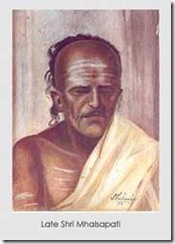
  • Mahlsapaty

    Mahlsapaty

    Mahlsapathy is the First & top most person in Sai Baba’s Court-Member of King’s Dharbar, and one among the VIBGYOR* member of Baba’s Dharbar.

    Sai Baba stayed at one Chandbhai’s [headman of Dhoopkheda village] home for some days. The nephew of Chandbhai’s wife got betrothed to a girl from Shirdi. So, Baba came to Shirdi in that wedding procession, in 1872.
    The marriage party had alighted at the pounding grounds, near Khandoba’s (incarnation of Shiva) temple, outside the village. When Baba went to the Khandoba temple, He met Mhalsapaty there.

    This Mhalsapaty was a resident of Shirdi and a goldsmith. As he was a devotee of Khandoba, and regular visitor of Khanderaya (Deity of Jejuri, who is also Khandoba), since many generations. As soon as Mhalsapaty saw Him, he welcomed Him with the words: “Welcome Sai”. Then, all the devotees of Sai Baba called Him “Sai Baba or Sai or Baba”.
    Mhalsapati brought Sai Baba into the village and introduced Him to his friends Kashiram Shimpi and Appa Jagale. These three usually served, according to their capacity, the sadhus, saints , fakirs and ascetics visiting the village, and graciously took care of them.

    Baba was an absolute “Vairagya Purusha” and never cared for wealth or women. Mahlsapalhy, being himself highly detached i.e. of a vairagya temperament and not being overned by lust or other low urges, could easily appreciate Baba, from the very beginning was drawn to Baba;

    when other people began to worship Baba, only when they saw Baba’s psychic powers e. g. when he turned water into oil to feed his lamps, and then they regarded him as God.

    An important event in Mahlsapathy’s life that was- “Baba’s trying to leave his body about 1886 and returning to it three days later”.

    Baba had made him the guardian of his body and told him, “Arre Bhagat, look after this body for three days. I am going to Allah. If I do not return, then get it buried in due course at that place, (that is, near the sacred gode neem tree).”

    Mahlsapathy supported Baba’s body on his own knee, and when officers, including the village headman karnam, etc., held an inquest over the body, declared it dead, and wanted it to be buried. Mahlsapathy with the help of others stoutly opposed their proposal, and saved Baba from losing his body.

    Thus, he rendered a valuable service in 1886, after which Baba lived for 32 years to create this huge Sai movement that has covered this World.

    If Mahlsapathy had failed in his duty, and Baba had been buried, perhaps the course of history might have been different.

    ‘Whatever a person thinks of at the time of death he reaches’. When Mahlsapathy’s death was approaching, he retained full-consciousness and control of his mind.

    That was on 11th Sep 1922, Monday (in the month of Badrapada, Ekadasi Somavara, sacred to Shiva and Khandoba), having finished all his puja, he said to his family, ‘To-day is my father’s Shraddha day. Finish cooking soon. To-day, I close my earthly life and go to Heaven’.

    So, a Brahmin came and finished the Sraddha at once; and finished the gift of balis to crows, cows, etc, and guests were fed. Then the family meals were finished.

    Mahlsapathy took betel and nuts after his meal. After chewing a bit, he put on a kupni. Having near him, Bala Gurav, Ramachandra Kothe, etc., he told them all to do Ramachandrajapa Japa.

    Muhlsapaty said to his son that ‘Spend time piously in Uttama Bhakti Marga i.e. in holy devotion. All that I told you will happen.” Then Mahlsapathy uttered the word ‘Ram’ and breathed his last.

    Thus he passed away in calm, faith and cheerfulness, on the 11th September 1922. This death was a fitting termination to a pure, lofty and dedicated life—a life of Love, faith and total surrender.

    His remains are interred in a tomb at Shirdi, which is still worshipped by many.

    * 1. Mahlsapathy 2. Narayan Govind Chandorkar 3. Das Ganu Maharaj 4. H.S. Dixit, 5. Hemadpant 6. Sri Upasani Baba and 7. G.S. Khaparde.

  • BABA WORSHIP IV -Refusing to own, the properties

    BABA WORSHIP IV -Refusing to own, the properties

    Baba began from 1908 to ask for dakshinas (Donations). Formerly, he would refuse offer of rupees to him, saying that he had no need for them.

    But from the time that this new tide began, he began to ask his visitors for payments of (even large) sums. Some he would ask for Rs.5, some for Rs.25, and some others for Rs.250.

    Baba would not ask for any funds except where he was going to recompense or where the visitor had already been blessed by Dana or Vittal and was bound to pay whom or those God pointed out.

    Many sent “vowed Sums” of their own accord, even Rs.6000 . Therefore, Baba easily succeeded in getting as dakshinas in the course of each day varying sums, that totaled up in the evening sometimes to Rs.300 and sometimes to thousands.

    Photo by Tima Miroshnichenko on Pexels.com

    In addition to the large crowd of persons who offered  Naivedyas [food] of eatables to Baba, it was possible for 200 beggars to be fed everyday by Baba’s bounty and doles. Thus the appearance of a very prosperous durbar was presented at Shirdi from 1909 up to 1918.

    It served a purpose, namely, the widening of Baba worship, which had a great purpose behind it. That is why Baba allowed all this to  develop his worship.

    Till then Baba avoided pomp. He would not even sit on a chair or lie on a cot, but sat and slept upon a sack cloth (gunny mattress) placed on the floor. He would not put on his head the crown or regal dress, when the devotees wanting him to look like a Maharaja/ King brought these for him. Nor would he accept or allow other royal insignia upon his person.

    Baba had no possessions, and all these regal paraphernalia mentioned above were kept with Ramakrishna Ayi, and on her death, were held by an association; and finally vested in the Sai Sansthan, formed by the “order of the Ahmednagar District Court in the year 1922“.

    When Baba left the body, he had only Rs.16 in his hand and no other property. Hence the Raja upacharas, which would have puffed up or affected other persons, did not affect him. In refusing to own properties or have a palace, he set an excellent example.

  • BABA WORSHIP III -Kings Durbar

    To make the congregational worship more advanced and attractive, there was an enthusiastic set gathering at Shirdi.

    One Ramakrishna Ayi, a young widow, being highly accomplished, was intent upon using all her gifts and cleverness for developing Sai Baba’s worship. She drew a large number of people to herself and made them more enthusiastic in the cause of Sai Worship

    Ramakrishna Ayi introduced silver whisks, silver maces, silver umbrellas, silver candelabras, moons, and artificial gardens to deck the chavadi, where Baba was worshipped on alternate nights. A (ratha) car, a palanquin with silver appurtenances, a horse, and other regal paraphernalia were furnished on her insistence and the insistence of other devotees to make Baba worship run exactly like Vittal worship or the worship of great Acharyas in their mutts.

  • Earlier Years at Shirdi V-Mad Fakir to Hero

    Suddenly one day an incident occurred which brought a thorough change in the situation, from obscurity to famous.

    Sai Baba was very fond of lights. He used to beg oil from shopkeepers-Banias, and keep lamps burning the whole night in the Masjid and temple. This went on for some time.

    The Banias, who supplied oil gratis, once met together and decided not to give Him oil. When, as usual, Baba went to ask for oil, they all gave Him a distinct No.

    Unperturbed, Baba returned to the Masjid and kept the dry wicks in the lamps. The banias were watching Him with curiosity.

    Baba took the Tumrel (tin pot) which contained very little (a few drops) of oil, put water into it and drank it; and forced it fall in the container. After consecrating the tin-pot in this way, He again took water in the tin-pot and filled all the lamps with it and lighted them.

    To the surprise and dismay of the watching Banias, the lamps began to burn and kept burning the whole night. The Banias repented and apologized.

    Baba forgave them, after asked them i) You really had Oil?, ii) if they had not come to the Mosque to enjoy the pain which they expected him? ; and then iii) asked them to be more truthful in future & never again to take pleasure in other’s distress!.

    The effect of this incident was marvelous. The contemptible pagal-Mad fakir, as they called him, was turned overnight into the Hero or the weird magician or the holy Sadhu of the place.

  • Earlier Years at Shirdi IV- Cure Ailments & His Garden

    At times when he was not absorbed in contemplation, he went about meeting people and noting their ailments. He picked up herbs or got cheap drugs from shops and with their use cured the villagers of their bodily illness.

    His knowledge of medicine and surgery appears to have been extraordinary for he cured not merely snake bite but also leprosy with snake venom and rotting eyes with Bibba. He never accepted any payment for his medical or other services. He also rendered other kinds of services.

    He ploughed up the village common land, the very land on which his Samadhi Mandir now stands, and raised a flower garden thereon. He watered the plants, carrying pots full of water on his own shoulders. He distributed the flowers and leaves freely to various Hindu temples and to Muslim holy places and

    never made any invidious distinction between Hindu and Muslim places of worship. From his supreme realised state, differences of caste, creed, position and learning, were non-existent or meaningless. This is all the history of the early years of Baba.

  • Earlier Years at Shirdi II-Food & Residence

    Baba, noting Mahlsapathy’s attitude, left the place (Khandoba temple), and went to the gode- neem tree, which he used as his halting place off and on. He went about the village and the surrounding lands and had no particular arrangements for food.

    Luckily the village head, Ganapat Rao Patil Kothe and his wife Bayaji Bai, were greatly attracted by Baba’s personality, and from the very beginning of his stay there, they undertook to feed him, even when he was running about. Gradually he gave up roaming and then went about the streets, halted at four or five places and from there collected whatever food was brought to him.

    For his stay and sleep, the dilapidated mosque of the village was the only place, and it soon became his residence. He was never for wholly deserting society and living in mountain caves and deserts.

    Mosque where Baba lived
  • Baba’s Earlier Years at Shirdi I-Khandoba temple

    Baba’s earliest years at Shirdi were passed in complete obscurity. Baba had no home; Fakirs have none. Hermits are, therefore, to reside either at a tree-foot or chavadi or temple or other public places.

    When he came into Shirdi, first Baba visited Khandoba temple at the outskirts of the village, and then noting how solitary and calm a place it was, exclaimed, ‘What a nice place this, for ascetics like me to live in.’ Mahlsapathy, the man then in charge objected to this observation and said that no Mohammadan would be allowed to put his foot into the Khandoba temple.

    He was evidently thinking that Baba was a Muslim and that he would break the images and defile the temple. But Baba was just the opposite.

  • WATCH AND CURE

    Baba’s loving watch and care

    Para Number in the Book & About His Watch and Care

    (I) Dhulia Bahalkar’s boy’s illness

    532. In March 1913, Raoji Balakrishna Upasani Bahalkar’s younger son had high fever for 5 or 6 days.

    The doctor gave up hopes. Then R.B.U. prayed to Baba.

    Baba, appearing at 2a.m. in his room at Dhulia and applying Udhi to the boy said: “Now, have no more anxiety. In two hours, your boy will perspire. In the morning he will feel better. After he gets well, bring him to me.”

    In the morning the boy was better. This was about 6-3-1913.

    On 8-3-1913 Shama wrote to Raoji, as follows: ‘Baba said, “I have been to your Dhulia friend’s house”. I (Shama) asked. Who is that friend?

    B.: ‘Upasani Bahalkar Raoji, I am daily going to his house. You had better write to him.”

    Therefore   I have written this letter’

    Fifteen days later, Raoji and his son were going to Shirdi. On the way at Kopergaon, the tonga driver was delaying them.

    At Arati time, Baba told Shama : “Sharma, wait a bit for the is Arati to start. Your Dhulia friend is coming. The tonga driver is troubling him. On their arrival in time for receiving prasada.’

    (After that) Baba (to the boy): “When you were ill, I came to Dhulia. Do You remember ?”

    (2) Mahalsapathy – Snakes

    533. B: “Bhagat, two serpents are moving about near your house”. Mahalsapathy (who was addressed by Baba as Bhagat, i.e. Bhakta) returning from Dwarkamayi saw one serpent at his own door and another at the potter’s beneath his pillow.

    • 533B. Baba: ‘Bhagat. when you come here to night come with a lamp. You will meet thieves at the village gate.”

    Mahalsapathy came that night with a lamp and found a serpent at the gate.

    534. A devotee had gone out in the dusk to ease himself. There he heard the rustle of something. Believing it to be a snake, he hurried back to his quarters.

    Later he met Baba.

    B.: “Am I not in the place, where you go to ease yourself? Why do you fear?

    • 534B Mrs.   Manager   i.e.   Mrs   Sadashiv   Tarkad  of Poona  being saved  from  treading  on  a  snake,  merely by intuition.

    Abhyam to Mirikar-Snake

    535A.   Mamlatdar Bala Saheb Mirikar, son of Sardar Mirikar (Dev Exp) was about to take leave of Baba.

    B.: “Do you know there is Dwaraka Mayi of ours”. Merikar was puzzled, as he did not know.

    B.: “This is Dwaraka Mayi, in which you are sitting; This wards off all dangers and anxieties from her children. Highly merciful is this Masudi Ayi. She is the mother of all those, who place entire faith in her. She will save them, in the hour of danger. Once a person trusts her all his troubles are over.”

    B. (then giving udhi. added); “Do you know the elongated gentleman? (Baba extends both his arms at full length and moves one plam like the hood of a cobra). So terrible he is ! But what can it do against the children of Dwaraka Mayi ? If it appears, we shall be merely amused. When the Dwaraka Mayi protects, can the serpent strike?”

    Baba ordered Shama to accompany Mirikar. At Chitali, at 9 p.m. that night, Mirikar, Shama and some peons were at the Maruti temple. Mirikar was reading newspapers. Suddenly the peon heard a rustling sound on the newspaper. The peon took a lamp and saw what it was.

    A part of Mirikar’s upper cloth was on a newspaper and a serpent lay on that end of the cloth. The peon cried “snake, snake !”and it moved off from Mirikar. People gathered and clubbed it to death. Mirikar was only amused and not terrified.

    535B. One day at Shirdi, Baba made dolorous Sankha sound (indicative of coming death) and said “Hallo, Nana is about to die. But will I let him die?”.

    At that time N.G. Chandorkar and Lela Sastri were near Poona. They were in a tonga, the horse of which reared and overturned the tonga. N.G.C. and Sastri were in peril of their life. But they picked themselves up and found that they had suffered no injury. When they reached Shirdi, they found that Baba had made the above declaration and had saved their lives.

    535C. R.V. Modak feared that a special examination was being held, wherein his appearance might be a means for elevation or the certain means of dismissal on the score of inefficiency. He went to Baba and Baba detained him so as to miss the examination at Bombay.

    At parting, Baba said “Go”

    R.V.M.: “whither Baba? Home or Bombay?”

    Baba: “Go home, your children are waiting for you.”

    (4) Abhayam (Ganda) to Buti

    536. Nana saheb Dengle (who was good at astrology) told Buti one day that there was Ganda, i e., danger to his life that day. Later both came to Baba.

    B.: “what does Nana say? He sees death coming to you, eh? We have no need to fear. Strike! Strike! Let me see how you strike and kill.”

    Later Buti went to ease himself and there saw a snake. His servant saw it and lifted up a stone. ‘A stick is safer and better’, said Buti. But before the stick came, the serpent moved away.

    V. CONSIDERATION FOR HEALTH

    537. Baba found Bala Shimpi on the road side, very ill with no one to attend to him. Baba had begged food in his (B.S’s.) house and was deeply attached to his family.

    Baba told Bala Shimpi to go to Nana Saheb Dengle at Nimgoan. Nana Saheb had at that time a dream and Baba in that dream told him to undertake the care of Bala Shimpe,who would go to him. So when Bala went, he was cordially received and looked after by Nana Saheb Dengle.
  • Baba and Others Saints

    Baba and Others Saints

    Para Number in the Book -BCS & Baba’s appearance in the form of other saints

    1. Keshav Naik of Tardev, when Akkalkote Maharaj was passing away
      (about 1878) thus addressed him: Maharaj, if you go away, what support have we?
      Akkalkote Maharaj (giving his shoes to be worshiped): My Avatar (spirit) will be at Shirdi in Ahmadnagar District. Go there always. Be devoted there. If you do so, you will not remember me. And you will be happy
      When Akkalkote Maharaj passed away, Keshav Naik and his son
      Ramachandra Naik, accompanied by two orthodox Brahmins went to Sai Baba at Shirdi. On the way the Brahmins referred to Baba as a mad moslem fakir to whom no Brahmins could bow. When all four reached Baba.

    Baba to Keshav Naik: You and your son may come and visit me, if you like.
    (Pointing to the other two); These are Karmata Brahmins.
    Baba to Ramachandra Naik: Fetch Margosa (Neem) leaves.
    Ramachandra Naik brought some leaves. Baba distributed the leaves to the four.
    Baba: Eat the leaves. How do they taste?
    Brahmis (with a wry face): Very bitter.
    The two Naiks: The leaves are sweet. We ate plenty of the leaves.

    Thus Baba parted his sheep from the goats, and confirmed the statement of Akkalkote Maharaj.
    I am at Mirzgaon (‘Fakir Bua’)
    Why come here? (To Kusa Bhav)
    I am Bandra Moulana.
    [I am Nanded Moulana] You have already given me Rs.3-14-0

    75. I am with you wherever you may be. I do not require conveyance to take me.

    1. Baba (May 1914) addressing Mrs. T., a Bandra lady and her son Master T. : “Mother, I have to go thrice a day to your house.”
      Mrs. T.: Yes, Baba
      A local lady was astonished at this statement. She saw Baba daily at Shirdi. She said “Baba, what is this strange thing you say?”
      Baba: I do not speak falsehood. I am Mahalaxmi. Mother I come to your house. You give me things to eat, is that not true?
      Bandra Lady: Yes, Baba
      Shirdi Lady: Truly, does Baba go to you and do you feed him? Bandra Lady: Yes.
      Baba to Master T.: Do I not come to your house?
      Master T.: Yes, Baba.
      Baba to Shirdi Lady: Yes, mother, I go easily to Bhav’s house
      (at Bandra). In the middle, there is a wall. Jumping over it, next comes the railway line, and then Bhav’s house. (Here Baba described the crow’s flight from Shirdi to the lady’s house at Bandra).
      I have to fly across walls and excavations.
    2. Mrs. Tendulkar of Bandra daily heaped up garlands of bakul (flower) over
      Baba’s picture in her house at Bandra for two months and then went to Shirdi.
      Baba : Hallo, Kaka (ie.To H.S. Dixit) these two or three months I have not been at Shirdi at all. This mother has smothered me with bakul flower and I was quite dizzy, and unconscious of myself. Now I am slowly coming around.
    3. I went to Bandra and saw Bhav left nothing for me to eat, so I have returned hungry.
    4. Do you think of me, at meal ? Am I not present near you ? Do you give me a morsel ?
    5. I am not at Shirdi, but in all.
    6. He who thinks that (Sai) Baba is in Shirdi (alone) has totally failed to see (i.e., know) Baba.
    7. Why do you (weep and) behave so madly. Am I not there (at Bombay) by your side?
    8. He (Sai) who is at Shirdi now is also at Machandragad here. It is to teach you this, I sent you here. (To Manker)
    9. I have just been to Kasi and had a bath.
      I was at Jejuri, Bagat.
      I was at Dhulia, did you not see me? (To Upasani’s son)
      When you heard my voice, why doubt? Bolted doors do not bar access to me. (To Megha)
    10. I will go with you (invisibly). Do not worry. Mother, I take thought for your family. Well, Go. I am by your side.
    11. I am myself sitting there (invisibly), guarding you (Purandhare) and your wife.
    12. Wherever you may be, think of me, and I am by your side.
    13. Wherever you may be, whatever any of my devotees think, say or do, that very instant I am aware of it.
      (cf Quran-“And when my servants ask thee concerning me, then I nigh unto them and answer the cry of him that crieth unto me”
    14. I look equally on all. Not a leaf moves, except by my grace. I look on all with equal eye.