Category: Books

Recommended reading for every Sai devotee โ€” from the Shri Sai Satcharita to contemporary works that illuminate Baba’s life, teachings, and relevance for the modern world

  • Discover Your Path to Inner Peace and Divine Connection

    Discover Your Path to Inner Peace and Divine Connection

    The timeless wisdom of Sri Shirdi Sai Baba continues to illuminate the lives of millions across the world. His words โ€” drawn from the “Charters and Sayings” โ€” are described as a manifestation of the Supreme Spirit, akin to how Lord Sree Krishna speaks through the Bhagavad Gita. Whether you seek peace in daily life or deeper spiritual realization, Baba’s teachings offer a path for every soul.


    Divine Promises and Unwavering Protection

    Baba’s love for His devotees is unconditional and eternal. He assured us:

    • “My eye of vigilant supervision is ever on those who love me.”
    • “I will not allow my devotees to come to harm.”
    • “In the abode of my devotees, there will be no dearth of food and clothing.”
    • “My tomb will speak and move with those who make me their refuge.”
    • “I will be with you, the moment you think of me, at any place.”

    Even the sacred Dwaraka Mayi โ€” Baba’s mosque โ€” wards off all dangers and anxieties, being “highly merciful” to all who seek her shelter.


    The All-Pervading Nature of Sai Baba

    Baba transcends all form and limitation. He is the embodiment of the Supreme Spirit, living eternally. He said: “I am formless and everywhere โ€” in every bit of the Globe” and “All the universe is in me.” He appeared in all forms to demonstrate His omnipresence to those open enough to see.


    Practical Guidance for Spiritual Growth

    Faith and Patience โ€” Nishta and Saburi

    Baba’s Guru sought no material gifts โ€” only Faith (Nishta) and Patient, cheerful endurance (Saburi). Saburi, He said, “ferries you across to the distant goal.”

    The Importance of a Guru

    “Trust the Guru fully. That is the only sadhana. Guru is all the Gods.”

    Self-Inquiry โ€” Atma Vichara

    Baba encouraged us to constantly ask: “Who am I? Who are we?” โ€” to unveil the unity of Jiva and Siva.

    Devotion โ€” Bhakti

    Baba proclaimed: “I am the bond slave of my devotees. I love devotion.” He taught the Navavidha Bhakti โ€” nine forms of devotion including listening to sacred works, reciting God’s name, remembrance, meditation, worship, and self-surrender.

    Surrender โ€” Atma Nivedan

    Complete surrender involves offering the five senses, five Pranas, Mind, Intellect, and Ego to the Divine. Baba gently invited: “Place your burdens on me.”

    Moral Teachings

    Baba emphasized love for all creatures, contentment, non-hatred, patience, and selfless giving โ€” and the importance of conquering the Shadripus: Lust, Anger, Covetousness, Delusion, Pride, and Jealousy.

    Study and Meditation

    Baba encouraged reading the Bhagavad Gita, Jnaneswari, Yoga Vasishta, and Rama Vijaya, along with Nama Japa (repetition of “Rama” or “Sai”) and Dhyana (meditation) on His form or as formless Ananda.


    Begin Your Journey Today

    Baba’s mission was simple: “My business is to give blessings.” He draws His devotees to Himself โ€” even from thousands of miles away โ€” first through earthly needs, then leading them gently toward the Divine.

    “Look to me; I will look to you.”

    Explore the teachings, find solace, and deepen your connection with the Divine. The path is open to all โ€” wherever you are, whoever you are.

  • Self-Affirmation from Chapter XIV of SSSC for Sai Babaย devotees

    Self-Affirmation from Chapter XIV of SSSC for Sai Babaย devotees

    1. ๐Ÿ‘‚I daily hear the stories of Sai Baba; so I always see Him, day and night and merge with Pure Consciousness.
    2. ๐ŸงŽI am always cautious and achieve the object of World viz. self-realization, for getting a human body is the result of past merits .
    3. ๐Ÿ’ฐI trust that Sai Baba is omniscient and knows my past vows and all my financial transactions
    4. ๐Ÿง‘โ€๐Ÿคโ€๐Ÿง‘I believe Sai Baba is all-pervading and can identify Himself, heart and soul with any saint or person.
    5. ๐Ÿ”ŸI heed Sai Baba’s teaching: I give one and receive tenfold in return .
    6. ๐ŸšธI understand that Sai Baba’s main object in taking offering /Dakshina is to teach me the lessons of Renunciation and Purification .
    7. 6๏ธโƒฃI surrender my six inner enemies (Lust, Anger, Greed, Attachment, Ego, Jealously) as the true offering /Dakshina.
    8. ๐Ÿช™I keep the money returned by Baba (Temple) in my shrine for worship, knowing it will benefit me immensely .
  • Self-Affirmation from Chapter III of SSSC for Sai Babaย devotees

    • ๐ŸŒŒAs I listen attentively and devoutly to Sai Babaโ€™s stories,My ignorance vanish, and the consciousness of worldly existence abate.
    • ๐Ÿ’‹I utter Sai Babaโ€™s name with love, HE shall fulfill all my wishes and increase my devotion.
    • ๐Ÿ’ซIf I sing earnestly His life and deeds, Sai Baba shall beset me in front and back and on all sides.
    • ๐Ÿ’†I am confident that Sai Baba will draw me out from the jaws of Death.
    • ๐Ÿ‘‚All my diseases will be got rid of by hearing Sai Baba’s stories with respect.
    • ๐Ÿ’ŒThe simple remembrance of Sai Baba’s name as โ€˜Sai, Saiโ€™ destroys my sins of speech and hearing.
    • ๐ŸŽฏReading of the Sai Baba stories secure me salvation; let me not exhaust myself by other sadhanas.
  • โœจGift for Our Every Subscribers

    โœจGift for Our Every Subscribers

    โ€œYour privacy is respected; your email will only be used to share Sai Babaโ€™s teachings; and ‘Use of Your Informationas detailed here , โ€

  • Sai Baba was there, truly!

    Sai Baba was there, truly!

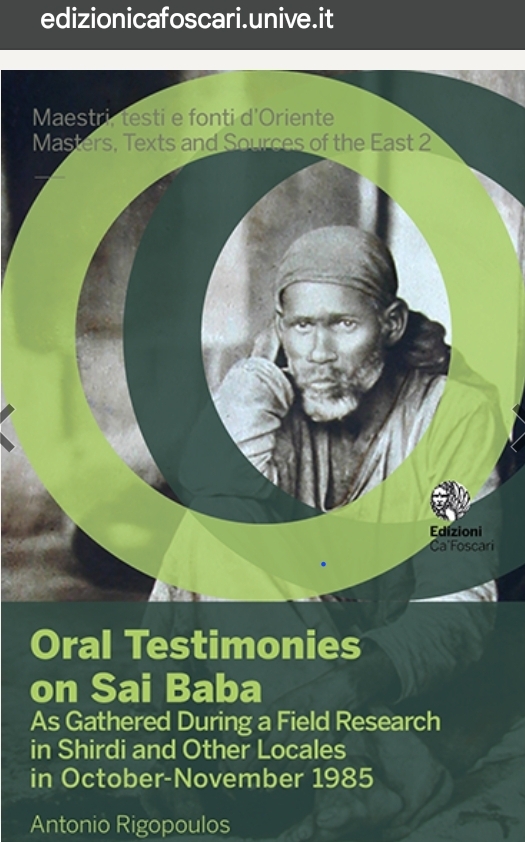
    Dr Antonio Rigopoulos, Italy in his ‘Oral Testimonies on Sai Baba As Gathered During a Field Research in Shirdi and Other Locales in October-November 1985′ (Venice Ca’ F Editions Oscar – Digital Publishing 2021) explained his own Experience that:-

    I went to the cฤvaแธฤซ and while I was casually sitting at the cฤvaแธฤซโ€™s entrance, looking at the raแน…golฤซs, the auspicious signs that some young women were skilfully drawing on the ground, a stray dog caught my attention. He was full of pustules and eczemas, of fleas, and was in a really bad shape. Then it suddenly flashed on me that that dog was Sai Baba. It was something stronger than a simple thought, like an insight or a sudden flash of awareness that I find hard to put into words. I really felt that he was that dog and that he was standing in front of me in that very form: it had the force of an incontrovertible truth. It was a strange and startling experience indeed. Sai Baba was that dog: the lowest, the despised, the most neglected creature. The dog had sweet and penetrating eyes, which called for sympathy and attention.

    I felt I finally understood something: not intellectually, i.e. with the head, but emotionally, i.e. with the heart. There was Sai Baba, truly and fully. It came like a revelation and I shed a few tears; couldnโ€™t help it. It was just so overwhelming

    -On 21 Oct 1985 at 7.30 am

    Thanks / Reference:

    Rigopoulos, Antonio. โ€˜7 Shirdi-Kopargaon-Shirdi. Monday, October 21, 1985โ€™. Masters, Texts and Sources of the East (2020): n. pag. Crossref. Web.

  • Study materials available to Foreigners, interested in Shirdi Sai Baba.

    Study materials available to Foreigners, interested in Shirdi Sai Baba.


    Foreign individuals seeking to understand the life, teachings, and global influence of Shirdi Sai Baba have access to a wide array of study materials.

    1. Academic Works

    Academic studies offer a structured, critical, and contextual understanding of Shirdi Sai Baba, often distinguishing historical facts from hagiographical embellishments.

    As per (Thanks) Oxford Bibliographies:-

    Academic study of Shirdi Sai Baba has emerged within the past several decades as scholars of religion in South Asia began to engage in a wide array of studies of popular saints and gurus;

    and as they observed the rapid growth in devotion to Shirdi Sai Baba in particular within the Indian subcontinent and, eventually, beyond India.

    White 1972 provided the first academic analysis of Shirdi Sai Baba, noting his growing popularity in western India and attributing it to the unifying bond created between Sai Babaโ€™s devotees, a bond that crosses distinctions of caste, class, and social status.

    Antonio Rigopoulos 1993 is the first book-length academic study of Shirdi Sai Baba, which presents a biography of Sai Baba in the first half that draws upon Hindu-authored hagiographies, and presents Sai Babaโ€™s key teachings in the second half with an emphasis on interreligious tolerance.

    Warren 2004 includes a valuable translation of the diary kept by Abdul Baba, a Muslim follower of Sai Baba in Shirdi, and draws upon that to present an interpretation of Sai Baba as a Muslim fakir who traveled the Sufi path.

    McLain 2016 traces Shirdi Sai Babaโ€™s rise from small village guru to global phenomenon, using a wide range of textual, material, and visual sources to investigate the different ways that Sai Baba has been understood and the reasons behind his skyrocketing popularity among Hindus in particular.

    The edited collection Srinivas, 2022 provides insight into the worship of Sai Baba beyond the village of Shirdi in the early twentieth century, with essays that examine more contemporary worship at multiple sites within India as well as in Asia and Africa.

    Several articles also make valuable contributions to the study of Shirdi Sai Baba:

    Hardiman 2015 analyzes the miracle healing cures associated with Sai Baba and the relationship between his spiritual power and secular science;

    Rigopoulos 2012 analyzes some of Sai Babaโ€™s miracles in connection with yoga powers;

    Vicziany 2016 examines the worship of two syncretic figures, Shirdi Sai Baba and Haji Ali, in the city of Mumbai, India; and

    Loar 2018 compares the hagiographies of Shirdi Sai Baba that were written by two of his Hindu followers, Dabholkar and Narasimhaswami.”- Thanks Oxford for your article at www.oxfordbibliogrsphies.com.


    Cambridge University

    Cambridge University have explored aspects of Sai Baba’s life and the movement he inspired.

    1. Academic Research and Publications:
    * Cambridge Core: Cambridge University Press has published academic works that discuss Shirdi Sai Baba and the broader Sai Baba movement.
    ย ย  * Smriti Srinivas’s article, “Sai Baba: The Double Utilization of Written and Oral Traditions in a Modern South Asian Religious Movement,” published in Diogenes, examines the origins of the Sai Baba movement rooted in Shirdi Sai Baba.
    ย ย  * Another article in Comparative Studies in Society and History titled “Miracle Cures for a Suffering Nation: Sai Baba of Shirdi” explores his popularity and perceived ability to provide miraculous cures.
    ย ย  * The “Cambridge Companion to New Religious Movements” features a chapter by Tulasi Srinivas on the Sathya Sai Baba movement, which originated from Shirdi Sai Baba’s legacy.
    * Cambridge University Library: Kevin R.D. Shepherd, a British author, conducted private research at Cambridge University Library for twelve years, focusing on the history of religions and philosophy. He has authored books such as “Sai Baba of Shirdi: A Biographical Investigation” and “Investigating the Sai Baba Movement.”
    2. Perspectives on Shirdi Sai Baba:
    * Syncretism: Some scholars highlight Shirdi Sai Baba’s image as a unifying figure between Hindu and Muslim traditions, emphasizing the composite nature of Indian culture in the growth of his devotion.
    * Miracles and Faith: His devotees often attribute miraculous abilities to him, which contributed to his widespread popularity. Academic analysis has also focused on these aspects.
    * Historical Context: Research connects the rise of Shirdi Sai Baba’s popularity with the Indian nationalist movement and the search for unifying symbols.
    3. Mentions in Other Contexts:
    * Sathya Sai Baba: Sathya Sai Baba of Puttaparthi, and his movement have also been subjects of academic study, including publications by Cambridge University Press.
    * Educational Initiatives: Cambridge University Press has collaborated with Indian educational institutions for programs like the “SAI-Cambridge Reading Quest,” although this is related to language skills development and not directly to the study of Sai Baba.
    While Cambridge University’s press has published scholarly articles and books that analyze his life, teachings, and the socio-religious movements associated with him. Individual researchers connected to the university have also contributed significantly to this field of study.


    Teachings and Philosophy

    Social and Cultural Significance

    • Karline McLainโ€™s Be United, Be Virtuous: This work investigates the role of Sai Babaโ€™s teachings in promoting religious harmony and examines the movementโ€™s cultural impact within Indian society.
    • Edited Volumes (e.g., Devotional Spaces of a Global Saint): These collections often feature contributions that analyze the institutional development of the Sai Baba movement and its place in the lives of modern devotees.

    Miracles and Belief Systems

    • Analytical Perspectives on Miracles: Academic literature explores the narrative function of miracles in constructing Sai Babaโ€™s authority, examining their sociological and psychological dimensions and drawing comparisons with miracle traditions in other religions.

    Global Spread and Contemporary Practices

    • Studies on Globalization: Scholars analyze how Sai Babaโ€™s devotion has transcended geographic boundaries, highlighting the establishment of temples and devotional practices in international contexts.
    • Media and Technology: Contemporary research considers how digital media platforms are employed to maintain global devotional networks and disseminate teachings.

    Methodological Approaches

    Engagement with academic resources introduces foreign learners to various methodological frameworksโ€”historical criticism, sociology of religion, and anthropologyโ€”that enable a comprehensive and critical study of religious figures and movements.

    2. Devotional and Informational Websites

    In addition to academic works, several online platforms provide accessible resources tailored to the needs of international devotees.

    Websites for International Devotees (e.g., shirdisaibaba.international)

    • Curated Publications: These platforms offer English-language articles, news updates, and publications, suited for global audiences.
    • Translations of Key Texts: They often provide details of translated versions of significant devotional texts and biographies.
    • Community Engagement: Discussion forums and community pages offer a space for interpretation, Lists of Sai Baba temples in countries like the USA, UK, Canada, Singapure, Dubai…and sharing of experiences, reflecting the living tradition of Sai Baba devotion.

    Official Temple Trust Website (sai.org.in)

    • Authoritative Information: Offers official narratives, details of temple rituals, and historical overviews from the perspective of the temple trust.
    • Online Resources: Includes downloadable material, videos, and frequently asked questions, all primarily in English, facilitating introductory-level engagement.

    3. Key Considerations for Foreigners

    Language Accessibility

    The wide availability of English-language materialsโ€”both academic and devotionalโ€”greatly enhances accessibility for non-Indian audiences.

    Multiple Perspectives

    A balanced approach that includes both academic and devotional materials provides a more nuanced and comprehensive understanding of Shirdi Sai Baba.

    Cultural Context

    Academic studies help situate Sai Baba within the broader Indian religious and cultural milieu, an essential context for foreigners unfamiliar with the subcontinentโ€™s spiritual traditions.

    Critical Engagement

    By engaging with academic sources, foreigners are encouraged to critically examine the narratives surrounding Sai Baba, differentiating between historically substantiated facts and devotional interpretations.



  • Various teachings and practices, prescribed by Baba

    Various teachings and practices, prescribed by Baba

    • Baba lovingly urged many to remember His name and to surrender to Him,
    • Yet for those seeking to understand ‘who they truly were’ (the ‘Who am I’ enquiry), He gently recommended Shravanam (study) and Mananam (meditation).
    • To some, He lovingly guided
      • the remembrance of God’s name,
      • to others, the joy of hearing HIS Leelas /Plays,
      • to some, the sacred worship of His Feet,
      • and to others, the reading and studying of the Adhyatma Ramayan, Jnaneshwari, and more sacred scriptures.
    • Some He tenderly invited to sit near His Feet,
    • while others He lovingly sent to Khandoba’s temple,
    • He advised some
      • to repetition the thousands of names of Vishnu,
      • and others to engage in the study of the Chhandogya Upanishad and Geeta.
    • To some, He offered His guidance directly in person, and to others, through the precious visions in their dreams.
    • He lovingly explained certain Mantras, such as ‘Guru Brahma’, “Raja Ram’ in their dreams.
    • To one devotee,
      • who was earnestly practicing Hath-Yoga,
      • HE conveyed a gentle message to leave those practices aside,
      • to sit in quiet and embrace patience (Saburi).
    • Truly, it is an immense task to describe all of His ways and methods, each filled with love and compassion.
  • Who, When, How and Why Shri Sai SatCharitra (SSSC) created?

    Who, When, How and Why Shri Sai SatCharitra (SSSC) created?

    • When seeking facts about Sai Baba,
      • the remarkable work that stands out is ‘Sai Satcharitra’ by HemadPant, known as Anna Saheb Dabolkar.
      • It is written in the Marathi language.
      • This wonderfully crafted poetical masterpiece spans 53 vibrant chapters and over 1000 pages, narrating incidents from Sai Baba’s inspiring life.
      • Written in rich and expressive Marathi, it beautifully fulfills the purpose of Puranic study, serves daily parayana.
      • It offers readers a path to deeper understanding and devotion.(LoSB p6)
    • Baba conveyed his heartfelt blessing to Hemadpant in 1916, when asked permission to write Baba’s life teachings and expressions,
      • by providing him with udhi and placing his Asirvada hand upon Dabolkar’s head, proclaiming,
      • Let him compile a collection of My stories and experiences,
      • diligently maintaining notes and memos.
      • I shall assist him in this endeavor.
      • He is merely an external instrument. It is I who should document my life and fulfill the aspirations of my devotees.
      • When his ego is entirely extinguished, leaving no remnants, I shall personally enter within him to narrate my life.
      • Listening to my stories and teachings will instill faith in the hearts of devotees, facilitating their journey toward self-realization and eternal bliss.
    • Hemadpant diligently gathered information concerning the lilas of Baba and, as a proficient writer possessing a profound command of Marathi verse and prose, along with a solid foundation in religious literature,
      • aspired to compose a comprehensive study of Baba’s lilas, thereby creating a significant chronicle of Baba’s life.
      • This endeavor would align with the framework established by Saraswati Gangadhar’s Guru Charitra, offering solace and happiness to individuals burdened with sorrow and the afflictions stemming from worldly existence.
      • Additionally, it would provide them with Jnana, or knowledge and wisdom, regarding both temporal and spiritual matters.
      • Baba’s lilas would serve as both instructive and engaging, akin to the Vedas,
      • and, upon contemplation, they would facilitate laya, or union with Brahman, as well as mastery of Yoga and Yoga Ananda.
      • Consequently, he resolved to compile these narratives, considering the publication as a form of upasana, or worship, of his Guru.
      • This collection would be particularly invaluable to those unable to experience Baba in person, allowing them to form an understanding of Baba through this compilation.
      • Baba’s teachings and expressions were the natural outcome of his boundless self-realization; it was Dabolkar’s belief that Baba himself inspired this initiative to gather and present his lifeโ€™s essence.(P376. )

    Shri N.V.Gunaji adapted the above Shri Hemanpant’s “Sri Sai SatCharita” and translated into English and donated the entire proceeds to the Sai Sansthan Trust, Shirdi.

  • Quotations 141

    Quotations 141

    “Oh Shama,ย  this book is very valuable and efficacious, so I present it to you, you read it.

    • Once I suffered intensely and My heart began to palpitate and My life was in danger.
    • At that critical time, I hugged this book to My heart and
    • then, Shama, what a relief it gave me!
    • I thought that Allah (God) Himself came down and saved Me.
    • So I give this to you, read it slowly, little by little.
    • Read daily one name at least, and it will do you good.”

    Baba to Shama in SSSC Ch-27 about the Book “Vishnu-Sahasra-Nam”

  • Proof Reading of Sai Literatures, Opportunity at Shirdi

    Proof Reading of Sai Literatures, Opportunity at Shirdi

    Public Appeal from Shirdi, Shri Sai Baba Sansthan

    Shri Saibaba Sansthan, Shirdi is planning to reprint its Literatures in Marathi, Hindi, Telugu, Tamil, Malayalam, Bengali, Odia, Kannada, Gujarati, Assamese, Punjabi, Sindhi, Urdu, Nepali etc.

    For this purpose, Sansthan is inviting Sai Devotees, who have PHD to Form a Committee of 30/40 members.

    The work involves i)corrections ii) proof reading of the text and iii) Helping Sansathan to resolve issues/doubt, raised by Sai Devotees, on a regular basis.

    Since Sai Seva, there is no compensation for this project.

    Thanks SSS Trust, Shirdi

    PS: please check their official website for latest updates.