Tag: Chavadi

Sai Baba went to sleep every alternate day in the Chavadi

  • Akhanda Parayan during the Mahasamadhi Utsav

    Akhanda Parayan during the Mahasamadhi Utsav

    The Akhanda Shri Sai Satcharitra Parayan (continuous reading of the sacred text) is a very significant event that takes place during the annual festival in Shirdi commemorating Sai Baba’s Mahasamadhi (death anniversary).


    General information about the Akhanda Parayan during the Mahasamadhi Utsav (Festival):
    * Date of the Mahasamadhi: Shirdi Sai Baba attained Mahasamadhi on the day of Vijayadashami (Dussehra) in 1918. The date changes each year according to the Hindu calendar, but it usually falls in September or October. The Utsav is typically a three or four-day event surrounding the main Mahasamadhi day.
    * Akhanda Parayan Schedule:
       * The Akhanda Parayan usually starts on the first day of the Utsav.
       * The reading begins after the Kakad Aarti (early morning aarti) and a procession of Baba’s photo and the Pothi (holy book, Shri Sai Satcharitra) from the Samadhi Mandir to Dwarkamai.
       * The continuous, uninterrupted reading of the Shri Sai Satcharitra takes place in Dwarkamai (Baba’s Masjid) and continues all day and through the night, as Dwarkamai is kept open.
       * The Parayan is completed on the morning of the main Utsav day (Mahasamadhi day), after which the Pothi and Baba’s photo are taken back to the Samadhi Mandir in a procession.
    * Participation: Devotees wishing to participate in the Akhanda Parayan, by reading one of the 53 chapters, often have to submit their names a day before the festival begins, and chapters are allotted through a lottery system.
    To get the exact dates for the upcoming Akhanda Parayan, you would need to check the official calendar for the Mahasamadhi Utsav for the specific year, which is generally published on the Shri Sai Baba Sansthan Trust (Shirdi) official website as the date gets closer.
    For example, in 2025, Sai Baba’s Mahasamadhi Day is on October 2nd (Vijayadashami/Dussehra), and this festival took place on 1st October.

  • Sai Baba was there, truly!

    Sai Baba was there, truly!

    Dr Antonio Rigopoulos, Italy in his ‘Oral Testimonies on Sai Baba As Gathered During a Field Research in Shirdi and Other Locales in October-November 1985′ (Venice Ca’ F Editions Oscar – Digital Publishing 2021) explained his own Experience that:-

    I went to the cāvaḍī and while I was casually sitting at the cāvaḍī’s entrance, looking at the raṅgolīs, the auspicious signs that some young women were skilfully drawing on the ground, a stray dog caught my attention. He was full of pustules and eczemas, of fleas, and was in a really bad shape. Then it suddenly flashed on me that that dog was Sai Baba. It was something stronger than a simple thought, like an insight or a sudden flash of awareness that I find hard to put into words. I really felt that he was that dog and that he was standing in front of me in that very form: it had the force of an incontrovertible truth. It was a strange and startling experience indeed. Sai Baba was that dog: the lowest, the despised, the most neglected creature. The dog had sweet and penetrating eyes, which called for sympathy and attention.

    I felt I finally understood something: not intellectually, i.e. with the head, but emotionally, i.e. with the heart. There was Sai Baba, truly and fully. It came like a revelation and I shed a few tears; couldn’t help it. It was just so overwhelming

    -On 21 Oct 1985 at 7.30 am

    Thanks / Reference:

    Rigopoulos, Antonio. ‘7 Shirdi-Kopargaon-Shirdi. Monday, October 21, 1985’. Masters, Texts and Sources of the East (2020): n. pag. Crossref. Web.

  • How Baba prepared food and distributed

    How Baba prepared food and distributed

    Let us see how Baba prepared food and distributed it.

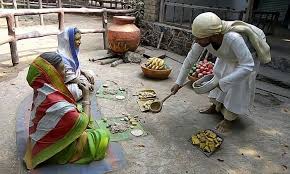
    Baba required very little food for Himself and what little He wanted, was obtained by begging from a few houses.

    But when He took it into His mind  to distribute food to all, He made all preparations from beginning to end, Himself.

    He depended on nobody and troubled none in this matter. First He went to the bazar and  bought all the things, corn, flour, spices etc., for cash. He did also the grinding.

    In the  open courtyard of the Masjid, He arranged a big hearth and after lighting a fire underneath kept a Handi over it with a proper measure of water…

    Sometimes He cooked ‘Mitthe Chaval’ (sweet rice), and at other times ‘pulava’ with  meat. At times in the boiling varan (soup), He let in small balls of thick or flat breads of  wheat flour. He pounded the spices on a stone-slab, and put the thin pulverized spices  into the cooking-pot. He took all the pains to make the dishes very palatable.

    He prepared  ‘Ambil’ by boiling jawari-flour in water and mixing it with butter-milk. With the food He  distributed this Ambil to all alike.

    To see whether the food was properly cooked or not,  Baba rolled up the sleeve of His Kafni. He put His bare arm in the boiling cauldron without the least fear. He churned (moved) the whole mass from side to side and up and  down. There was no mark of burn on His arm, nor fear on His face.

    When the cooking  was over, Baba got the pots in the Majid, and had them duly consecrated by the moulvi.

      First He sent part of the food as prasad to Mhalasapati and Tatya Patil. Then, He served the remaining contents with His own hand to all the poor and helpless people. They ate to their hearts’ content.

    Really blessed and fortunate must be those people who got food prepared  by Baba and served by Him.

  • TIPS relate to Shirdi and Mandir Visits

    TIPS relate to Shirdi and Mandir Visits

    Day and Time:

    Mondays, Tuesdays and Wednesdays are least crowded, normally.

    Fridays from 12 Noon-8 p.m. & Daily from 3 to 4 p.m. are also less crowded.

    The best day to visit is on Thursday; many people visit the temple and fast for nine consecutive Thursdays (referred to as the Sai Vrat Pooja). You do visit on Thursdays, but be prepared for the crowd.

    Other busy times are on weekends and celebration like Holi, Guru Purnima, Dussehra, Ram Navami festivals. The temple is kept open overnight during these festivals.

    Months

    Best period to visit Shirdi is October to March.

    But crowd is more, during the festive months ie September to December; and maximum during Dussehra and Diwali

    Others

    • There’s a procession of Sai Baba’s chariot around 9.15 p.m on Thursdays.
    • The main temple (Samadhi Mandir) is open from 5am to 10.30pm,
    • where as Dwarkamayi Masjid, Chavadi, Gurusthan are closed around 8.30pm.
    • But first ‘darshan’ of the day starts, after the morning program of worship (Morning aarti and others ), at around 7am.
    • There is no restriction on darshan during the day in Dwarkamayi Masjid, Chavadi, Gurusthan, and Nanda deep.
    • However, there are a few minutes of restriction during Dhuni Pooja or while offering food to Shri Sai.

    PLACE:

    • Free Bus is also available from Sai Nivas and Mandir to here.
    • Mobile phones, cameras and other electronic devices aren’t permitted inside the temple area.
    • Have “Mukh darshan” of  Baba Face, adjoins Dwarkamayi . DO mediation here, while leaving Shirdi pilgrimage, by sitting few minutes. (Quick one, as small queue, but some distance darshan)
    • The Museum displays articles used by Sai Baba. Do not forget to visit it, near Gurusthan.
    • FREE food provided at Prasadalaya. Devotees and visitors can take unlimited food (rice, vegetables, dal with Sweet). The capacity of Prasadalaya is huge and 1000s of people come every day. It is open from 10 a.m. to 10 p.m.
    Free Food Token Counter
    • In Chavadi, ladies are not allowed to enter the section where Baba used to sleep.

    Accommodation:

    Accommodation Booking Counter
    • Avoid the touts for getting any accommodation.
    • It is advisable to approach any hotel/lodge directly, ONLY if not available accommodation i)through https://online.sai.org.in/ OR ii)directly at Mandir Accommodation Offices.
    • There is a wide choice of hotels/lodges in Shirdi, suiting the budget of all.

    Don’t go to any shop for keeping Mobile, Free Slippers and Luggage, BUT USE Trust’s counters, very near to Gate No. 2 to keep all these.

    Be cautious about the prices while taking the garland, coconut etc particularly as a package from the nearby shops and avoid being overcharged by them.

    Prasadam and Books:

    • BUY Prasadam at SAI SANSTHAN EMPLOYEES CREDIT CO-OPERATIVE SOCIETY LTD, SHIRDI” stall, near Sai Commercial Complex and

    Donation:

    Each gift item must be registered in the Donation Office of the temple. Devotees can donate at SRI SAIBABA SANSTHAN TRUST Office

    • cash either in the Donation Office, with due receipt or
    • put into directly any of the donation boxes, placed at all important places of temple complex or
    • Crossed and A/C payee Cheques, Demand Drafts, Indian Postal Orders, Foreign Postal Order, Travelers  Cheques or Money Orders are accepted. Transactions are handled only at the Official address of Sansthan.
    • Andhra bank is authorized to collect the donations for Nitya Prasadalaya Annadan (Free Food Scheme) through their network of branches. But then, official receipt is issued by Sansthan itself.

    Prior registration is mandatory before you make any offering at the temple.

    Communication:

    Devotees are requested to call, ONLY 02423-258500 for any information regarding Saibaba Sansthan. 2] For all Online Services please do contact on 02423-258956/63 & WhatsApp-07720077203

  • Interesting Spot in and around Shirdi Mandir

    Interesting Spot in and around Shirdi Mandir

    INTERESTING PLACEs MUST VISIT IN AND NEAR SHIRDI

    • WITHIN/CLOSE TO SHIRDI MANDIR
      • Samadhi Mandir
      • Gurusthan [Neem Tree]
      • Lendi Baug
      • Dwarkamai
      • Chavadi
      • Dixit Wada Museum
      • Meditation Hall
      • Nanda Lamp
      • Ganapthy, Siva_Parvathy & Sani Temples
      • Maruti Mandir
      • Abdul Baba cottage
      • Thursday Palki procession

    • AROUND SHIRDI
    • 1 Upasani Maharaj Ashram – A serene place for reflection and spiritual growth.
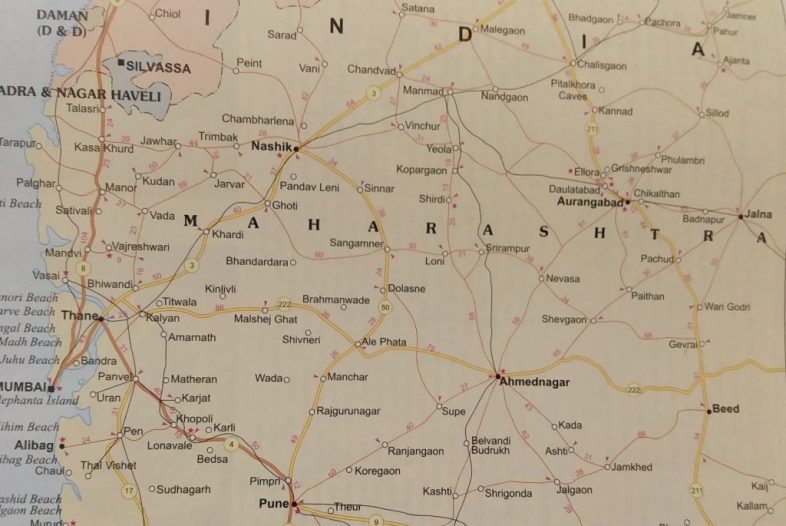
    • 2 Shani Shingnapur, (70 kms. Nevasa Taluk, Ahmednagar Dt.) – This temple is dedicated to Lord Shani, related Plant Saturn. Its unique feature is that the houses and shops in the village have no doors or locks. Visitors can perform puja and seek blessings from Lord
    • 3 Nevasa, (Nevasa Taluk, Ahmednagar Dt.) – A peaceful area rich in cultural heritage and ancient Mohiniraj (Vishnu) temple.
    • 4 Muktidham (Nashik) – A place where the essence of devotion and tranquility beautifully converge. Marble temple. Replicas of 12 Jyotirlingas which have built as per dimension of original
    • 5 Kalaram Temple, (Panchavati – Nashik) – An important pilgrimage site for Lord Ram, built in 1782.
    • 6 Pandavleni Caves, (Nashik) – These are ancient caves. Buddhist monks built them in these serene surroundings. They date back to the 2nd century.
    • 7 Ramkund, (Panchavati – Nashik) – A sacred water spot that invites introspection and calm.
    • 8 Manmad Thumbs Up Mountain Trek – A thrilling adventure surrounded by breathtaking nature.
    • 9 Ellora Caves, (Aurangabad) – A remarkable UNESCO World Heritage site, showcasing the grandeur of ancient art and architecture.
    • 10 Daulatabad, (Aurangabad) – A historic fort that stands as a testament to the strategic brilliance of the past.
    • 11 Coin Museum, (Anjaneri Village – Nashik) – A fascinating place that takes you on a journey through history via rare coins.
    • 12 Trimbakeshwar, (Nashik) – A sacred temple that holds deep significance in the hearts of devotees.
    • 13 Alandi, (Khed Taluk– Pune) – A tranquil town that offers peace and spiritual solace such as Dnyaneshwar samadhi
    • 14 Bhimashankar, (75 kms. Khed – Pune) – a scenic hill station that offers picturesque views of mountains, valleys, and waterfalls. It is a perfect place for nature lovers and adventure enthusiasts.
    • 15 Nashik: (90 km) A city on the banks of the Godavari River, famous for its historical and religious ancient temples, like Trimbakeshwar Temple, one of the twelve Jyotirlingas in India
    • 15 Ellora Caves: (100 km) An UNESCO World Heritage site, showcase a blend of Hindu, Buddhist, and Jain architecture; intricate carvings and sculptures that depict the ancient Indian culture
    • 16 Ajanta Caves: (110 km) An UNESCO World Heritage site and showcase exquisite rock-cut Buddhist cave monuments and frescoes that date back to the 2nd century BC