

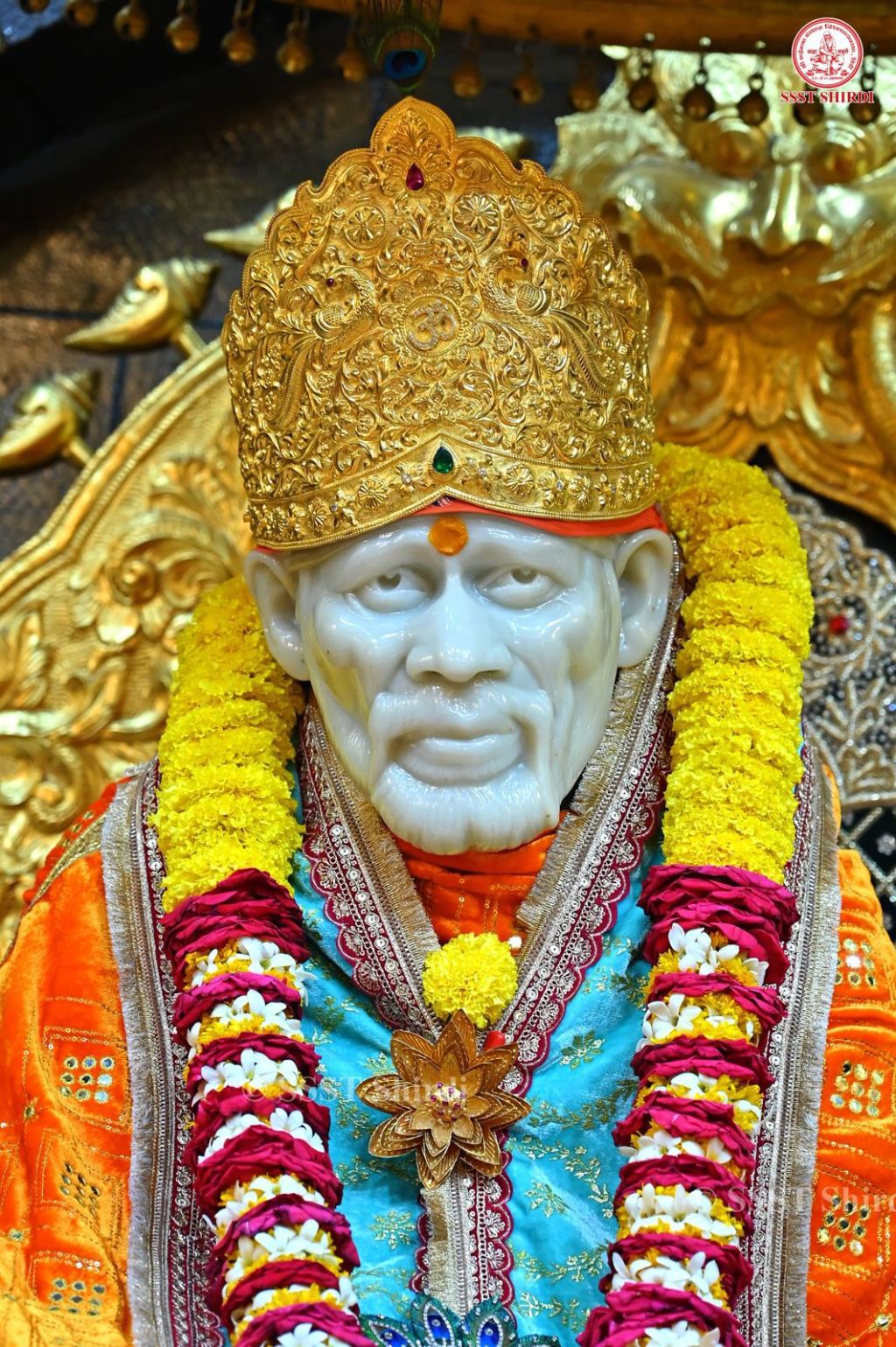
A captivating exploration of the profound themes and vital truths surrounding Shirdi Sai Baba reveals a figure of immense spiritual significance.
I. The Nature and Identity of Sai Baba
Sai Baba is a divine, omniscient, and omnipresent, being whose true nature transcends conventional human and religious classifications.
- Ambiguity of Origin and Faith:
- Baba’s identity as Hindu or Muslim is deliberately obscured, highlighting his universality.
- He celebrated both Hindu festivals (Rama-Navami, Gokul Ashtami) and allowed Muslim practices (Sandal procession, Namaj in Masjid).
- His physical attributes (pierced ears like a Hindu, advocacy of circumcision, but not circumcised himself) further blurred the lines.
- No one definitely knew whether He was a Hindu or a Mahomedan.
- Divine Incarnation and Sadguru:
- Baba is depicted as a “Wonderful Incarnation,” a “precious Jewel,” and a “precious Diamond.”
- He is the “crest-jewel of the Saints, who is the home of all auspicious things, who is our Atmaram (Dear Self), and who is the able refuge of the devotees.”
- He is explicitly referred to as a “Sadguru,” a true spiritual master.
- “Lord (God) dwells in the Saints.
- In fact they are not different from Him.
- Our Sai is One of these,
- Who incarnated for the welfare of the devotees,
- Supreme in knowledge and surrounded with divine lustre.”
- Omniscience and Omnipresence: Baba has absolute knowledge of the past, present, and future.
- He knew Mr.Damu Anna’s secret thoughts about cotton speculation and his desire to offer Baba a share of profits.
- He knew Mr. Cholkar’s secret vow regarding sugar and his decision to forego sugar. Baba remarked, “Though, I am here bodily, still I know what you do; beyond the saven seas. Go wherever you will, over the wide world, I am with you. My abode is in your heart and I am within you.”
- He knew Mr.Hari Kanoba’s name, parentage, and other details about him, even though it was Hari’s first visit to Shirdi.
- He read Somadeva Swami’s critical thoughts about the flags at the Mosque, directly addressing them.
- He knew about one pleader’s slander behind His back at Bar Council, demonstrating “His omniscience and His using it for correcting people and setting them on the right path.”
- He correctly predicted and averted the death of Ramachandra Patil and foresaw Tatya Patil’s passing.
- He is described as “omnipresent, occupying land, air, country, world, light and heaven, and that He was not limited.”
- Detachment and Humility: Despite his divine powers, Baba lived a life of extreme simplicity and humility. He lived on alms, possessing nothing, and residing in a deserted Masjid. He begged for food daily, mixing all offerings together, and “His tongue knew no taste.” Dogs, cats, and crows freely ate from his earthen pot, and “Baba never drove them away.”
II. The Role and Importance of the Sadguru
The Sadguru (Guru, who realized Self) as the sole means to spiritual liberation and worldly well-being.
- Bridge to Salvation:
- The Sadguru is essential for crossing the “worldly ocean.”
- “Where Real or Sadguru is the helmsman, he is sure to carry us safely and easily beyond the worldly ocean.”
- The Vedas alone cannot achieve this; “It is only the Sad-guru, who can do so and make you, see the Lord in all creatures.”
- Destroys Egoism and Sins:
- The touch of the Guru’s hand is described as having “wonderful… power.”
- It can destroy the “subtle-body (consisting of thoughts and desires)” and cleanse “sins of many past births.”
- M. Hemadpant said, when starting writing Shri Sai SatCharitra, “Sai Baba took away my egoism and wrote Himself His stories.”
- Catalyst for Transformation:
- Baba’s darshan (sight) leads to profound inner change:
- “by His darshana our thoughts are changed,
- the force of previous actions is abated and
- gradually non-attachment of dispassion towards worldly objects grows up.”
- He transforms his devotees into “Himself (His nature).”
- Baba’s darshan (sight) leads to profound inner change:
- Teacher and Guide:
- The Sadguru Sai teaches based on the disciple’s qualifications, without unsettling their minds.
- He dispels ignorance (“Destroying ignorance is Jnana”) and
- He helps the disciple realize their true Self (“You are God, you are mighty and opulent.”).
- Unconditional Love and Service:
- A true Sadguru expects no service or profit,
- but instead wishes to serve his disciples, treating them as equals or even as Brahma.
- “Baba had great love for the disciples.”
- He “loved all beings equally.
- He was unattached. Foes and friends, kings and paupers, were the same to Him.”
III. Key Teachings and Practices Advocated by Sai Baba
Baba’s teachings, though sometimes indirect, emphasized faith, surrender, moral conduct, and devotion.
- Faith (Nishtha) and Patience (Saburi): These were presented as two coins of devotion by Baba to His Guru.
- Baba said: “This is one pice -Faith. Patience or perseverance is the other pice. I waited patiently and very long on My Guru and served him. This Saburi will ferry you across the sea of this mundane existence.” (pice=1/100 INR)
- Complete Surrender: “If any one prostrates before Sai and surrenders heart and soul to Him,
- then unsolicited, all the chief objects of life viz. Dharma (righteousness), Artha (wealth), Kama (Desire) and Moksha (Deliverance), are easily and unsolicitedly attained.”
- “The best way, therefore, to get free from the shackles of Maya is our complete and whole-hearted surrender to Baba.”
- Charity and Non-Attachment to Wealth: Baba frequently extracted “Dakshina” (offerings),
- not for personal gain, but “to teach the devotees the lesson of charity and to remove their attachment to money and thus to purify their minds.”
- He asserted that “He had to give back hundred times more of what He received.”
- He discouraged debt for spiritual purposes: “Baba never liked people to run into debt for taking His darshan, or celebrating any holiday or making any pilgrimage.”
- He considered “money as a danger or bar to spiritual progress.”
- Ethical Conduct and Self-Correction:
- He advised against discourteously turning away those who come to you, emphasizing:
- “Shri Hari (God) will be certainly pleased, if you give
- water to the thirsty,
- bread to the hungry,
- clothes to the naked, and
- your verandah of your Home to strangers for sitting and resting.”
- Baba condemned slander:
- “Let anybody speak hundreds of things against you,
- do not resent by giving any bitter reply.
- If you always tolerate such things, you will certainly be happy.”
- He used the example of a pig eating filth to correct a slanderer, stating, “Your conduct is similar. You go on reviling your own brethren to your heart’s content.”
- Baba taught the importance of offering everything to the Guru before enjoyment:
- “before the senses, mind and intellect enjoy their objects, Sai should first be remembered, and if this be done, it is in a way an offering to Him...
- all the Vrittis (thoughts) regarding Desire, Anger, Avarice etc. should first be offered and directed to the Guru.”
- He guided devotees to remain calm and composed, engage in good actions, and perform duties without attachment.
- Remembrance of God/Guru (Dhyana/Bhajan): Baba advised various forms of devotion, including
- “remembering My name,”
- “hearing His Leelas,”
- “worship of His Feet,” and
- studying sacred scriptures like Shri Sai SatCharitra, Bhagwat, Jnaneshwari, and Vishnu-Sahasra-Nam.
- He stated, “If you always say ‘Sai, Sai’ I shall take you over the seven seas.”
IV. The Human and the Divine
- Interaction with Devotees:
- Baba allowed devotees to serve him in their own way,
- demonstrating his “dependency on Bhaktas” (in the sense that he allowed their devotion to manifest).
- He engaged in normal conversation, jokes, and sometimes strong reprimands, always with a deeper purpose.
- The Guru-Disciple Relationship: The relationship is central. Disciples are encouraged to fully surrender and trust the Guru. The Guru sees beyond superficiality and acts for the disciple’s ultimate good.
- Transcending Form:
- While he had a physical form, Baba’s true nature was “unattached and indifferent” and “the state of Brahman.”
- He demonstrated “Khandayoga, i.e., separating His limbs and joining them again,”
- His visible form was merely a “mould” for the “liquid essence of Pure Self.”
V. Miraculous Powers (Leelas) and Their Purpose
Baba’s “Leelas” (divine plays or miracles) are frequently cited, serving not as ends in themselves, but as tools to deepen devotees’ faith, teach spiritual lessons, and alleviate suffering.
- Manifestation of Divine Power:Grinding Wheat: Initially misunderstood as mundane, Baba’s grinding of wheat was a symbolic act to “destroy the cholera epidemic in Shirdi” with the flour.
- Turning Water into Oil: This demonstrated his control over natural elements(fire) and taught the Banias (Oil Traders) a lesson in /
- ‘truthfulness.
- Curing Diseases: He cured various ailments, including eye problems with Beeba (marking nuts-Carpus Ana Cardium) and diarrhea with groundnuts, emphasizing that “The true medicine… was Baba’s word.”
- Saving from Calamities: He averted the snake bite for Shama and predicted/averted the death of Ramachandra Patil. He also saved Mr. Mirikar from a potential snake bite.
- Fulfilling Desires (within divine plan):
- The “Amra-Leela” story illustrates his power. Four mangoes, given by Sai resulted in four sons and four daughters for Damu Anna. This happened despite astrological predictions.
- He facilitated the return of a stolen jewel-box and a stolen sum of money.
- Disguised Blessings and Tests:Baba’s “rage” and “abuses” were often a “blessing in disguise,” as seen with Somadeva Swami, or a direct command to the poison in Shama’s case.
- Drawing Devotees and Confirming Faith:
- The numerous anecdotes of individuals being drawn to Shirdi, despite their initial reluctance (Hemadpant’s own journey, Kakaji Vaidya being directed by Goddess Sapta-Shringi, the “idolater” friend of Kaka Mahajani) highlight Baba’s magnetic spiritual pull.
- His precise knowledge of hidden thoughts or distant events served to “create faith and devotion” in his devotees.
- Guaranteeing the Welfare of His devotees:
- “There will never be any dearth or scarcity, regarding Food and clothes in My devotee’s home.”
- In a nutshell
- Baba’s teachings
- emphasize love, compassion, and faith,
- uniting all religions and
- inspiring devotion beyond boundaries.
- His miraculous acts instill hope, and
- His wisdom fosters inner peace.
- Baba’s teachings

 Welcome to https://ShirdiSaiBaba.InterNational