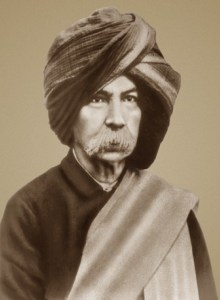
"I draw to Me, My man from far off or even across the seven Seas to Shirdi, like a sparrow with a string fastened to its feet"-Shirdi Sai Baba, Indian Spiritual Guru-God
I am formless and everywhere. I am in everything. I am in everything and beyond. I fill all space. All that you see taken together is Myself. I do not shake or move.
All that is seen is my form; ant, fly, prince, pauper.
I am in the water, in dry places, in woods, amidst crowds, and in the solitary wilderness. I am in the fire and in ether. I am not limited to any place.
Feeding the hungry bitch is feeding me. I have the feeling of my hunger being satisfied, when hers is satisfied. Baba to Laxmi Bai Sciedhe: I am hungry. Laxmi Bai Scindhe; Shall I go and bring food? Baba; Do. Laxmi Bai Scindhe; Then brought food; Baba took nothing from it and placed the entire plate before a hungry bitch. Laxmi Bai Scindhe: Baba why do you do so? Baba: Is not the bitch also a Jiva? We talk, bitches do not. She is hungry; she and I are one and the same. It is the same if I eat or she eats.
I am still belching with the heavy feeding you gave the dog this morning. I am also in the mire besmirched pig (that you did not feed, though it came to you). To serve me, give up differentiation, (to Bombay Lady)
Sometimes I come as dog, sometimes as pig. The devotee who recognises me in each form and treats me adequately is blessed.
You have been with me eighteen years Nana. Does “Sai” mean to you only this 3’/2 cubits height of body? I am in the ant and fly. Whenever you see this sign, remember that I am there and that I can eat food through ants, flies etc. 72-A. Baba: This body is but my house. My guru Mourshad has long ago taken me away from this.
I went as a cat to drink this man’s Hansraj’s curds to save him, despite his cussedness. But he beat me to day. I was the black dog. I was the sickly sudra. I am in everything, and beyond. I was the fakir who begged of you, at Bombay. I was the spirit, you saw at midnight under the tree. [I am Akkalkote Maharaj.] I gave you Rs. 2, Pitale(Devotee) 73-A. Baba as a cat is beaten. Baba to Hansraj, an Asthma patient: Do not take curds or taste sour things. But Hansraj was daily preparing curds overnight to drink it, at the noon meal. Daily a cat drank it off and one day he beat the cat. Baba to others, in the presence of Hansraj: “There is an Urphatia. a cussed, cross-grained man. I told him not to take curds. But he daily prepared it. Daily I went as a cat and drank it off, to save his life. Today 1 went again. Do you know what he did? He beat me over the shoulder. See here. (Hansraj looked and found a fresh weal on Baba’s shoulder, though it was a cat, he beat with a stick on the shoulder) cf. 359. 73-B. Baba as a dog and sickly Sudra: Kasinath Govind Upasani-KGU Maharaj, who lived at Shirdi in 1911-4, prepared his food which a black dog was watching. Offering nothing to the dog, K.G.U. went to the masjid and offered it to Baba. Baba: Why did you bring it here? I was there. K.G.U.: Baba, there was none there, except a black dog. Baba : I was that black dog. Baba refused to accept food that day. Next day K.G.U. prepared his meal at his quarters and found no dog there. But a sickly Sudra(Lower caste) was standing, leaning on a wall and looking at the food. The orthodox K.G.U. drove him away from that place and brought the food to S.Baba. Baba : Yesterday you did not offer me food. Today also you drove me away. Why bring the food here? K.G.U.: Where were you there, Baba? Baba.: I was leaning on the wall. K.G.U.: What! Could you be in such a person? Baba: Yes I am in all things and beyond. Purusha Sukta -i.e. HE pervades the earth and transcends it.
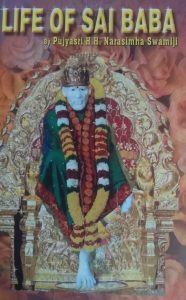
The author of this Book is Pujya Sri H.H. Nara Simha Swamiji- Founder & First President of All India Sai Samaj, Chennai , India.
A) Shirdi Sai Baba:–
Baba’s training, teachings and achievements were of widely different sorts. They were suited to the conditions of each person who approached him. They are also suited to the conditions of those who approach him now.
Baba is still a Guru, a Divine Personality. He is not a mere abstraction. He can be seized by those who are in dead earnest.
Unfortunately for mankind, very few are so earnest. Most stop with raising preliminary questions, as to the impossibility of such an experience or its undesirability and the various objections, from the standpoint of the learning that they have already acquired.
If the highest is not possible at the present moment, Baba suitably develops them. This development occurs either in this life or in the life beyond. Baba has repeatedly undertaken to guide his devotees. He promises to guide them life after life, and to be born with them for that purpose.
–By H.H. Narasimha Swamiji, Author of this Book, in his Preface
B) Parts of this Book-LoSB on Sai Baba.
The object of this book, is to help people to realise more and more the great work, that is being done by Shirdi Sai Baba and his essential greatness. This Book consists of four Volumes /Parts.
Part I- History, Personality, Nature, Functions of Sai Baba
The early history and accounts of Baba and the materials are necessary to understand Baba as a Samartha Sadguru. He will help one to attain the highest in life. At the same time, He enables one to get the other incidental benefits of contact with such a saint.
Part II -Sai’s Apostles and Mission
This second part mainly consist of Baba’s dealings with various prominent persons. It shows how they were drawn to him and influenced by him. It also illustrates what progress they made. Additionally, it details how they were helped to make it by reason of their contact with him.
Most of the Bhaktas were drawn for specific temporal gains, but they stuck on and became very good Adherents of Baba.
Part III. -Baba’s Lovers
Baba’s prominent devotees, not in Part II, must come into here. They like something unintelligible, “just like Love at first sight of a pure Girl with a pure bachelor”.
Part IV- Life and Teachings of Sai Baba
Which as the residuals and final part must include general matter not covered by the previous parts. The spiritual and mystical personalities, such as Saints like Sai, embody an adventurous and worthy life. They think intellectually in the pursuit of their lives.
The life of Sai Baba especially gives a very tough treat for the spiritual seekers. Only a few writings present so vivid a picture of the life and teachings of Sai Baba. They do so in such a descriptive form. For this reason, this volume stands out.
C) Baba provided Ankita children for this Book Project
Sri Krishna says, ‘Those who rescue my entirely devoted bhakta from his troubles, I shall rescue and help them. I will save them from all troubles and calamities. A boat rescues one in the ocean in the same way’. Baba somehow gives the feeling to the author’s helpers, that they are being looked after by him.
Baba provided his Ankita child with a stenographer who, out of modesty, wishes to conceal his light under a nom-de-plume R.R. Without the help of a stenographer, turning out any work would be impossible. This applies to work for the book, for the Sai Sudha, or for the numerous pamphlets constantly requisitioned by others from this author.
Since October 1953, the author’s health has been extremely unreliable. The work would have been impossible without the due provision of medical help. Here again Baba’s help to his Ankita child is remarkable. Baba designated a doctor in a very good position. The doctor had excellent knowledge. Baba made him repeatedly attend without receiving any recompense at all.
Baba’s grace alone made the work see the light of day. It also aided in getting the means for publication. The royal present of Rs.5,000 by His Highness The Maharaja of Mysore, enabled the All India Sai Samaj to purchase a Press and Types.
There may be numerous others (Sri Dewan Bahadur R.V. Krishna Ayyar and Miss Indira, Professor of English, etc) who have helped this author in the course of getting up this book.
Stage after stage, idea after idea, and reference after reference, the remarkable help that was suddenly forthcoming was the clearest evidence to the Author that, Baba is giving unstinted support for this publication. Fact it is not mere modesty, but love of truth that makes the author say that, “the real producer of this book is Baba himself“.
– By B.V. NARASIMHA SWAMI, Author in Preface to Part I in 1955
D) After studying “Life of Sai Baba”
A properly written life of Sai (like all saintly biography, cf. “Jo Sant, Toch Dev” i.e. Saint is himself God) would be a scripture in itself.
One should rise from that study with the feeling that they have been through scripture. They should mentally keep in touch with God. This allows them to derive all benefit necessarily flowing from such contact.
The benefits are temporal, intellectual, moral, spiritual, etc. There is no limit to the benefit one can derive from such contact.
A saint’s life is like the milk of the ocean. From it, one might extract, a few interesting bits of saintly biography. It also offers a collection of apothegms, counsels, reflections and other miscellaneous items. But the main interest is still the milk of ocean. It will yield an infinite and inexhaustible supply of divine nectar.
The essentials of the Bhagavad Gita, for instance, have always been regarded as a valuable religious mine. They have been found to embody what is contained in Sri Sai’s life. Sri Krishna and Jesus Christ are better understood, after studying Sai Baba’s life than without such study.
PS: The collection of data was made for this book project, by the great author, after 36 years of Sai Baba’s Mahasamadhi. (LoSB-Ch 1)
“It is our earnest desire and intention that, the book of “Life of Sai Baba” written by our revered Founder and First President H.H. Narasimha Swamiji, to reach the hands of numerous Sai Devotees, who are earnestly interested in attaining “Sai Bliss”. –By the Publisher, Management of All India Sai Samaj, Chennai-600004, India
“Presenting the Great Master Sri Sai Baba to the world through his intensely dedicated service, Sri Narasimha Swamiji has made himself into a living golden link between the present generation and Sri Sai Baba. Yes, Sri Swamiji is still active from His tomb. He guides millions of devotees to the feet of his Master.
This book will surely fulfill its glorious task of helping, guiding and transforming countless lives on their onward progress towards Divine Perfection. All glory to Sri B.V. Narasimha Swamiji Maharaj! Glory, Supreme glory to Samartha Sadguru Sai Baba!” – In Foreword to Part 1 by -By His Holiness Sri Swami Sivananda of Divine Life Society, Rishikesh, India.
“During the last 20 years, thanks to Swamiji’s energetic propaganda and publicity, Shri Sai Baba has attracted devotees from far and near, as also from all sects, communities and religions. They come from all sections of the society and, in particular, from its intelligentsia. In the case of the latter, one has to carry them across the fields of doubt and scepticism before they reach the other shore of spiritual enlightenment; and are safely and for ever established on the bedrock of faith in and devotion to the Divinity that Shri Sai Baba WAS and IS”. -In Foreword to Part II by Sri B N Datar, then Home Minister, Government of India
Extract from Pujyasri H.H. Nara Simha Swamiji’s ‘Life of Sai Baba’ book-LoSB
Correct knowledge of facts connected with the lives of saints is good for the individual who knows them. It is also beneficial to society. In the long run, it promotes social unity. It encourages ethical, spiritual, and religious study and endeavor. Lives of saints provide more than information, for the reader’s brain. They offer sustenance…
Earnest readers, who are anxious to study the history of Sai Baba (who realised in himself the perfection of Godhead by attaining Purnalaya) -concentrating his mind always on God with intense love from his earliest period of life; and -thereby attained Aikya (merge with God), -so that he could say Mainm Allahum, that is Aham…
“There has not been a good biography containing a fair, full and faithful description of Sai baba’s life. Other small sketches or introduction to Baba’s life have been published in English and other languages, but these also are too tiny to deserve the name of a biography, sketches of a few early incidents in Baba’s…
“5 minutes Nov 7, 2024 4:45 PM The author of this Book is Pujya Sri H.H. Nara Simha Swamiji- Founder & First President of All India Sai Samaj, Chennai , India. A) Shirdi Sai Baba:– Baba’s training, teachings and achievements were of widely different sorts. They were suited to the conditions of each person who approached…
I request the readers to leave out the various hindrances viz. indolence, sleep, wandering of mind, attachments to senses, etc. and turn their whole and undivided attention to these stories of Sai Baba. Let their love be natural, let them know the secret of devotion; let them not exhaust themselves by other Sadhanas, let them…
Govind Raghunath Dabolkar, called Anna Saheb Dabolkar, was Mamlatdar and first class resident Magistrate.
His work ‘Sai Satcharitra’ in Marathi Ovi verse extends to a thousand pages. Maharashtra Sai bhaktas treat it as Sai Ramayana or modern Guru Charitra. They give it the respect due to ancient puranas. Even others respect it when they gain access through N.V. Gunjaji’s English adaptation or translations in Telugu, etc.
This work is highly meritorious and has been the instrument for many people becoming Sai bhaktas. The verses are highly sonorous. The stories about Sai Baba collected from various individuals are based on actual experiences. These stories have great charm and are always fresh.
On his first visit to Shirdi and Sai Baba in 1910, went to the mosque. He and his friend Bala Saheb Bhate prostrated before Baba. Baba pointed to Dabolkar and said, ‘What talk was going on there at the wada? And what did this Hemad Pant say (pointing his chin to Dabolkar)?’. Dabolkar’s name was not Hemad Pant at all.
Hemadpant-“I began to think why Sai Baba should call me by the name Hemadpant. This word is a corrupt form of Hemadripant.
This Hemadripant was a wellknown Minister of the kings Mahadev and Ramadev of Devgiri of the Yadav dynasty. He was very learned and good-natured. He authored good works, such as Chaturvarga Chintamani (dealing with spiritual subjects) and Rajprashasti. He invented and started new methods of accounts and was the originator of the Ovi (Marathi Shorthand) script.
But I was quite the opposite, an ignoramus, and have dull, mediocre intellect. I could not understand why the name or title was conferred upon me. However, after thinking seriously about it, I thought that the title was a dart to destroy my ego. This way, I should always remain meek and humble. It was also a compliment paid to me for the cleverness in the discussion#. (# before he started from Wada/Lodge to Sai Temple, he had some hot discussion with Bala Saheb Bhate about”Guru’s essential ” for 30 minutes)”.
Looking to the future history, we think that Baba’s word (calling Mr. Dabholkar by the name Hemadpant) was significant and prophetic, as we find that he looked after the management of Sai Sansthan very intelligently, kept nicely all the accounts and helped greatly in the publications of ‘Sai Lila Masik (Magazine)’ also as the author of such a good work “Shri Sai Satcharita (SSSC)”, which deals with such important and spiritual subjects as Jnana, Bhakti and dispassion, self-surrender and self-realization.
The premier poet-saint of Maharashtra (India), Shri Jnaneshwar Maharaj, has stated that the Lord loves those who write the lives of saints;
and the saints also have a peculiar method of their own of getting the service, which the devotees long for, successfully accomplished.
The saints inspire the work; the devotee becomes only an indirect cause or instrument to achieve the end.
For instance, in 1700 Shaka* year (AD year=78 + Shaka year) the poet Mahipati aspired to write the lives of saints. Saints inspired him, and got the work done;
So also in 1800 Shaka year, Das Ganu’s service was accepted.
The former wrote 4 works-Bhakta Vijaya, Santa Vijaya, Bhakta Leelamrit and Santa Kathamrit, while the latter wrote two – “Bhakta Leelamrit and Santa Kathamrit“, in which the lives of modern Saints were described. In chapters 31,32,33 of Bhakta Leelamrit and in chapter 57 of Santa Kathamrit, the sweet life and teachings of Sai Baba are very well depicted. These have been separately published in Sai Leela Magazine, Nos. 11 and 12, Vol. 17; the readers are advised to read these chapters.
So also Sai Baba’s wonderful Leelas are described in a small decent book named Shri Sainath Bhajana Malaby Mrs. Savitribai Raghunath Tendulkar of Bandra.
Das-Ganu Maharaj also has composed various sweet poems on Sai Baba.
A devotee named Amidas Bhavani Mehta has also published some stories of Sri Baba in Gujarathi;
some Nos. of Sainath Prabha, a magazine published by Dakshina Bhiksha Sanstha of Shirdi, are also published
Sai Samasthan itself published Rao Bahadur M.W. Pradhan’s book ‘A glimpse of Indian spirituality‘ but it ran upto about 25 to 30 pages and set out just a handful of facts about Baba.
When a man takes a plunge into the sea, he gets the merit of bathing in all the Tirthas and sacred rivers. Similarly when a man takes refuge at the feet of the Sad-guru, he gets the merit of bowing to the Trinity, i.e. Siva, Vishnu and Brahma (Gods ) and also Para-Brahma.
Victory be unto Shri Sai the wish-fulfilling tree and the ocean of knowledge, who gives us self-realisation.
” Oh Sai, create in us regard for Your stories. viz.
let their bodies perspire,
let their eyes be full of tears,
let their prana be steady,
let their minds be composed,
let their hair stand on end,
let them cry, sob and shake,
let their hostilities and their distinctions, great and small vanish.”
If these things happen, that is a sign of the grace of the Guru dawning upon them. When these emotions develop in you, the Guru is most pleased and will certainly lead you on to the goal of self-realisation.
The best way, therefore, to get free from the shackles of Maya is our complete and whole-hearten surrender to Baba.
that the Sadguru looks first to the qualifications of his disciples; and
then gives them suitable instructions, without unsettling their minds in the least, and
leads them on towards the goal of self-realization.
In this respect, some say that what the Sadguru teaches or instructs, should not be divulged to others. They think that their instructions, become useless, if they are published. This view is not correct.
The Sadguru is like a monsoon cloud.
He pours down profusely, i.e., scatters widely his nectar-like teachings.
These, we should enjoy and assimilate to our heart’s content;
and then serve others with them, without any reserve. This rule should apply, not only to what he teaches in our waking state, but to the visions he gives us in our dreams.
Like a loving mother forcing bitter but wholesome medicines down the throats of her children for the sake of their health, Sai Baba imparted spiritual instructions to His devotees. His method was not veiled or secret, but quite open.
The devotees who followed His instructions got their object.
Sad-gurus like Sai Baba open our (eyes of the) intellect and show us the divine beauties of the Self, and
fulfill our tender longings of devotion.
When this is done, our desire for sense-objects vanishes, twin fruits of Viveka (discrimination) and Vairagya (dispassion or non-attachment) come to our hands; and knowledge sprouts up even in the sleep. All this we get, when we come in contact with Saints (Sad-guru), serve them and secure their love.
The Lord, who fulfills the desires of His devotees, comes to our aid, removes our troubles and sufferings, and makes us happy. This progress or development is entirely due to the help of the Sadguru, who is regarded as the Lord Himself. Therefore, we should always be after the Sad-guru, hear His stories, fall at His Feet and serve Him.
Rao Bahadur bought a good Chirdi (small Sari) and presented it to the mind-servant of Kaka (Kakasaheb Dixit)
Like a starving person getting luckily good dishes to eat, her joy knew to bounds. Next day she wore the new Sari, and out of great joy and merriment, whirled, danced round and played `Fugadi’ with other girls and excelled them all.
The Day following, she kept the new Sari in her box at home and came with the old and torn rags, but she looked as merry as she did the previous day.
On seeing this, Das Ganu’s pity was transferred into admiration. He thought that the girl being poor had to wear a torn rag, but now she had a new Sari which she kept in reserve and putting on the old rag, strutted herself, showing no trace of sorrow or dejection.
Thus he realized that all our feelings of pain and pleasure depend upon the attitude of our mind.
On thinking deeply over this incident, he realized that a man ought to enjoy whatever God has bestowed on him in the firm conviction that He besets every thing, from behind and before, and on all sides and that whatever is bestowed on him by God must be for his good.
In this particular case, the impoverished condition of the poor girl, her torn rag and the new Sari, the donor, the dance and the acceptance were all parts of the Lord and pervaded by HIM
Hence, Das Ganu got a practical demonstration of the lesson of the Upanishad – the lesson of contentment with one’s own lot in the belief that whatever happens, is ordained by God, and is ultimately good for us.
Unique Method of Teaching
In this particular case, He sent Das Ganu to Vile Parle, where he got his problem solved,through the maid-servant. To those, who say that it was not necessary to sent Das Ganu outside and that Baba could have personally taught him, we say that Baba followed the right or best course, or how else could Das Ganu would have learnt a great lesson, that the poor maid-servant and her Sari were pervaded by the Lord.
Bhagavad Gita 16.1-3: The Supreme Divine Personality said the saintly virtues of those endowed with a divine nature—
fearlessness,
purity of mind,
steadfastness in spiritual knowledge,
charity,
control of the senses,
performance of sacrifice,
study of the sacred books,
austerity, and
straightforwardness;
non-violence,
truthfulness,
absence of anger,
renunciation,
peacefulness,
restraint from fault-finding,
compassion toward all living beings,
absence of covetousness,
gentleness,
modesty, and
lack of fickleness;
vigor,
forbearance,
fortitude,
cleanliness,
bearing enmity toward none, and
absence of vanity.
How many of You got out of the 26? Pray Baba to help you to get more virtues. Come back after 21 days; Check again. Repeat every 21 days. Try to get atleast 14/26; but continue until reach 21/26 and more. On Sai Ram








 Welcome to https://ShirdiSaiBaba.InterNational
