

Shirdi, Shri Sai Baba’s life is a testament to His boundless compassion, profound gentleness, and unwavering selflessness. He consistently demonstrated these qualities through His actions, teachings, and interactions with His devotees. Here are instances:
Baba’s Compassion:
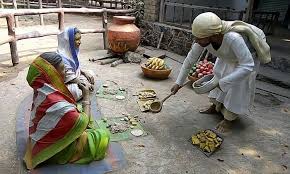
- Protection from Epidemics: Baba displayed compassionate foresight by grinding wheat and having the flour thrown on the Shirdi village borders to curb a cholera epidemic.
- Villagers understood that He was not only grinding wheat.
- He was also grinding the cholera itself to pieces. This act pushed cholera, out of the village. This led to the epidemic’s subsidence.
- Encouragement of Hemadpant: When Hemadpant expressed self-doubt about writing Baba’s biography,
- Baba gently encouraged him. He blessed him with Udi (sacred ashes) and placed His boon-bestowing hand on his head.
- Baba assured,
- “I will help him.
- He is only an outward instrument.
- I should write Myself My autobiography and
- satisfy the wishes of My devotees”.
- This shows His desire for devotees’ spiritual growth and His loving support.
- Motherly Love for Disciples: Baba exhibited a unparalleled motherly love towards His disciples. He was always attending to their needs. Sadgurus like Baba have this peculiar and extraordinary love for their disciples.
- All-Embracing Love and Tolerance:
- Baba’s all-embracing love was evident in His defense of the Rohilla, who disturbed villagers with loud prayers.
- Baba took the villagers to task, explaining that the Rohilla’s prayers kept away “Durbuddhi” (bad thoughts),
- thus protecting even those perceived as troublesome.
- All-Embracing Love and Tolerance:
- Omnipresence and Constant Protection: Baba’s statement: “I am the Inner Ruler of all and seated in their hearts. I envelope all the creatures, the movable and immovable world.“
- Curing Ailments through Grace: Baba cured numerous diseases without using conventional medicine. He did so through His Grace, Words, or Udi. This demonstrated His compassion for the suffering. Examples include:
- Bhimaji Patil’s severe tuberculosis, cured by Baba’s words of hope and mercy, through two dreams.
- Bala Ganapat Shimpi’s malaria, cured by instructing him to feed a black dog, with rice mixed with curds.
- Bapusaheb Booty’s dysentery and vomiting, instantly cured by Baba’s command, “Now take care, you should not purge any more” and “The vomiting must also stop”. He also cured in another time, Booty’s cholera with a seemingly fatal remedy, effective due to Baba’s word.
- A Swami from Alandi’s ear pain, relieved by Baba saying, “Alla Accha Karega (God will do good)”.
- Madhavrao Deshpande’s piles and Gangadharpant’s stomach-pain, cured by simple words and touch, and Nanasaheb Chandorkar’s stomach-pain with a sweetmeat.
- A doctor’s nephew of tubercular bone-abscess, cured with Udi and Baba’s “loving glances”.
- Dr. Pillay’s excruciating guinea-worm pain, relieved by Baba’s command to be ‘fearless’ and allowing an accidental step on the wound, to expel the worms.
- Shama’s sister-in-law’s bubonic plague, cured overnight by sending Udi and giving instructions.
- A Harda gentleman’s bladder stone, dissolved with Udi mixed with water.
- A Bombay lady’s painless delivery, despite a stillborn issue, by her praying to Baba and consuming Udi-mixture.
- Acceptance of Sincere Offerings: Baba lovingly accepted offerings made with devotion, such as
- Mr. Cholkar’s small offering of sugar-candy, knowing his secret vow to save money for his trip by abstaining from sugar.
- He knew devotees’ sincere intentions,
- even reminding them if they
- forgot to offer something,
- demonstrating His acceptance of their inner devotion over the material value.
- Teaching Non-duality through Action: Baba profoundly taught the principle of “See God in all beings”
- when He told Mrs. Tarkhad, “Mother, you have fed Me sumptuously… The dog which you saw before meals and to which you gave the piece of bread is, one with Me, so also other creatures… I am roaming in their forms. He, who sees Me in all these creatures is My beloved.“. This practical demonstration encouraged compassion for all life.
- Drawing Devotees and Fulfilling Desires: Baba had an incredible ability to draw devotees to Shirdi, “like a sparrow, with a thread tied to its feet.” He was omniscient and knew their innermost thoughts and desires. Often, His compassion led Him to fulfill them. Examples include:
- Knowing Lakhamichand’s taking a loan for his darshan and forgetting to buy guavas, but arranging for an old woman to sell him the fruits.
- Knowing Damu Anna’s secret thoughts about speculative business and gently dissuading him, saving him from financial ruin. He blessed Damu Anna’s wife with four sons and four daughters, by gave her four mangoes as Prasad. This act overrode astrological predictions.
- Fulfilling Mrs. Tendulkar’s dream of her son passing his medical examination despite unfavorable astrological predictions, emphasizing faith. He also blessed Mr. Tendulkar with a higher pension after a dream.
- Ensuring painless death and salvation (Sadgati) for devotees like Sannyasi Vijayanand, Balaram Mankar, and Tatya Noolkar; Even showering flowers on Megha’s body and arranging his funeral rites after his passing shows, deep affection.
- Compassion for Animals: Baba displayed immense compassion for animals.
- Notably, he bought two goats for an exorbitant sum. He explained their past lives and their enmity in their previous human forms. Out of pity, he fed them.
- He also taught not to kill creatures, stating “God lives in all beings and creatures”.
- Personal Sacrifice for Devotees:
- A supreme act of compassion was when Baba
- sacrificed His own life to save Tatya Kote Patil’s life, fulfilling an earlier prophecy that Tatya would pass away, but Baba took his place.
Shirdi’s Shri Sai Baba exemplified unparalleled compassion and selflessness through numerous acts. He protected villagers from epidemics, encouraged disciples, healed ailments without medicine, and accepted sincere offerings. Baba’s teachings emphasized seeing God in all beings, fulfilling devotees’ desires, and displaying profound love for both people and animals, often embodying true sacrificial spirit.

 Welcome to https://ShirdiSaiBaba.InterNational