"I draw to Me, My man from far off or even across the seven Seas to Shirdi, like a sparrow with a string fastened to its feet"-Shirdi Sai Baba, Indian Spiritual Guru-God
Despite its filth, mucus, and susceptibility to decay, disease, and death, the human body’s special value lies in its capacity to acquire knowledge and attain God-vision, which is impossible in any other birth.
Love is better than intelligence-
The pure love of Shirdi women, despite their ignorance, inspired them to compose poems, implying that love is more inspiring than intelligence.
Giving food is better than other charities-
While other charities like giving away wealth, property, and clothes require some discrimination, offering food requires no such consideration.
Also, the merit of feeding lame, crippled, blind, and diseased paupers is much greater than that of feeding able-bodied persons and relations.
Butter-milk (Leelas) is better than Milk (Darshan)-
If one desires to see Sai Baba’s but they did not get any opportunity of taking His darshan, their quest for milk (darshan) will be, to a great extent, satisfied by the butter-milk (Leelas).
Remembering and chanting Hari’s and Guru’s name confers salvation is better than getting the powerful Bhakti of the Nathas-
one Madhavarao did not like Kakasaheb’s pessimistic attitude of how to get the powerful Bhakti of the Nathas, as he said, ‘has not Baba told us authoritatively that remembering and chanting Hari’s and Guru’s name confers salvation? Then where is the cause for fear and anxiety?’
The observance of the vow of silence is the best way of praising the Sad-guru-
In reality, the observance of the vow of silence is the best way of praising the Sad-guru.
Having recourse to Sai Baba’s Feet and surrendering to Him is the best luck-
The best luck is to get an opportunity to have recourse to Sai Baba’s Feet and surrender to Him, than any other
Let us see how Baba prepared food and distributed it.
Baba required very little food for Himself and what little He wanted, was obtained by begging from a few houses.
But when He took it into His mind to distribute food to all, He made all preparations from beginning to end, Himself.
He depended on nobody and troubled none in this matter. First He went to the bazar and bought all the things, corn, flour, spices etc., for cash. He did also the grinding.
In the open courtyard of the Masjid, He arranged a big hearth and after lighting a fire underneath kept a Handi over it with a proper measure of water…
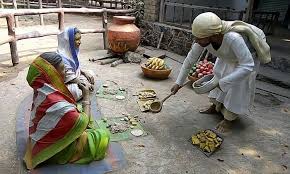
Sometimes He cooked ‘Mitthe Chaval’ (sweet rice), and at other times ‘pulava’ with meat. At times in the boiling varan (soup), He let in small balls of thick or flat breads of wheat flour. He pounded the spices on a stone-slab, and put the thin pulverized spices into the cooking-pot. He took all the pains to make the dishes very palatable.
He prepared ‘Ambil’ by boiling jawari-flour in water and mixing it with butter-milk. With the food He distributed this Ambil to all alike.
To see whether the food was properly cooked or not, Baba rolled up the sleeve of His Kafni. He put His bare arm in the boiling cauldron without the least fear. He churned (moved) the whole mass from side to side and up and down. There was no mark of burn on His arm, nor fear on His face.
When the cooking was over, Baba got the pots in the Majid, and had them duly consecrated by the moulvi.
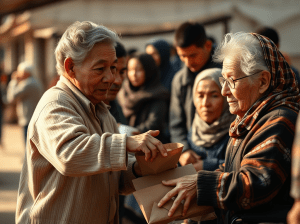
First He sent part of the food as prasad to Mhalasapati and Tatya Patil. Then, He served the remaining contents with His own hand to all the poor and helpless people. They ate to their hearts’ content.
Really blessed and fortunate must be those people who got food prepared by Baba and served by Him.
Let us go to Shirdi, and see carefully the programmes, after the noon-Arati. After the Arati ceremony was over, Sai used to
come out of the Masjid, and
standing on its edge,
distribute udi to the devotees with
very kind and loving looks.
The Bhaktas also got up with equal fervour,
clasped His Feet, and
standing and staring at Him,
enjoyed the shower of Udi.
Baba
passed handfuls of Udi into the palms of the devotees and
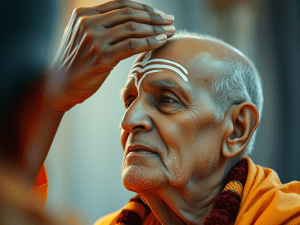
marked their foreheads with Udi with His fingers.
The love He bore for them in His heart was boundless. Then He addressed the Bhaktas as follows:-
“Oh Bhau, go to take your lunch;
you Anna, go to your lodgings;
you Bapu, enjoy your dishes”.
In this way He accosted each and every devotee and sent them home.
Even now, you can enjoy these sights if you bring into play your imagination. You can visualize and enjoy them.
Now bringing Sai before our mental vision, let us meditate on Him, from His Feet upwards to His face, and prostrating before Him humbly, lovingly and respectfully
“Look here, my Guru was a great saint and highly merciful.
I fatigued myself in trying to serve him and yet he did not utter any mantra in my ear. Instead he first shaved me clean and then begged of me two pice (money).
What he wanted was not metallic coin—he did not care even for gold,but only Nishta and Saburi, i.e. faith and courageous patience. I gave these to him and at once, he was pleased.
Mother, Saburi is courage, do not discard it. It ferries you across to goal. It gives i) overcomes all fears, ii) manliness to men, iii) eradicates sin and dejection and
For 12 years I waited on my Guru, who is peerless and loving.
How can I describe his love to me?
When he was Dhyanasta (in love trance),
I sat and gazed at him; and
we were both filled with Bliss.
I cared not to turn my eye upon anything else.
Night and day, I pored upon his face with an ardour of love that banished hunger and thirst.
The Guru’s absence, even for a second, made me restless.
I meditated upon nothing but the Guru and had no goal or object other than the Guru.
Unceasingly fixed upon him was my mind.
Wonderful indeed the art of my Guru!
I wanted nothing but the Guru and
he wanted nothing but my love.
Apparently action less,
he never neglected me,
but always protected me by his glance.
That Guru—I tell the truth, sitting as I do in this Masjid— never blew any mantra into my ear; nor do I blow any into yours.
Go thou and do likewise.
If you make me, the sole object of your thoughts and aims,
you will attain Paramartha, the supreme goal.
Look at me with undivided attention;
so will I look at you.
This is the only truth my Guru taught me. The four sadhanas and the six sastras are not necessary.
With entire confidence, trust your Guru. That is enough.”
The lady bowed, accepted the advice and gave up her satyagraha.
Baba to a Lady, who started Fasting to get mantra from Him, about His Guru.
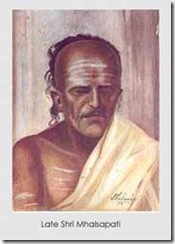
Mahlsapathy is the First & top most person in Sai Baba’s Court-Member of King’s Dharbar, and one among the VIBGYOR* member of Baba’s Dharbar.
Sai Baba stayed at one Chandbhai’s [headman of Dhoopkheda village] home for some days. The nephew of Chandbhai’s wife got betrothed to a girl from Shirdi. So, Baba came to Shirdi in that wedding procession, in 1872. The marriage party had alighted at the pounding grounds, near Khandoba’s (incarnation of Shiva) temple, outside the village. When Baba went to the Khandoba temple, He met Mhalsapaty there.
This Mhalsapaty was a resident of Shirdi and a goldsmith. As he was a devotee of Khandoba, and regular visitor of Khanderaya (Deity of Jejuri, who is also Khandoba), since many generations. As soon as Mhalsapaty saw Him, he welcomed Him with the words: “Welcome Sai”. Then, all the devotees of Sai Baba called Him “Sai Baba or Sai or Baba”. Mhalsapati brought Sai Baba into the village and introduced Him to his friends Kashiram Shimpi and Appa Jagale. These three usually served, according to their capacity, the sadhus, saints , fakirs and ascetics visiting the village, and graciously took care of them.
Baba was an absolute “Vairagya Purusha” and never cared for wealth or women. Mahlsapalhy, being himself highly detached i.e. of a vairagya temperament and not being overned by lust or other low urges, could easily appreciate Baba, from the very beginning was drawn to Baba;
when other people began to worship Baba, only when they saw Baba’s psychic powers e. g. when he turned water into oil to feed his lamps, and then they regarded him as God.
An important event in Mahlsapathy’s life that was- “Baba’s trying to leave his body about 1886 and returning to it three days later”.
Baba had made him the guardian of his body and told him, “Arre Bhagat, look after this body for three days. I am going to Allah. If I do not return, then get it buried in due course at that place, (that is, near the sacred gode neem tree).”
Mahlsapathy supported Baba’s body on his own knee, and when officers, including the village headman karnam, etc., held an inquest over the body, declared it dead, and wanted it to be buried. Mahlsapathy with the help of others stoutly opposed their proposal, and saved Baba from losing his body.
Thus, he rendered a valuable service in 1886, after which Baba lived for 32 years to create this huge Sai movement that has covered this World.
If Mahlsapathy had failed in his duty, and Baba had been buried, perhaps the course of history might have been different.
‘Whatever a person thinks of at the time of death he reaches’. When Mahlsapathy’s death was approaching, he retained full-consciousness and control of his mind.
That was on 11th Sep 1922, Monday (in the month of Badrapada, Ekadasi Somavara, sacred to Shiva and Khandoba), having finished all his puja, he said to his family, ‘To-day is my father’s Shraddha day. Finish cooking soon. To-day, I close my earthly life and go to Heaven’.
So, a Brahmin came and finished the Sraddha at once; and finished the gift of balis to crows, cows, etc, and guests were fed. Then the family meals were finished.
Mahlsapathy took betel and nuts after his meal. After chewing a bit, he put on a kupni. Having near him, Bala Gurav, Ramachandra Kothe, etc., he told them all to do Ramachandrajapa Japa.
Muhlsapaty said to his son that ‘Spend time piously in Uttama Bhakti Marga i.e. in holy devotion. All that I told you will happen.” Then Mahlsapathy uttered the word ‘Ram’ and breathed his last.
Thus he passed away in calm, faith and cheerfulness, on the 11th September 1922. This death was a fitting termination to a pure, lofty and dedicated life—a life of Love, faith and total surrender.
His remains are interred in a tomb at Shirdi, which is still worshipped by many.
* 1. Mahlsapathy 2. Narayan Govind Chandorkar 3. Das Ganu Maharaj 4. H.S. Dixit, 5. Hemadpant 6. Sri Upasani Baba and 7. G.S. Khaparde.
Carpology is a branch of botany. It focuses on the study of seeds and fruits, particularly their structure and morphology. It helps in understanding the evolution of plant species and reconstructing
Here is the proof of the Baba’s knowledge in this Science
Kaka was the Manager in the firm of Thakkar Dharmasey Jethabhai, a solicitor of Bombay. Out of curiosity and just to test Baba, Mr. Thakkar once decided to go to Shirdi with Kaka during Shimga holidays.
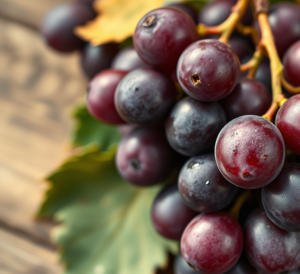
Kaka bought two seers of raisins (dried grapes with seed) on the way for presentation to Baba. Then Kaka prostrated himself before Baba and offered the raisins to Him. Baba ordered them to be distributed.
Mr. Thakkar got a few of them. He did not like the raisins and he was advised by his doctor not to eat them without washing and cleaning them. So he was in a fix. He did not like to eat them, nor could he reject them.
To keep up formalities, he put them into his mouth, but did not know what to do with the seeds. He could not spit them out on the floor of the Masjid, so he pocketed them against his wish.
He then thought about Baba being a Saint. He questioned how Baba could be ignorant of his dislike for the raisins. Could Baba force them on him?
When this thought arose in his mind Baba again gave him some more raisins. He could not eat them, but held them in his hand. Then Baba asked him to eat them up.
He obeyed and found, to his surprise, that they were all seedless. He wanted to see miracles and here was one. He knew that Baba read his thought; and as per his wish converted raisins (with seeds) into seedless grapes. What a wonderful power!
Again to test further he asked Tarkhad, who was sitting by and who also got some raisins, “What kind of grapes you got?” He replied “They variety with seeds.” Mr. Thakkar was still more surprised to hear this.
Then to confirm his growing faith Thakkar thought in his mind that if Baba was a real Saint, the raisins should be now given to Kaka first.
Reading this thought also, Baba ordered that distribution should be commenced from Kaka. These proofs were sufficient for Thakkar.
Idiopsychology refers to an individualized approach. It examines how an individual’s unique experiences, personality traits, and background influence their mental processes and behavior.
Baba, with his individualized approach, is influencing his devotees.
One young man made up his mind to lend the money to Dixit (Dixit had to meet a heavy obligation of Rs. 30,000 to be paid to a moneylender-Marwadi. The day for payment was drawing near and could not see how to get funds for meeting this large demand.), on account of his need and on account of his being his father’s friend; and thus the creditor of Dixit was paid in time. But who could know that the sum of Rs. 30,000 was with a person with a mind to be influenced to lend it to Dixit? Baba alone could influence the possessor of the funds. It is just like this that at the crucial moment Baba acts often!
For instance Baba operated on the minds of Brahmins to come to do Pitru Sraddha for Jog just at the nick of time (B C. S. 377-8).
HE influenced the appellate Magistrate’s mind to deal summary justice to his convicted servant Raghu.
HE influenced the minds of Government members to refrain from granting sanction against Khaparde for prosecution (BCS 402-5).
HE influenced the minds of all and sundry to turn Upasani Maharaj back to Shirdi in June 1911 (BCS 635).
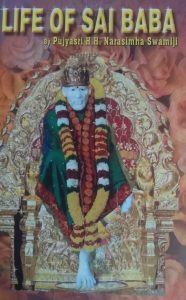
The author of this Book is Pujya Sri H.H. Nara Simha Swamiji- Founder & First President of All India Sai Samaj, Chennai , India.
A) Shirdi Sai Baba:–
Baba’s training, teachings and achievements were of widely different sorts. They were suited to the conditions of each person who approached him. They are also suited to the conditions of those who approach him now.
Baba is still a Guru, a Divine Personality. He is not a mere abstraction. He can be seized by those who are in dead earnest.
Unfortunately for mankind, very few are so earnest. Most stop with raising preliminary questions, as to the impossibility of such an experience or its undesirability and the various objections, from the standpoint of the learning that they have already acquired.
If the highest is not possible at the present moment, Baba suitably develops them. This development occurs either in this life or in the life beyond. Baba has repeatedly undertaken to guide his devotees. He promises to guide them life after life, and to be born with them for that purpose.
–By H.H. Narasimha Swamiji, Author of this Book, in his Preface
B) Parts of this Book-LoSB on Sai Baba.
The object of this book, is to help people to realise more and more the great work, that is being done by Shirdi Sai Baba and his essential greatness. This Book consists of four Volumes /Parts.
Part I- History, Personality, Nature, Functions of Sai Baba
The early history and accounts of Baba and the materials are necessary to understand Baba as a Samartha Sadguru. He will help one to attain the highest in life. At the same time, He enables one to get the other incidental benefits of contact with such a saint.
Part II -Sai’s Apostles and Mission
This second part mainly consist of Baba’s dealings with various prominent persons. It shows how they were drawn to him and influenced by him. It also illustrates what progress they made. Additionally, it details how they were helped to make it by reason of their contact with him.
Most of the Bhaktas were drawn for specific temporal gains, but they stuck on and became very good Adherents of Baba.
Part III. -Baba’s Lovers
Baba’s prominent devotees, not in Part II, must come into here. They like something unintelligible, “just like Love at first sight of a pure Girl with a pure bachelor”.
Part IV- Life and Teachings of Sai Baba
Which as the residuals and final part must include general matter not covered by the previous parts. The spiritual and mystical personalities, such as Saints like Sai, embody an adventurous and worthy life. They think intellectually in the pursuit of their lives.
The life of Sai Baba especially gives a very tough treat for the spiritual seekers. Only a few writings present so vivid a picture of the life and teachings of Sai Baba. They do so in such a descriptive form. For this reason, this volume stands out.
C) Baba provided Ankita children for this Book Project
Sri Krishna says, ‘Those who rescue my entirely devoted bhakta from his troubles, I shall rescue and help them. I will save them from all troubles and calamities. A boat rescues one in the ocean in the same way’. Baba somehow gives the feeling to the author’s helpers, that they are being looked after by him.
Baba provided his Ankita child with a stenographer who, out of modesty, wishes to conceal his light under a nom-de-plume R.R. Without the help of a stenographer, turning out any work would be impossible. This applies to work for the book, for the Sai Sudha, or for the numerous pamphlets constantly requisitioned by others from this author.
Since October 1953, the author’s health has been extremely unreliable. The work would have been impossible without the due provision of medical help. Here again Baba’s help to his Ankita child is remarkable. Baba designated a doctor in a very good position. The doctor had excellent knowledge. Baba made him repeatedly attend without receiving any recompense at all.
Baba’s grace alone made the work see the light of day. It also aided in getting the means for publication. The royal present of Rs.5,000 by His Highness The Maharaja of Mysore, enabled the All India Sai Samaj to purchase a Press and Types.
There may be numerous others (Sri Dewan Bahadur R.V. Krishna Ayyar and Miss Indira, Professor of English, etc) who have helped this author in the course of getting up this book.
Stage after stage, idea after idea, and reference after reference, the remarkable help that was suddenly forthcoming was the clearest evidence to the Author that, Baba is giving unstinted support for this publication. Fact it is not mere modesty, but love of truth that makes the author say that, “the real producer of this book is Baba himself“.
– By B.V. NARASIMHA SWAMI, Author in Preface to Part I in 1955
D) After studying “Life of Sai Baba”
A properly written life of Sai (like all saintly biography, cf. “Jo Sant, Toch Dev” i.e. Saint is himself God) would be a scripture in itself.
One should rise from that study with the feeling that they have been through scripture. They should mentally keep in touch with God. This allows them to derive all benefit necessarily flowing from such contact.
The benefits are temporal, intellectual, moral, spiritual, etc. There is no limit to the benefit one can derive from such contact.
A saint’s life is like the milk of the ocean. From it, one might extract, a few interesting bits of saintly biography. It also offers a collection of apothegms, counsels, reflections and other miscellaneous items. But the main interest is still the milk of ocean. It will yield an infinite and inexhaustible supply of divine nectar.
The essentials of the Bhagavad Gita, for instance, have always been regarded as a valuable religious mine. They have been found to embody what is contained in Sri Sai’s life. Sri Krishna and Jesus Christ are better understood, after studying Sai Baba’s life than without such study.
PS: The collection of data was made for this book project, by the great author, after 36 years of Sai Baba’s Mahasamadhi. (LoSB-Ch 1)
“It is our earnest desire and intention that, the book of “Life of Sai Baba” written by our revered Founder and First President H.H. Narasimha Swamiji, to reach the hands of numerous Sai Devotees, who are earnestly interested in attaining “Sai Bliss”. –By the Publisher, Management of All India Sai Samaj, Chennai-600004, India
“Presenting the Great Master Sri Sai Baba to the world through his intensely dedicated service, Sri Narasimha Swamiji has made himself into a living golden link between the present generation and Sri Sai Baba. Yes, Sri Swamiji is still active from His tomb. He guides millions of devotees to the feet of his Master.
This book will surely fulfill its glorious task of helping, guiding and transforming countless lives on their onward progress towards Divine Perfection. All glory to Sri B.V. Narasimha Swamiji Maharaj! Glory, Supreme glory to Samartha Sadguru Sai Baba!” – In Foreword to Part 1 by -By His Holiness Sri Swami Sivananda of Divine Life Society, Rishikesh, India.
“During the last 20 years, thanks to Swamiji’s energetic propaganda and publicity, Shri Sai Baba has attracted devotees from far and near, as also from all sects, communities and religions. They come from all sections of the society and, in particular, from its intelligentsia. In the case of the latter, one has to carry them across the fields of doubt and scepticism before they reach the other shore of spiritual enlightenment; and are safely and for ever established on the bedrock of faith in and devotion to the Divinity that Shri Sai Baba WAS and IS”. -In Foreword to Part II by Sri B N Datar, then Home Minister, Government of India
Extract from Pujyasri H.H. Nara Simha Swamiji’s ‘Life of Sai Baba’ book-LoSB
Correct knowledge of facts connected with the lives of saints is good for the individual who knows them. It is also beneficial to society. In the long run, it promotes social unity. It encourages ethical, spiritual, and religious study and endeavor. Lives of saints provide more than information, for the reader’s brain. They offer sustenance…
Earnest readers, who are anxious to study the history of Sai Baba (who realised in himself the perfection of Godhead by attaining Purnalaya) -concentrating his mind always on God with intense love from his earliest period of life; and -thereby attained Aikya (merge with God), -so that he could say Mainm Allahum, that is Aham…
“There has not been a good biography containing a fair, full and faithful description of Sai baba’s life. Other small sketches or introduction to Baba’s life have been published in English and other languages, but these also are too tiny to deserve the name of a biography, sketches of a few early incidents in Baba’s…
“5 minutes Nov 7, 2024 4:45 PM The author of this Book is Pujya Sri H.H. Nara Simha Swamiji- Founder & First President of All India Sai Samaj, Chennai , India. A) Shirdi Sai Baba:– Baba’s training, teachings and achievements were of widely different sorts. They were suited to the conditions of each person who approached…
I request the readers to leave out the various hindrances viz. indolence, sleep, wandering of mind, attachments to senses, etc. and turn their whole and undivided attention to these stories of Sai Baba. Let their love be natural, let them know the secret of devotion; let them not exhaust themselves by other Sadhanas, let them…







 Welcome to https://ShirdiSaiBaba.InterNational