

” What is this sira and who eats it? Do not say of anyone that he is your enemy”.
Baba wanted to point out to Das Ganu (devotee) that he is the soul, which neither eats nor has any other physical function. And that all souls are in essence one and the same, viz., Paramatma.
To one who has realised himself as Paramatma, there can be no enemy at all.
Which means, “The one Vishnu (God) is in you, in me and others; all he endures. Your anger is senseless. See the (same) Atman in every one. “
LoSB-Chapter 3 of Part II, to Das Ganu Maharaj who had said that “that man is my enemy”, when not getting sira/drink
Tag: Discipline and Guidance
How Baba guides and discipline his children
-

Quotation 323
-
Quotations 141
“Oh Shama, this book is very valuable and efficacious, so I present it to you, you read it.
- Once I suffered intensely and My heart began to palpitate and My life was in danger.
- At that critical time, I hugged this book to My heart and
- then, Shama, what a relief it gave me!
- I thought that Allah (God) Himself came down and saved Me.
- So I give this to you, read it slowly, little by little.
- Read daily one name at least, and it will do you good.”
Baba to Shama in SSSC Ch-27 about the Book “Vishnu-Sahasra-Nam”
-

Proof Reading of Sai Literatures, Opportunity at Shirdi
Public Appeal from Shirdi, Shri Sai Baba Sansthan
Shri Saibaba Sansthan, Shirdi is planning to reprint its Literatures in Marathi, Hindi, Telugu, Tamil, Malayalam, Bengali, Odia, Kannada, Gujarati, Assamese, Punjabi, Sindhi, Urdu, Nepali etc.
For this purpose, Sansthan is inviting Sai Devotees, who have PHD to Form a Committee of 30/40 members.
The work involves i)corrections ii) proof reading of the text and iii) Helping Sansathan to resolve issues/doubt, raised by Sai Devotees, on a regular basis.
Since Sai Seva, there is no compensation for this project.

Thanks SSS Trust, Shirdi PS: please check their official website for latest updates.
-

Baba’s standpoint similar to Mahatma Gandhi
That is ‘Live and let live’- and To unite persons, use common joint formula.
Mahtama Gandhi (freedom fighter of India) tried to effect a rapproachment between Hindus and Muslims. He started the formula noted below, where Rahim and Ram are put together. He also made his Hindu and Muslim followers repeat the formula or mantra.
“Raghupati Raghava Rajaram Patita paavana Sitaram,
Iswara Allah Tere nam, Sabko Sanmati De Bhagavan,
Rama Rahim Krishna Karim, Sabko Sanmati de Bhagavan.“
Mahatma Gandhi aimed to familiarise the ears of impartial and co-operatively minded Hindus and Muslims, with a mix of both cultures. This would help both groups to hear each other’s names without losing equanimity.
This would become easier and inspiring by habit for future generations. That was the great object of Mahatma Gandhi’s formula. Baba added to Gandhiji’s plan of work. He secretly worked on the hearts of all.
Baba was perfectly neutral and submitted to the peculiar idiosyncracies of his worshippers in order to avoid offending them. Left to himself Baba would have no mark on his forehead. Baba did not believe at all that there is a separate Siva and a separate Vishnu as Gods. ‘To him, there was only one God. It might be called Siva or Vishnu, Vittal, Rama or Datta. Khuda, Khandoba, Devi, Allah or Hari; might all be names given with equal justification’. “A rose by any other name would smell as sweet”.
If each wants to get on in his own way, he should do so. He should choose the way that suits him best. By all means, let him do so. He should not be hindered. This is the only way to unite all sincere worshippers. Sincere bhaktas’ worship of Sai is the same as the worship of God.
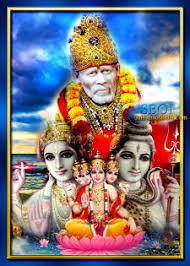
That is their feeling and according to correct metaphysics and philosophy, there is no difference between the worship of Sai treated as God and the worship of God under any other name or any other form. Both achieve the same ends.
“In whatever form you surrender to Me, in that form, I respond- BG (4) 11.
LoSB/Part I: Ch-XIV
-
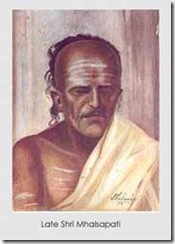
Mahlsapaty
Mahlsapathy is the First & top most person in Sai Baba’s Court-Member of King’s Dharbar, and one among the VIBGYOR* member of Baba’s Dharbar.
Sai Baba stayed at one Chandbhai’s [headman of Dhoopkheda village] home for some days. The nephew of Chandbhai’s wife got betrothed to a girl from Shirdi. So, Baba came to Shirdi in that wedding procession, in 1872.
The marriage party had alighted at the pounding grounds, near Khandoba’s (incarnation of Shiva) temple, outside the village. When Baba went to the Khandoba temple, He met Mhalsapaty there.This Mhalsapaty was a resident of Shirdi and a goldsmith. As he was a devotee of Khandoba, and regular visitor of Khanderaya (Deity of Jejuri, who is also Khandoba), since many generations. As soon as Mhalsapaty saw Him, he welcomed Him with the words: “Welcome Sai”. Then, all the devotees of Sai Baba called Him “Sai Baba or Sai or Baba”.
Mhalsapati brought Sai Baba into the village and introduced Him to his friends Kashiram Shimpi and Appa Jagale. These three usually served, according to their capacity, the sadhus, saints , fakirs and ascetics visiting the village, and graciously took care of them.Baba was an absolute “Vairagya Purusha” and never cared for wealth or women. Mahlsapalhy, being himself highly detached i.e. of a vairagya temperament and not being overned by lust or other low urges, could easily appreciate Baba, from the very beginning was drawn to Baba;
when other people began to worship Baba, only when they saw Baba’s psychic powers e. g. when he turned water into oil to feed his lamps, and then they regarded him as God.
An important event in Mahlsapathy’s life that was- “Baba’s trying to leave his body about 1886 and returning to it three days later”.
Baba had made him the guardian of his body and told him, “Arre Bhagat, look after this body for three days. I am going to Allah. If I do not return, then get it buried in due course at that place, (that is, near the sacred gode neem tree).”
Mahlsapathy supported Baba’s body on his own knee, and when officers, including the village headman karnam, etc., held an inquest over the body, declared it dead, and wanted it to be buried. Mahlsapathy with the help of others stoutly opposed their proposal, and saved Baba from losing his body.
Thus, he rendered a valuable service in 1886, after which Baba lived for 32 years to create this huge Sai movement that has covered this World.
If Mahlsapathy had failed in his duty, and Baba had been buried, perhaps the course of history might have been different.
‘Whatever a person thinks of at the time of death he reaches’. When Mahlsapathy’s death was approaching, he retained full-consciousness and control of his mind.
That was on 11th Sep 1922, Monday (in the month of Badrapada, Ekadasi Somavara, sacred to Shiva and Khandoba), having finished all his puja, he said to his family, ‘To-day is my father’s Shraddha day. Finish cooking soon. To-day, I close my earthly life and go to Heaven’.
So, a Brahmin came and finished the Sraddha at once; and finished the gift of balis to crows, cows, etc, and guests were fed. Then the family meals were finished.
Mahlsapathy took betel and nuts after his meal. After chewing a bit, he put on a kupni. Having near him, Bala Gurav, Ramachandra Kothe, etc., he told them all to do Ramachandrajapa Japa.
Muhlsapaty said to his son that ‘Spend time piously in Uttama Bhakti Marga i.e. in holy devotion. All that I told you will happen.” Then Mahlsapathy uttered the word ‘Ram’ and breathed his last.
Thus he passed away in calm, faith and cheerfulness, on the 11th September 1922. This death was a fitting termination to a pure, lofty and dedicated life—a life of Love, faith and total surrender.
His remains are interred in a tomb at Shirdi, which is still worshipped by many.
* 1. Mahlsapathy 2. Narayan Govind Chandorkar 3. Das Ganu Maharaj 4. H.S. Dixit, 5. Hemadpant 6. Sri Upasani Baba and 7. G.S. Khaparde.
-
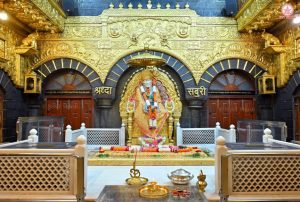
Who is Shirdi Sai Baba
Sri Krishna, Sri Rama, Sai Baba, are all divinely gifted or perfected souls and expressions of divinity. They transform everyone who comes into contact with their divine personality. This is especially true for those who are drawn through Rinanubandha (karmic Bond) by their divinity. That is the purpose or mission of their lives.
Baba’s Birth and Grown-up:
- Sai Baba (1838-1918) was an Indian spiritual Guru, Yogi, and Fakir, revered as a saint by millions of devotees, both Hindu and Muslim, across the world.
- Sai Baba stated that while still a young child, his parents entrusted him to the care of a fakir. The fakir raised him.
- From this foster father, Baba readily acquired Vairagya (detachment from worldly pleasures and pains) and developed a spiritual mindset.
- That fakir passed away within four or five years after taking charge of him.
- This fakir instructed his wife to take the young Baba and leave him in the care of the renowned saintly zaminder, Gopal Rao Deshmukh (Provincial Governor) in Selu.
- Gopal Rao was an exceedingly devout individual, deeply attached to Tirupati Lord Venkatesa. He was affluent and generous, and he supported education and piety.
- A wealth of true education was available to the young Baba, as he was consistently in attendance on this master.
- Gopal Rao, upon departing from this world peacefully, signaled to the young Baba with a wave of his hand, instructing him to leave Selu and proceed westward to his new abode. (Shirdi is situated along the banks of the Godavari river, directly west of Selu).
- After some time, Chand Bhai Patel, the Headman of Dhoop (Dhukeda) Village in Nizam’s State, arrived in Shirdi with a grand procession. He had come for the marriage of his wife’s nephew at Shirdi, around 1872. Sai Baba accompanied him for this occasion. When the marriage party arrived in Shirdi, they halted at Mhalsapati’s land near the Khandoba temple.
- Bhagat Mhalsapati noticed the young Fakir disembarking from the bullock cart and greeted him with “YA SAI” (Welcome Sai). Others began to address him as Sai, and henceforth he became known as Sai Baba.
- Baba’s final residence was Shirdi, where he lived from 1872 until the end of his life in 1918.
Baba’s Mission:
Baba has not one mission, but a hundred missions. Divine personalities have specific functions. They protect the good (virtuous). They punish or reform the wicked. They also establish Dharma (Virtue) or its hold on the people. And Baba was performing all these functions.
His mission is to help every one, that means, of course, everyone capable of benefiting, not persons who come in an unreceptive mood .
Baba’s marga-Path:
Studying Gitas, one sees that there is no meaning in asking for ‘any one marga (path)‘ expounded by the Divine Person. Saints expound all the margas. They find which marga or combination of margas would suit each approaching devotee. Then they give the same to him.
Thus Baba adopted every marga. In particular, one may note that the predominance in his methods was neither for ritual nor for Vedic study. Instead, it was for living in consonance with the Supreme manifestation of Divinity in himself.
Baba distributes:
Baba quoted occasionally his master’s or Guru’s behest. “As he had received liberally from his master, he must similarly distribute liberally amongst those that approached him.” Baba was distributing not merely wealth, worldly relief and comforts. He was also giving spiritual gifts and spiritual blessings to all and sundry capable of receiving those benefits.
Baba advises :
- ‘Love all creatures.
- Do not fight with any.
- Do not retaliate nor scandalize any.
- When any one talks ill of you, that is, against you, pass on unperturbed. His words cannot pierce into your body. Others’ acts will affect them alone and not you.’
Baba was ever active and never idle and His advice was, ‘Do not be idle. Work, Utter God’s name. Read scriptures’.
Baba is also advising:
- ‘We should not harbour envy, rivalry, or combative disposition towards others.
- If others hate us, let us simply take to Nama Japa and avoid their company.
- Hearken to the words of your parents.
- Help your mother in her tasks.
- Speak the truth and truth alone’.
Baba’s advice was always simple and capable of being accepted and acted upon by even persons of the meanest capacity.
Baba’s moral teachings:
Important thing for peace and happiness is love of all creation. Baba’s moral teachings were conveyed by his own life and activity. Baba loved all creatures. The underlying motive of every act of his was love towards all human beings and all creatures.
Baba’s Powers:
He did not even appear to be a teacher and was chiefly a granter of wishes. But all the same, he was a powerful instiller of principles and virtue. He instilled these into the hearts of those capable of receiving such impress.
Other Saints, about Sai Baba:
One Saint, from Puntambe by name Gangagir always frequented Shirdi. When he first saw Sai Baba, carrying pitchers of water in both hands, for watering the garden, he was amazed. And said openly, “Blessed is Shirdi, that it got this precious Jewel. This man is carrying water today; but He is not an ordinary fellow. As this land (Shirdi) was lucky and meritorious, it secured this Jewel.”
So also one famous Saint by name Anandnath of Yewala Math, a disciple of Akkalkot Maharaj came to Shirdi with some Shirdi people. When he saw Sai Baba, he said openly, “This is a precious Diamond in reality. Though he looks like an ordinary man, he is not a ‘gar’ (ordinary stone) but a Diamond. You will realize this in the near future.”The meaning of the name, ‘Sai Baba’:
‘Sa’ means ‘Divine’; ‘ai’ or ‘ayi’ means ‘mother’ and ‘Baba’ means father. The Name indicates Divine Mother and Father.
Your physical parents exhibit love with a dose of selfishness. But this Sai, ‘Mother and Father’, showers affection or reprimands. This is only for leading you towards victory in the struggle for self-realisation.Sai Baba/ Sai/ Baba has achieved, the supreme task of:-
- Sai has come to achieve the supreme task of uniting the entire mankind as one family, through the bond of brotherhood of affirming;
- And illumining the Atmic Reality of each. This is done in order to reveal the Divine, which is the basis on which the entire Cosmos rests.
- And also instructing all to recognise the common Divine Heritage that binds man to man. This way, man can rid himself of the animal. He can rise into the Divine, which is his goal.
The most important facts to remember about Baba is that,
- Baba was the embodiment of all virtues,
- Baba did nothing which he did not preach.
- In Himself, all the virtues were the efflorescence of the central root in Him, with which he began as a little child, namely:-
- love for the Guru,
- love that knows no bounds of time, place, or circumstance, and
- love that sacrifices anything and everything at its altar.
- Gratitude, service, equality, justice, consideration and so many other good qualities that were in him and taught by him were the direct issue of this love. These qualities could not have all been sustained without this love. This is the central point to remember about Baba.
This enables the sishya (student or Devotee) to get more and more like unto the Guru. By constant meditation on him, the sishya becomes the soul of the Guru.ie
- The sishya grows in love,
- absorbs the love from the Guru, and
- returns it with all his soul and body.
- Does not consider himself as anything except as the lover and the beloved of the Guru.
- Thus he attains –
- moral perfection,
- spiritual perfection,
- perfection of siddhis and
- perfection of every sort .
- This is the natural result of Baba’s moral teachings.
-

Have you promised God?
You may be worried because you have promised Me something, and later, you are tempted to break your word.
Now, do not hesitate. When you promise that you will not smoke, or will not attend films, the promise must be clear, firm and complete.
I do not gain by your promise nor do I lose, if you break it.
You gain self-confidence, you gain strength, you gain moral fibre, you gain Ananda: Yes, your Ananda is My Food. So, I gain, too!
The snows on the mountain peaks soften during the day as a result of the Sun; they harden during the night since the Sun is absent. So too, your hard heart hardens Me; your soft hearts soften Me.
Understand this: Each of you knows the love of a single mother only.
But My affection, My love towards every one of you is that of a thousand mothers! Do not deny yourself of that affection, that love, by denying Me your Love!
– Divine Discourse by Puttaparti Satya Sai Baba, on Oct 04, 1970. -
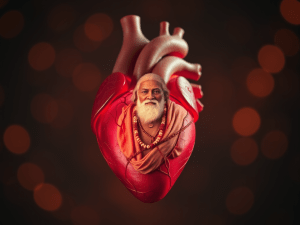
I know, what you do beyond the seven seas.
“If you spread your palm with devotion before Me, I am immediately with you, day and night. Though, I am here physically, still I know what you do beyond the seven seas.
Go wherever you wish, over the wide world, I am with you. My abode is in your heart, and I am within you.
Always worship me, who is seated in your heart as well as in the hearts of all beings. Blessed and fortunate indeed is he, who knows, Me thus.”
Sai Baba in SSSC-Chapter 15
-

Karma-The choices we make, that create our state
In the cosmic dance of cause and effect,
Where actions and consequences intersect,
Karma weaves its intricate thread,
A tapestry of life, stitch by stitch, it’s spread.Not a punishment, nor a reward,
But a natural law, universally adored,
It teaches us to act with care,
For every deed reflects, in life’s fair mirror, bare.So let us sow seeds of kindness and love,
And watch as they blossom from below and above,
For in the end, it’s not about fate,
But the choices we make that create our state.-By Unknown, but Well Knew

 Welcome to https://ShirdiSaiBaba.InterNational