

- Baba was extremely forgiving, never irritable, straight, soft, tolerant and content beyond comparison.
- Though He looked embodied (as having the form), He was really dis- embodied, emotionless, unattached and internally free.
- The Ganges on its way to the sea, cools and refreshes the creatures affected with heat, gives life to the crops and trees, and quenches the thirst of many. Similarly Saints (Souls) like Sai, while they live their own life, give solace and comfort to all.
- Lord Krishna has said that ‘the Saint is My soul, My living image, I am He or He is My pure form (Being).’
- This in-describable Shakti or Power of God, known as Pure Existence, Knowledge and Bliss, incarnated in the form of Sai in Shirdi.
- The Shruti (Taitiriya Upanishad) describes Brahman as Bliss. This we read or hear daily in the books, but the devout people experienced this Brahman or Bliss in Shirdi.
- Baba, the support of all, required no prop or support (Asan) from anybody. He always used a piece of sack-cloth for His seat, which was covered with a small beautiful bed by His bhaktas and has a bolster placed by them, as a rest to His back.
- Baba respected the feelings of His devotees and allowed them to worship Him as they liked. Some waved Chamara or fans before Him, some played on musical instruments, some washed His hands and Feet, some others applied scent and chandan, some gave betel nut with leaves and other things, and some others offered naivedya.
- Though He looked like living in Shirdi, He was present everywhere.
- This all-pervasiveness of His way daily experienced by His devotees.
- Our humble prostration to this all-pervasive Sadguru.
Tag: Bliss
Ob Trance visions or dreams
-
Bliss, incarnated in the form of Sai in Shirdi.
-

What can the Snake do?”
Balasaheb Mirikar, son of Sirdar Kakasaheb Mirikar was Mamlatdar of Kopergaon. He was going on tour to Chitali. On the way he came to Shirdi to see Sai Baba.
When he went to the Masjid and prostrated himself before Baba, usual conversation regarding health and other matters commenced, when Baba sounded a note of warning as follows:- “Do you know our Dwarakamayi?”
As Balasaheb did not understand he kept quiet, Baba continued – “This is our Dwarakamayi, where you are sitting. She wards off all dangers and anxieties of the children, who sit on her lap. This Masjidmayi (its presiding Deity) is very merciful. She is the mother of the simple devotees. She will save them in calamities. Once a person sits on her lap, all his troubles are over. He, who rests in her shade, gets Bliss”.
Then Baba gave him Udi, and placed His protecting hand on his head.
When Balasaheb was about to depart, He again said- “Do you know the “Lamba Bava” (long gentleman), Viz. serpent?” And then he closed his left arm like a fist. He brought it near the right elbow. Moving his left arm like the hood of a serpent, Baba said, “He is so terrible. But what can he do to the children of Dwarakamayi? When the Dwarakamayi (its presiding deity) protects, what can the serpent do?”
Everyone present there was curious. They wanted to know the meaning of all this and its reference to Mirikar. However, none had the courage to ask Baba about this. Then Balasaheb saluted Baba and left the Masjid with Shama. Baba called Shama back and asked him to accompany Balasaheb, and enjoy the Chitali trip.
They reached Chitali at 9 P.M. and encamped in the Maruti temple. The office-people had not come; so they sat quiet in the temple, talking and chitchating.
Balasaheb was sitting on a mat reading a newspaper. His Uparani (upper dhotar) was spread across his waist and on a part of it a snake was sitting unobserved. It began to move with a rustling sound which was heard by the peon. He brought a lantern, saw the snake and raised an alarm- ‘serpent, serpent’. Balasaheb was frightened and began to quiver.
Shama was also amazed. Then he and others moved noiselessly and took sticks and clubs in their hands. The snake got down slowly from the waist and it moved away from Balasaheb; it was immediately done to death. Thus this calamity, which was prophesied by Baba, was averted and Balasaheb’s love for Baba was deeply confirmed.
-

When one gets laya in God, all powers, all wisdom, all perfection, termed divine, shine forth from such a person’.
Baba said, his nights were not intended for sleep. On the other hand, he used his divine eye of supervision.
He kept watch over all his bhaktas in all their places. He averted danger from them. Look at this vast unimaginable task of one person trying to save hundreds in hundred different places. The task is simply unimaginable. No human being could ever succeed in it.
It is the divine Baba that could do it and that did it. His divine power enabled him to do it. His divine kindness made him forego sleep and all comforts for that purpose.
The sacrifice of physiological well-being by giving up sleep night after night, was very serious, but Baba willingly consented to do it. Baba’s body was human, though his soul was divine; Baba had to undergo all the physiological evils of protracted loss of sleep and loss of comforts.
‘When one gets laya in God, all powers, all knowledge, all wisdom, all perfection, that are termed divine, shine forth from such a person‘. Baba was perfect in his concentration on God.
Therefore in the above quoted instances, as in the other innumerable instances to be found in the Gospel of Sai Baba (i.e. BCS) or other books on Baba, the powers exercised by Baba were the result of his laya in God, that is, they were really divine powers.
In many cases, the object of Baba was that a devotee should not merely get relief. The devotee should also develop full belief in him (Baba) as the Guru-God. This belief allows the devotee to attach himself firmly to Sai Baba and develop his life thereafter with his help. This is the great object with which siddhis were utilised by Baba.
Temporal help was given by means of these chamatkars, but there was always a string attached to the temporal help. The man who got temporal benefit had at the same time a push in the spiritual direction.
Patanjali Yoga Sutras in Chapter III, especially those about Pratibha and Sarva Bhava Athreshta Trithva and Sarve Jnathruthva. Patanjali has said therein that by concentrating on the Purusha and developing Suddhasatva one attains pratibha (knowledge of everything), and one can do everything, i.e., achieve omnipotence and omniscience.
Use of siddhis may be good or bad and both are referred to not only in Bhagavata, Skanda XI, but also in Baba’s advice and actions. Baba gave a warning to a devotee just beginning to develop powers. This is the stage when curiosity, ambition, and other worldly motives arise. These desires come from the appearance of siddhis within the grasp of the sadhaka or devotee.
Regarding Baba’s action, anyone would note that Baba made ample use of innumerable siddhi powers. Therefore, there is nothing wrong in using siddhi powers. All great ones including Sri Krishna have used their divine powers or siddhis
-
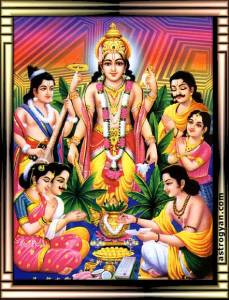
Sathya Narayana Poojah
People in the Maharashtra, India always celebrate God Satya-Narayana Puja in their homes every fortnight or month.
When they are suffering from any problem, they say, ‘I do Satya Narayana Pooja.’ After getting rid of the problem, they performed the Satya Narayana Puja.
In all Sai Baba Temples, Sai Satya-vrata Puja is performed instead of Satya Narayana Pooja. People choose to recite the Sai story. It was told in three figurative verses. These were from the book “Bhakta Liyamaruth” composed by Daskanu Maharaj.
Satya Narayana Puja will be held daily at 7 am and 9 am in Shirdi. At the end of the prayer, the priest reads the three stories in Marathi. He reads them on behalf of all the devotees present. Then the offering will be given.
If you have time, please attend the Sai Satya Narayana puja, at Shirdi Mandir(RS.100 per couples), and also do monthly Pooja at your home in front of Satya Narayana picture and get Health, Wealth and Happiness
-
Bread and Food getting is an Auspicious. Here is Baba’s own story.
Do not discard offers of food; served dish should not be thrust away. Offers of bread and food should be regarded as auspicious signs of success.” Saying this Vanjari offered us food and asked us to be calm and patient.
Again we did not like this good hospitality and discarded his offer and went away. Without doing any quest and without taking any food, the three began to move out. So obstinate were they.
I (Baba) was hungry and thirsty and I was moved with the Vanjari’s extraordinary love; we thought ourselves very learned but were quite strangers to pity and kindness. The Vanjari was a quite illiterate and unqualified fellow and belonged to a low caste. Still he had love in his heart and asked us to eat the bread.
In this way he who loves others disinterestedly is really enlightened and I thought acceptance of his hospitality was the best beginning of getting knowledge. So very respectfully I accepted the loaf of bread offered, ate it and drank water.
Then to! The Guru at once came and stood before us, “What was the dispute about?” He asked and I told him everything that had happened. Then he said, “Would you like to come with me? I will show you what you want; but he alone, who believes in what I say, will be successful.” The others did not agree to what he said and left him; but I bowed to him reverently and accepted his dictum.
Then he took me to a well, tied my feet with a rope and hung me – head downwards and feet up – from a tree near the well. I was suspended three feet above the water, which I could not reach with My hands, nor which could go into my mouth. Suspending me in this manner he went away, no one knew where. After 10 or 12 ghatakas (4 or 5 hours) he returned and taking me out quickly asked me how I fared.
“In Bliss supreme, I was. How can a fool like me describe the joy I experienced?” I replied. On hearing my answer the Guru was much pleased with me, drew me near him and stroking my body with his hand kept me with him. He took care of me as tenderly as a mother-bird does of her young ones.
He put me into his school; how beautiful it was! There I forgot my parents, all my attachment was snapped and I was liberated easily. I thought that I should embrace his neck and remain staring at him always. If his image were not fixed in my pupils, I would like better to be blind. Such was the school!
No one, who entered it once, could return empty-handed. My Guru became my all-in-all, my home and property, mother and father, everything. All my senses left their places and concentrated themselves in my eyes, and my sight was centred on him. Thus was my Guru, the sole object of my meditation and I was conscious of none else. While meditating on him my mind and intellect were stunned and I had thus to keep quiet and bow to him in silence.
.. By his grace, realization flashed upon me of itself, without effort or study. I had not to seek anything, but everything became clear to me as broad day-light.
-
Donation Why asked?
Baba, from 1908 established a threshold of dakshina (Donation) for those approaching him to cross.
A man too much attached to wealth is frightened at the demand for dakshina and does not approach Baba.
A person who is ready to pay dakshina shows his readiness to part with worldly things and may also be ready to part with his worldly avocations and attachments and thus be prepared for intense love towards and surrender to the Guru.
The love of the Guru is the one thing needed, for the Guru is the sole sadhana.
If one fully believes (the Guru Gita dicta) (1) that the Guru is an absolutely essential pre-requisite for one’s attaining Bliss (sukham) or wisdom (jnana) and to make sure that at death there will be no faltering or pain and (2) that a Guru would ensure success and happiness in life and a happy death with his help.
-
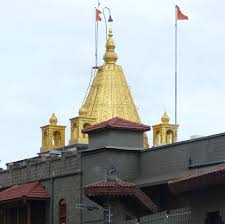
Baba’s Tomp
During his last illness Baba said “Carry me to the Wada”, (ie. Buty wada). Buty was quite willing that his building should become the tomb of Baba.
The Mamlatdar pointed out his difficulties. He said that if all parties agreed, he could give directions for the disposal of the body in accordance with the terms of the agreement. If they did not, he said, they should go to Ahamadnagar, and get the District Magistrate’s decree, and he (Mamlatdar) would have to act upon that decree. Then Dixit was ready to go to Ahamadnagar.
As he was a solicitor of high repute, the Muslims thought that if he went to Ahamadnagar, he would get the District Magistrate’s order in his own favour, and they would be nowhere. So, they came to an agreement with the Hindus that Baba’s body should be in Buty wada, and, as usual the management of the tomb, etc., should also be with the Hindus, but Muslims should be allowed free access even though it was in a Hindu gentleman’s house, and that Mamul should continue.
So, the Mamlatdar himself passed an order, and Baba’s body was buried without any difficulty at Buty wada, where it still remains. That was only a temporary settlement. The more important matter was as to the guidance of the future.
That should be a scheme sanctioned by the District Court of Ahamadnagar. H.S. Dixit with his remarkable legal ability, his worldly wisdom, and great bhakti, drew up a Scheme and presented it with the signatures of number of influential devotees. That was sanctioned by the District Court in 1922 and that governs the Shirdi Sai Sansthan and Baba’s tomb and other affairs.
The property of the Sansthan vested in a body of trustees with managing committee of fifteen. Dixit contented himself with being the Honorary Secretary, and his able management pleased all parties.
H.S. Dixit thus laid firm foundation for the success of the Shirdi Sai Sansthan, and he must be given the credit for its present position. This may be ranked as one of his great services to Sai and to the public or to humanity.

-

BABA and JESUS
One common feature of both Sai’s and Jesus’ lives is the reliance on miracles. People needed miracles to be convinced of their divine nature.
They could only demonstrate their divinity by performing these miracles. Miracles are a concession that divinity allows for human blindness.
*When Jesus said to Nilko … ‘I saw you under the fig tree before Thomas talked to you there.’; The addressee immediately concluded, ‘Surely, thou art the Son of God.’
Jesus said that he would see more wonderful things indicative of divine power . Again when and unable to rise from his bed, saying ‘ Arise , take up thy bed and walk ‘; and the man with palsy rose up and walked. The conclusion was drawn that the miracle was a token of Jesus’s divinity as also
*when Jesus cured a man of leprosy
Some reader might desire to know whether similar incidents happened in Sai’s history .
*First about palsy , a Marwadi had a young daughter of eight years or so with paralyzed legs . She could not walk to Baba, and therefore had to be carried in a chair, palki or stretcher.
She remained with Baba for three days. Suddenly her legs, which she could not bend at all till then, were stretched out and the second day she could stand. Thereafter, before she left Shirdi on the third day, she could walk back.
No application, medical or surgical, was made to her. This cure was purely by Baba’s power with his blessings, offered with udhi applied to her.
*There was once a patient. He had been suffering for years from inflammation of an ulcer in his stomach or bowels. Because of this, he could not eat any food. He was brought to Baba.
Baba ordered sweetmeats to be purchased; and brought and placed before the patient. Strange to say, the man was able to eat them. This cure also was purely by Baba’s power blessings.
-
Death has no meaning, When?
Constant repetition of a sakshatkara is required, as to make it a permanent possession. Instead of relying on a momentary glimpse of the view of something divine, one has to work one’s own self, till the self of the individual disappears in the self of the Universe. This is called Brahma Jnana– Brahman realisation.
Even this may be momentary. In order to become permanent, the sadhaka is advised to repeat it so that the impression (samskara) in the heart is far stronger and more serviceable. If one has really become identified with Brahman, death has disappeared.
Then, death has no meaning to a person, whose self has become the self of all, that is, who has lost his sense of separateness at once and forever.
-
Five sheaths
Man is enclosed in five sheaths: the physical, vital, mental, intellectual and blissful; the last, blissful is the core. So, man need only explore within himself for infinite bliss.
Bliss has to be sought not through accumulation but through sacrifice and promotion of the welfare of others. Sacrifice (Tyaga) is recommended by the Vedas as the only path to immortality.
Give in plenty, give gladly, give for the glory of God, and. in gratitude to God.
Selfishness is the canker that destroys charity. Though one is aware that a step is wrong, selfishness does not allow him to desist. But it can be overcome by steady determination.
Share with others the knowledge and skills you have earned,. the ideas and ideals you have benefited from, and the joy you have won by discipline and dedication.
Sharing will not diminish them or devalue them. On the other hand, they will shine better with added splendour.
– Puttaparti Satya Sai Baba in Divine Discourse, Apr 21, 1983.
Have a sense of values, rather a scale of values; give everything, everyone, its worth or their worth, not a whit more.
Five sheaths encase the Atma and hide its splendour from revealing itself.
Make all these pure and shining. The physical sheath (annamaya kosa) must be purified by good, clean, pure food; the vital sheath (pranamaya kosa) by calm, steady breathing and an equanimous temper; the mental sheath (manomaya kosa) by holy thoughts and emotions, untouched by attachment to senses or unaffected by joy or grief; the wisdom sheath (vijnanamaya kosa) by contemplation of the reality; and the bliss sheath (anandamaya kosa) by getting immersed in the ecstasy of God-realisation. – Divine Discourse, Feb 26, 1961.
 Welcome to https://ShirdiSaiBaba.InterNational