Welcome to https://ShirdiSaiBaba.InterNational

Thanks SSS Trust, Shirdi

"I draw to Me, My man from far off or even across the seven Seas to Shirdi, like a sparrow with a string fastened to its feet"-Shirdi Sai Baba, Indian Spiritual Guru-God


Tag: Awake

  • Sai Baba was there, truly!

    Sai Baba was there, truly!

    Dr Antonio Rigopoulos, Italy in his ‘Oral Testimonies on Sai Baba As Gathered During a Field Research in Shirdi and Other Locales in October-November 1985′ (Venice Ca’ F Editions Oscar – Digital Publishing 2021) explained his own Experience that:-

    I went to the cāvaḍī and while I was casually sitting at the cāvaḍī’s entrance, looking at the raṅgolīs, the auspicious signs that some young women were skilfully drawing on the ground, a stray dog caught my attention. He was full of pustules and eczemas, of fleas, and was in a really bad shape. Then it suddenly flashed on me that that dog was Sai Baba. It was something stronger than a simple thought, like an insight or a sudden flash of awareness that I find hard to put into words. I really felt that he was that dog and that he was standing in front of me in that very form: it had the force of an incontrovertible truth. It was a strange and startling experience indeed. Sai Baba was that dog: the lowest, the despised, the most neglected creature. The dog had sweet and penetrating eyes, which called for sympathy and attention.

    I felt I finally understood something: not intellectually, i.e. with the head, but emotionally, i.e. with the heart. There was Sai Baba, truly and fully. It came like a revelation and I shed a few tears; couldn’t help it. It was just so overwhelming

    -On 21 Oct 1985 at 7.30 am

    Thanks / Reference:

    Rigopoulos, Antonio. ‘7 Shirdi-Kopargaon-Shirdi. Monday, October 21, 1985’. Masters, Texts and Sources of the East (2020): n. pag. Crossref. Web.

  • Why Shirdi Sai Baba is a Universal Spiritual Guide

    Why Shirdi Sai Baba is a Universal Spiritual Guide

    A captivating exploration of the profound themes and vital truths surrounding Shirdi Sai Baba reveals a figure of immense spiritual significance.

    I. The Nature and Identity of Sai Baba

    Sai Baba is a divine, omniscient, and omnipresent, being whose true nature transcends conventional human and religious classifications.

    • Ambiguity of Origin and Faith:
      • Baba’s identity as Hindu or Muslim is deliberately obscured, highlighting his universality.
      • He celebrated both Hindu festivals (Rama-Navami, Gokul Ashtami) and allowed Muslim practices (Sandal procession, Namaj in Masjid).
      • His physical attributes (pierced ears like a Hindu, advocacy of circumcision, but not circumcised himself) further blurred the lines.
      • No one definitely knew whether He was a Hindu or a Mahomedan.
    • Divine Incarnation and Sadguru:
      • Baba is depicted as a “Wonderful Incarnation,” a “precious Jewel,” and a “precious Diamond.”
      • He is the “crest-jewel of the Saints, who is the home of all auspicious things, who is our Atmaram (Dear Self), and who is the able refuge of the devotees.”
      • He is explicitly referred to as a “Sadguru,” a true spiritual master.
      • “Lord (God) dwells in the Saints.
        • In fact they are not different from Him.
        • Our Sai is One of these,
          • Who incarnated for the welfare of the devotees,
          • Supreme in knowledge and surrounded with divine lustre.”
    • Omniscience and Omnipresence: Baba has absolute knowledge of the past, present, and future.
      • He knew Mr.Damu Anna’s secret thoughts about cotton speculation and his desire to offer Baba a share of profits.
      • He knew Mr. Cholkar’s secret vow regarding sugar and his decision to forego sugar. Baba remarked, “Though, I am here bodily, still I know what you do; beyond the saven seas. Go wherever you will, over the wide world, I am with you. My abode is in your heart and I am within you.”
      • He knew Mr.Hari Kanoba’s name, parentage, and other details about him, even though it was Hari’s first visit to Shirdi.
      • He read Somadeva Swami’s critical thoughts about the flags at the Mosque, directly addressing them.
      • He knew about one pleader’s slander behind His back at Bar Council, demonstrating “His omniscience and His using it for correcting people and setting them on the right path.”
      • He correctly predicted and averted the death of Ramachandra Patil and foresaw Tatya Patil’s passing.
    • He is described as “omnipresent, occupying land, air, country, world, light and heaven, and that He was not limited.”
    • Detachment and Humility: Despite his divine powers, Baba lived a life of extreme simplicity and humility. He lived on alms, possessing nothing, and residing in a deserted Masjid. He begged for food daily, mixing all offerings together, and “His tongue knew no taste.” Dogs, cats, and crows freely ate from his earthen pot, and “Baba never drove them away.”

    II. The Role and Importance of the Sadguru

    The Sadguru (Guru, who realized Self) as the sole means to spiritual liberation and worldly well-being.

    • Bridge to Salvation:
      • The Sadguru is essential for crossing the “worldly ocean.”
      • “Where Real or Sadguru is the helmsman, he is sure to carry us safely and easily beyond the worldly ocean.”
      • The Vedas alone cannot achieve this; “It is only the Sad-guru, who can do so and make you, see the Lord in all creatures.”
    • Destroys Egoism and Sins:
      • The touch of the Guru’s hand is described as having “wonderful… power.”
      • It can destroy the “subtle-body (consisting of thoughts and desires)” and cleanse “sins of many past births.”
      • M. Hemadpant said, when starting writing Shri Sai SatCharitra, “Sai Baba took away my egoism and wrote Himself His stories.”
    • Catalyst for Transformation:
      • Baba’s darshan (sight) leads to profound inner change:
        • “by His darshana our thoughts are changed,
        • the force of previous actions is abated and
        • gradually non-attachment of dispassion towards worldly objects grows up.”
      • He transforms his devotees into “Himself (His nature).”
    • Teacher and Guide:
      • The Sadguru Sai teaches based on the disciple’s qualifications, without unsettling their minds.
      • He dispels ignorance (“Destroying ignorance is Jnana”) and
      • He helps the disciple realize their true Self (“You are God, you are mighty and opulent.”).
    • Unconditional Love and Service:
      • A true Sadguru expects no service or profit,
      • but instead wishes to serve his disciples, treating them as equals or even as Brahma.
      • “Baba had great love for the disciples.”
        • He “loved all beings equally.
        • He was unattached. Foes and friends, kings and paupers, were the same to Him.”

    III. Key Teachings and Practices Advocated by Sai Baba

    Baba’s teachings, though sometimes indirect, emphasized faith, surrender, moral conduct, and devotion.

    • Faith (Nishtha) and Patience (Saburi): These were presented as two coins of devotion by Baba to His Guru.
      • Baba said: “This is one pice -Faith. Patience or perseverance is the other pice. I waited patiently and very long on My Guru and served him. This Saburi will ferry you across the sea of this mundane existence.” (pice=1/100 INR)
    • Complete Surrender: “If any one prostrates before Sai and surrenders heart and soul to Him,
      • then unsolicited, all the chief objects of life viz. Dharma (righteousness), Artha (wealth), Kama (Desire) and Moksha (Deliverance), are easily and unsolicitedly attained.”
      • “The best way, therefore, to get free from the shackles of Maya is our complete and whole-hearted surrender to Baba.”
    • Charity and Non-Attachment to Wealth: Baba frequently extracted “Dakshina” (offerings),
      • not for personal gain, but “to teach the devotees the lesson of charity and to remove their attachment to money and thus to purify their minds.”
      • He asserted that “He had to give back hundred times more of what He received.”
      • He discouraged debt for spiritual purposes: “Baba never liked people to run into debt for taking His darshan, or celebrating any holiday or making any pilgrimage.”
      • He considered “money as a danger or bar to spiritual progress.”
    • Ethical Conduct and Self-Correction:
      • He advised against discourteously turning away those who come to you, emphasizing:
      • “Shri Hari (God) will be certainly pleased, if you give
        • water to the thirsty,
        • bread to the hungry,
        • clothes to the naked, and
        • your verandah of your Home to strangers for sitting and resting.”
    • Baba condemned slander:
      • “Let anybody speak hundreds of things against you,
      • do not resent by giving any bitter reply.
      • If you always tolerate such things, you will certainly be happy.”
      • He used the example of a pig eating filth to correct a slanderer, stating, “Your conduct is similar. You go on reviling your own brethren to your heart’s content.”
    • Baba taught the importance of offering everything to the Guru before enjoyment:
      • before the senses, mind and intellect enjoy their objects, Sai should first be remembered, and if this be done, it is in a way an offering to Him...
      • all the Vrittis (thoughts) regarding Desire, Anger, Avarice etc. should first be offered and directed to the Guru.”
    • He guided devotees to remain calm and composed, engage in good actions, and perform duties without attachment.
    • Remembrance of God/Guru (Dhyana/Bhajan): Baba advised various forms of devotion, including
      • “remembering My name,”
      • “hearing His Leelas,”
      • “worship of His Feet,” and
      • studying sacred scriptures like Shri Sai SatCharitra, Bhagwat, Jnaneshwari, and Vishnu-Sahasra-Nam.
      • He stated, “If you always say ‘Sai, Sai’ I shall take you over the seven seas.”

    IV. The Human and the Divine

    • Interaction with Devotees:
      • Baba allowed devotees to serve him in their own way,
      • demonstrating his “dependency on Bhaktas” (in the sense that he allowed their devotion to manifest).
      • He engaged in normal conversation, jokes, and sometimes strong reprimands, always with a deeper purpose.
    • The Guru-Disciple Relationship: The relationship is central. Disciples are encouraged to fully surrender and trust the Guru. The Guru sees beyond superficiality and acts for the disciple’s ultimate good.
    • Transcending Form:
      • While he had a physical form, Baba’s true nature was “unattached and indifferent” and “the state of Brahman.”
      • He demonstrated “Khandayoga, i.e., separating His limbs and joining them again,”
      • His visible form was merely a “mould” for the “liquid essence of Pure Self.”

    V. Miraculous Powers (Leelas) and Their Purpose

    Baba’s “Leelas” (divine plays or miracles) are frequently cited, serving not as ends in themselves, but as tools to deepen devotees’ faith, teach spiritual lessons, and alleviate suffering.

    • Manifestation of Divine Power:Grinding Wheat: Initially misunderstood as mundane, Baba’s grinding of wheat was a symbolic act to “destroy the cholera epidemic in Shirdi” with the flour.
    • Turning Water into Oil: This demonstrated his control over natural elements(fire) and taught the Banias (Oil Traders) a lesson in /
    • ‘truthfulness.
    • Curing Diseases: He cured various ailments, including eye problems with Beeba (marking nuts-Carpus Ana Cardium) and diarrhea with groundnuts, emphasizing that “The true medicine… was Baba’s word.”
    • Saving from Calamities: He averted the snake bite for Shama and predicted/averted the death of Ramachandra Patil. He also saved Mr. Mirikar from a potential snake bite.
    • Fulfilling Desires (within divine plan):
      • The “Amra-Leela” story illustrates his power. Four mangoes, given by Sai resulted in four sons and four daughters for Damu Anna. This happened despite astrological predictions.
      • He facilitated the return of a stolen jewel-box and a stolen sum of money.
    • Disguised Blessings and Tests:Baba’s “rage” and “abuses” were often a “blessing in disguise,” as seen with Somadeva Swami, or a direct command to the poison in Shama’s case.
    • Drawing Devotees and Confirming Faith:
      • The numerous anecdotes of individuals being drawn to Shirdi, despite their initial reluctance (Hemadpant’s own journey, Kakaji Vaidya being directed by Goddess Sapta-Shringi, the “idolater” friend of Kaka Mahajani) highlight Baba’s magnetic spiritual pull.
      • His precise knowledge of hidden thoughts or distant events served to “create faith and devotion” in his devotees.
    • Guaranteeing the Welfare of His devotees:
      • “There will never be any dearth or scarcity, regarding Food and clothes in My devotee’s home.”
    • In a nutshell
      • Baba’s teachings
        • emphasize love, compassion, and faith,
        • uniting all religions and
        • inspiring devotion beyond boundaries.
      • His miraculous acts instill hope, and
      • His wisdom fosters inner peace.
  • Study materials available to Foreigners, interested in Shirdi Sai Baba.

    Study materials available to Foreigners, interested in Shirdi Sai Baba.


    Foreign individuals seeking to understand the life, teachings, and global influence of Shirdi Sai Baba have access to a wide array of study materials.

    1. Academic Works

    Academic studies offer a structured, critical, and contextual understanding of Shirdi Sai Baba, often distinguishing historical facts from hagiographical embellishments.

    As per (Thanks) Oxford Bibliographies:-

    Academic study of Shirdi Sai Baba has emerged within the past several decades as scholars of religion in South Asia began to engage in a wide array of studies of popular saints and gurus;

    and as they observed the rapid growth in devotion to Shirdi Sai Baba in particular within the Indian subcontinent and, eventually, beyond India.

    White 1972 provided the first academic analysis of Shirdi Sai Baba, noting his growing popularity in western India and attributing it to the unifying bond created between Sai Baba’s devotees, a bond that crosses distinctions of caste, class, and social status.

    Antonio Rigopoulos 1993 is the first book-length academic study of Shirdi Sai Baba, which presents a biography of Sai Baba in the first half that draws upon Hindu-authored hagiographies, and presents Sai Baba’s key teachings in the second half with an emphasis on interreligious tolerance.

    Warren 2004 includes a valuable translation of the diary kept by Abdul Baba, a Muslim follower of Sai Baba in Shirdi, and draws upon that to present an interpretation of Sai Baba as a Muslim fakir who traveled the Sufi path.

    McLain 2016 traces Shirdi Sai Baba’s rise from small village guru to global phenomenon, using a wide range of textual, material, and visual sources to investigate the different ways that Sai Baba has been understood and the reasons behind his skyrocketing popularity among Hindus in particular.

    The edited collection Srinivas, 2022 provides insight into the worship of Sai Baba beyond the village of Shirdi in the early twentieth century, with essays that examine more contemporary worship at multiple sites within India as well as in Asia and Africa.

    Several articles also make valuable contributions to the study of Shirdi Sai Baba:

    Hardiman 2015 analyzes the miracle healing cures associated with Sai Baba and the relationship between his spiritual power and secular science;

    Rigopoulos 2012 analyzes some of Sai Baba’s miracles in connection with yoga powers;

    Vicziany 2016 examines the worship of two syncretic figures, Shirdi Sai Baba and Haji Ali, in the city of Mumbai, India; and

    Loar 2018 compares the hagiographies of Shirdi Sai Baba that were written by two of his Hindu followers, Dabholkar and Narasimhaswami.”- Thanks Oxford for your article at www.oxfordbibliogrsphies.com.


    Cambridge University

    Cambridge University have explored aspects of Sai Baba’s life and the movement he inspired.

    1. Academic Research and Publications:
    * Cambridge Core: Cambridge University Press has published academic works that discuss Shirdi Sai Baba and the broader Sai Baba movement.
       * Smriti Srinivas’s article, “Sai Baba: The Double Utilization of Written and Oral Traditions in a Modern South Asian Religious Movement,” published in Diogenes, examines the origins of the Sai Baba movement rooted in Shirdi Sai Baba.
       * Another article in Comparative Studies in Society and History titled “Miracle Cures for a Suffering Nation: Sai Baba of Shirdi” explores his popularity and perceived ability to provide miraculous cures.
       * The “Cambridge Companion to New Religious Movements” features a chapter by Tulasi Srinivas on the Sathya Sai Baba movement, which originated from Shirdi Sai Baba’s legacy.
    * Cambridge University Library: Kevin R.D. Shepherd, a British author, conducted private research at Cambridge University Library for twelve years, focusing on the history of religions and philosophy. He has authored books such as “Sai Baba of Shirdi: A Biographical Investigation” and “Investigating the Sai Baba Movement.”
    2. Perspectives on Shirdi Sai Baba:
    * Syncretism: Some scholars highlight Shirdi Sai Baba’s image as a unifying figure between Hindu and Muslim traditions, emphasizing the composite nature of Indian culture in the growth of his devotion.
    * Miracles and Faith: His devotees often attribute miraculous abilities to him, which contributed to his widespread popularity. Academic analysis has also focused on these aspects.
    * Historical Context: Research connects the rise of Shirdi Sai Baba’s popularity with the Indian nationalist movement and the search for unifying symbols.
    3. Mentions in Other Contexts:
    * Sathya Sai Baba: Sathya Sai Baba of Puttaparthi, and his movement have also been subjects of academic study, including publications by Cambridge University Press.
    * Educational Initiatives: Cambridge University Press has collaborated with Indian educational institutions for programs like the “SAI-Cambridge Reading Quest,” although this is related to language skills development and not directly to the study of Sai Baba.
    While Cambridge University’s press has published scholarly articles and books that analyze his life, teachings, and the socio-religious movements associated with him. Individual researchers connected to the university have also contributed significantly to this field of study.


    Teachings and Philosophy

    Social and Cultural Significance

    • Karline McLain’s Be United, Be Virtuous: This work investigates the role of Sai Baba’s teachings in promoting religious harmony and examines the movement’s cultural impact within Indian society.
    • Edited Volumes (e.g., Devotional Spaces of a Global Saint): These collections often feature contributions that analyze the institutional development of the Sai Baba movement and its place in the lives of modern devotees.

    Miracles and Belief Systems

    • Analytical Perspectives on Miracles: Academic literature explores the narrative function of miracles in constructing Sai Baba’s authority, examining their sociological and psychological dimensions and drawing comparisons with miracle traditions in other religions.

    Global Spread and Contemporary Practices

    • Studies on Globalization: Scholars analyze how Sai Baba’s devotion has transcended geographic boundaries, highlighting the establishment of temples and devotional practices in international contexts.
    • Media and Technology: Contemporary research considers how digital media platforms are employed to maintain global devotional networks and disseminate teachings.

    Methodological Approaches

    Engagement with academic resources introduces foreign learners to various methodological frameworks—historical criticism, sociology of religion, and anthropology—that enable a comprehensive and critical study of religious figures and movements.

    2. Devotional and Informational Websites

    In addition to academic works, several online platforms provide accessible resources tailored to the needs of international devotees.

    Websites for International Devotees (e.g., shirdisaibaba.international)

    • Curated Publications: These platforms offer English-language articles, news updates, and publications, suited for global audiences.
    • Translations of Key Texts: They often provide details of translated versions of significant devotional texts and biographies.
    • Community Engagement: Discussion forums and community pages offer a space for interpretation, Lists of Sai Baba temples in countries like the USA, UK, Canada, Singapure, Dubai…and sharing of experiences, reflecting the living tradition of Sai Baba devotion.

    Official Temple Trust Website (sai.org.in)

    • Authoritative Information: Offers official narratives, details of temple rituals, and historical overviews from the perspective of the temple trust.
    • Online Resources: Includes downloadable material, videos, and frequently asked questions, all primarily in English, facilitating introductory-level engagement.

    3. Key Considerations for Foreigners

    Language Accessibility

    The wide availability of English-language materials—both academic and devotional—greatly enhances accessibility for non-Indian audiences.

    Multiple Perspectives

    A balanced approach that includes both academic and devotional materials provides a more nuanced and comprehensive understanding of Shirdi Sai Baba.

    Cultural Context

    Academic studies help situate Sai Baba within the broader Indian religious and cultural milieu, an essential context for foreigners unfamiliar with the subcontinent’s spiritual traditions.

    Critical Engagement

    By engaging with academic sources, foreigners are encouraged to critically examine the narratives surrounding Sai Baba, differentiating between historically substantiated facts and devotional interpretations.


  • Control senses to increase lifespan.

    Control senses to increase lifespan.

    With determination, man can touch the sky and conquer the world. But today man is losing this strength. What is the reason for this?

    He is losing his mastery over the senses. The more sensual he is, the lesser is the lifespan.

    Today’s man is losing his physical strength and consequently destroying his inner strength completely. To remain immortal and retain youth, the power of the senses should be developed by controlling them.

    There should be no body-attachment. If on one hand, man loses control over the senses and on the other hand, he develops body-attachment, then what will be his plight? 

    These two can be compared to two holes in a pot filled with water. Water is filled in such a pot, which gets drained.

    Similarly, the pot of our heart is filled with nectarous grace of God. Man has to foster his heart. But without forbearance and sympathy, he has drilled holes into it. Consequently, his lifespan has decreased.

    In this limited life span,

    what good deeds can he do? How can he work for the welfare of the society? God-given strength should be utilized properly by Satsangam (Good Company), by Satpravartana (Good conduct) and by Seva (Service). Only then can your strength improve.

    – Puttaparti Satya Sai Baba in the Divine Discourse, Oct 02, 2000.

  • Mastering Dispassion: A Guide to Spiritual Liberation with Baba

    Mastering Dispassion: A Guide to Spiritual Liberation with Baba

    Baba’s physical or finite form has undoubtedly vanished from our sight; however, the infinite or spiritual essence (Spirit of Baba) endures eternally.

    Baba’s plays continue:

    • The divine Leelas (play) that transpired during His earthly existence have been extensively discussed till now.
    • Since His departure, new Leelas (play) have emerged and continue to unfold even now.
    • This clearly illustrates that Baba remains ever-living and extends His assistance to His devotees as before.

    About Those contacted physically Baba:

    • Those who were blessed to have contact with Baba during His lifetime were indeed fortunate;
    • nevertheless, if any of them failed to cultivate dispassion for worldly possessions and pleasures, or did not turn their minds toward the Lord,
    • it is purely a matter of their misfortune.

    Now what is necessary:

    • What was necessary then, as it is Now, is a wholehearted devotion to Baba.
      • All our
        • senses,
        • organs-faculties, and
        • minds should collaborate in worshiping and serving Baba:
      • to engage only certain faculties in worship, while neglecting others is of no use.
      • Should one partake in worship or meditation, it ought to be undertaken with one’s full mind and soul.

    Can anyone assist us in achieving?

    • The love that a devoted wife holds for her husband is frequently, likened to the devotion a disciple offers to his master (Guru).
    • Yet, the latter is unparalleled and far surpasses the former.
    • No individual, be it a father, mother, brother, or any other relative, can assist us in achieving the ultimate purpose of life (self-realization).
    • We must delineate and navigate the path of self-realization independently.
    • We are tasked with
      • discerning the Unreal from the Real,
      • renouncing the desires and pleasures of this world and
      • the next, mastering our senses and minds, and
      • aspiring solely for liberation.
    • Rather than depending on others, we ought to place total faith in ourselves.

    Practice What? and How?

    • As we begin to practice discernment,
    • we come to realize the transitory and illusory nature of the world, and
    • our passions for worldly matters gradually diminish,
    • ultimately leading to dispassion or non-attachment.
    • We then acknowledge that the Brahma,
      • which is none other than our Guru, is the sole reality;
      • as it transcends and pervades the apparent universe,
      • we begin to worship it in all beings.
    • By wholeheartedly worshiping the Brahma or Guru, we become one with Him and attain self-realization.
    • In summary:
      • consistently chanting the name of the Guru and
      • meditating on Him, enables us to
      • perceive Him in all beings.
      • It bestows upon us eternal bliss.
  • Summary of Soul Science

    Summary of Soul Science

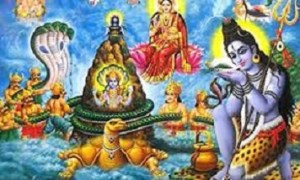
    • The heart, full of purity and poise (Satwa) is the Ocean of milk.
    • Steady contemplation of the Divine, either as i) your own reality or ii) as ideal to be reached, is Mandara mountain,
    • placed in it as a churning rod Vasuki, the serpent wound round the churning rod as a rope,
      • is the group of senses,
      • emitting poisonous fumes
      • during the process of churning and
      • nearly frightening the asuras (demons) who held the head.
    • The rope is
      • held by good and bad impulses and
      • both struggle with the churning process,
      • eager for the results, which each has set the heart on!
    • Grace of God is the
      • Tortoise incarnation,
      • for the Lord Himself comes to the rescue
    • once
      • HE knows that you are earnestly seeking the secret of Immortality!
      • He comes,
        • silently and
        • unobserved,
        • as the tortoise did,
        • holding the reflection (manana) process
        • unimpaired and
        • serving as the steady base of all spiritual practices!
    • Many things emerge from the mind, when churned,
      • but the wise wait patiently
      • for the appearance of the guarantor of immortality, and
      • seize upon it with avidity!
    • That is the lesson of the legend. It is a summary of Atma-vidya!

    – Puttaparti Satya Sai Baba in the Divine Discourse on Jan 13, 1965

  • You are God, you are mighty and opulent

    You are God, you are mighty and opulent

    Shishya (disciple) like the Sad-guru is really embodiment of Jnana.

    The difference between the two lies in the attitude, high realization, marvellous super-human Sattva (beingness) and unrivalled capacity and Aishwarya Yoga (divine powers).

    The Sad-guru is Nirguna, Sat-Chit-Ananda. He has indeed taken human form to elevate mankind and raise the world. But his real Nirguna nature is not destroyed thereby, even a bit. His beingness (or reality), divine power and widsom remain undiminished.

    The disciple also is in fact of the same swarupa. But, it is overlaid by the effect of the samaskaras of innumerable births in the shape of ignorance, which hides from his view that he is Shuddha Chaitanya (see B.G. Ch. V-15). As stated therein, he gets the impressions – “Iam Jiva, a creature, humble and poor.”

    The Guru has to root out these offshoots of ignorance and has to give upadesh or instruction.

    To the disciple, held spell- bound for endless generations by the ideas of his being a creature, humble and poor, the Guru imparts in hundreds of births the teaching – “You are God, you are mighty and opulent.” Then, he realizes a bit that he is God really.

    The perpetual delusion under which the disciple is labouring, that he is the body, that he is a creature (jiva) or ego, that God (Paramatma) and the world are different from him, is an error inherited from innumerable past births. From actions based on it, he has derived his joy, sorrows and mixtures of both.

    To remove this delusion, this error, this root ignorance, he must start the inquiry.

    How did the ignorance arise? Where is it? And to show him this, is called the Guru’s upadesh.

    SSSC-Ch 29

  • During 72 generations that you were with me.

    During 72 generations that you were with me.

    A woman from Sholapur tried for 27 years to have a child, making prayers to various gods in vain. In her final effort, she and her stepson went to Shirdi and stayed for two months, serving Baba.

    Whenever she visited the Masjid, it was crowded, and Baba was always surrounded by people. She wanted to express her feelings, but couldn’t find the right moment to pray to Him for a child. In the end, she asked Shama to speak to Baba for her when He was alone.

    Shama told her Baba’s Darbar was open, still he would try for her, hoping the Lord would bless her. ‘She should be ready with a coconut and joss sticks when Baba had His meals. She should also come to Him, when he called’.

    One day, after dinner, Shama was wiping Baba’s wet hands with cloth, when Baba playfully pinched his cheek. Pretending to be upset, Shama said, “Deva, is it right to pinch me? We don’t want a mischievous God. Are we Your dependents; is this fruit of intimacy?”

    Baba replied, “Oh Shama, during 72 generations that you were with me, I never pinched you until now. Now you resent my touch.”

    Shama: “We want a God who always love us and give food; we don’t want reward or heaven. Let our faith unto your feet be awake.” Baba: “Yes, I have come for that. I care for you and love you.”

    Then Baba sat down, and Shama signaled to a lady who offered a coconut and joss sticks. Baba shook the dry coconut, and the kernel made noise. He said, “Shama, look how it’s rolling, what does it mean?” Shama replied, “The woman hopes to have a child that rolls and grows in her womb. Please bless her.”

    Baba questioned, “Will the coconut give her a child? People are foolish to believe such things!” Shama insisted, “Your blessing will bring her children. You are just wrangling and not giving a real blessing.” They continued to discuss.

    Baba wanted to break the coconut, but Shama suggested gifting it to the lady instead. Then Baba agreed, saying, “She will have a child in 12 months.” The coconut was split in two. One half was eaten by Baba and Shama. The other half was given to the lady.

    Shama alias Madhav looked at the woman and said, “You will be my witness. If you don’t have a child in a year, I will break a coconut on Deva’s head. If I fail, I won’t call myself Madhav anymore.”

    A year later, she had a son, taken to Baba at five months. The grateful father, Mr. Aurangabadkar, donated Rs.500, which was spent to build a shed for Baba’s home, “Shyamakarna.”

  • Last thought, man has at death-hour, determines his future

    Last thought, man has at death-hour, determines his future

    The last wish or thought that a man has at the hour of death, determines his future course.

    Shri Krishna has said in Gita (VIII-5-6) that “he who remembers Me in his last moments, comes verily to Me, and he who meditates otherwise at that time, goes to what he looks for.”

    We cannot be certain that we can entertain a particular good thought at our last moment, for, more often than not, we are more likely to be frightened and terrif ied by death.

    Hence constant practice is necessary, for enabling us to fix our mind on any desired good thought at any moment.

    All Saints, therefore, recommend us to always remember God and chant His name always, so that we may not be puzzled when the time for departure comes.

    The devotees on their part surrender themselves completely to the Saints, fully believing that the all-knowing Saints (Sai Baba) would guide and help them in their last moments.