

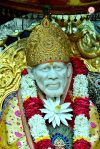





Emerson has stated that the human and divine are not separate, but rather various grades of one continuous series. When qualities arrive at a certain stage and are of a certain sort, people declare, This is divine’, for they are far above the average human.
Whether the superiority is in respect of power or of kindness or other qualities, the words are uttered at once, ‘These are divine qualities’.
Yet it is a human person that exhibits those qualities. We are not at present concerned with the intricacies of Christian theology, and we are at liberty to take Jesus Christ as a human person and point out the divine qualities in him. Tennyson wrote of him in the opening lines of ‘In Memoriam’, ‘Thou seemest human and divine’, and many readers would certainly note the human features of Jesus Christ as beaming out of the gospel, touched not infrequently with the divine features.
Similarly those who came in contact with Sai Baba have come in contact with his human peculiarities and the divine peculiarities mixed up so very closely that the two seem to be inseparable.
So, ‘Thou seemest human and divine’ may be applied to Sai Baba as well as to Jesus Christ. We may note in passing that this combination, far from being an undesirable mixture, is a necessary one.
If some being existed with all divine perfections only, human beings would not be able to approach or appreciate him. It is the fact that this Satpurusha has his human body, human touches, and human limitations that make us feel that he is also a human being, and we draw inferences about his inner nature from knowledge of our own nature and that of our fellow beings;
we have the confidence that we have understood the nature and qualities of the Satpurusha to some extent at least, and, we, are, therefore, emboldened in approaching and dealing with such a Satpurusha.
Unless there were such human features and limitations, this personality would be of no use to us. That is why, avatars are described in the Hindu scriptures as promoting human welfare. They combine human and divine features.
Especially in the case of Sri Rama, the seventh Avatar, the human features come out constantly, and yet are supported by the divine features so as to enable the Rama personality to be of great service to us, spiritual and temporal. Rama dhyana, Rama smarana, and Rama Lila, in general are found very useful for spiritual and temporal purposes alike on account of the human element in Rama.
Similarly in Sai Baba, who is often termed Sai Rama, (partly because Ram Navami was chosen by Baba to be the day for his Urus— annual festival—to be celebrated at Shirdi and partly because he showed himself as Rama) his human elements and divine elements are both mixed up so finely as to help to understand him and approach him.
It is common knowledge that any one who pins his faith to Baba , regardless of creeds or castes , and appeals to him, gets remarkable relief, and, therefore, feels convinced that this Sai, whatever he might have been by birth, parentage, or training, in his corporal life, is now nothing but God, that is, the dispenser of desired things to those who want them and make the proper approach. So Baba is the Godman to all Sai devotees .
While unifying on that basis , he is the granter to millions of individual devotees of all their cherished or most ardently longed for objects .





Baba inspires New Seekers. See How
New seekers can find immense inspiration in the accounts of Sai Baba for several reasons, primarily stemming from His divine characteristics, accessible teachings, and the profound impact He had on His devotees:
Keep readingSomething went wrong. Please refresh the page and/or try again.
 Welcome to https://ShirdiSaiBaba.InterNational