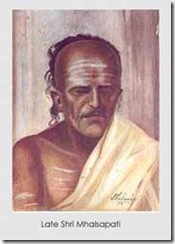
Mahlsapathy is the First & top most person in Sai Baba’s Court-Member of King’s Dharbar, and one among the VIBGYOR* member of Baba’s Dharbar.
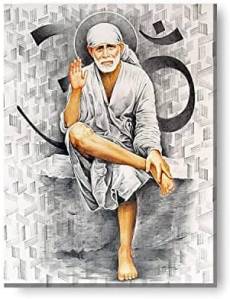
Sai Baba stayed at one Chandbhai’s [headman of Dhoopkheda village] home for some days. The nephew of Chandbhai’s wife got betrothed to a girl from Shirdi. So, Baba came to Shirdi in that wedding procession, in 1872.
The marriage party had alighted at the pounding grounds, near Khandoba’s (incarnation of Shiva) temple, outside the village. When Baba went to the Khandoba temple, He met Mhalsapaty there.
This Mhalsapaty was a resident of Shirdi and a goldsmith. As he was a devotee of Khandoba, and regular visitor of Khanderaya (Deity of Jejuri, who is also Khandoba), since many generations. As soon as Mhalsapaty saw Him, he welcomed Him with the words: “Welcome Sai”. Then, all the devotees of Sai Baba called Him “Sai Baba or Sai or Baba”.
Mhalsapati brought Sai Baba into the village and introduced Him to his friends Kashiram Shimpi and Appa Jagale. These three usually served, according to their capacity, the sadhus, saints , fakirs and ascetics visiting the village, and graciously took care of them.
Baba was an absolute “Vairagya Purusha” and never cared for wealth or women. Mahlsapalhy, being himself highly detached i.e. of a vairagya temperament and not being overned by lust or other low urges, could easily appreciate Baba, from the very beginning was drawn to Baba;
when other people began to worship Baba, only when they saw Baba’s psychic powers e. g. when he turned water into oil to feed his lamps, and then they regarded him as God.
An important event in Mahlsapathy’s life that was- “Baba’s trying to leave his body about 1886 and returning to it three days later”.
Baba had made him the guardian of his body and told him, “Arre Bhagat, look after this body for three days. I am going to Allah. If I do not return, then get it buried in due course at that place, (that is, near the sacred gode neem tree).”
Mahlsapathy supported Baba’s body on his own knee, and when officers, including the village headman karnam, etc., held an inquest over the body, declared it dead, and wanted it to be buried. Mahlsapathy with the help of others stoutly opposed their proposal, and saved Baba from losing his body.
Thus, he rendered a valuable service in 1886, after which Baba lived for 32 years to create this huge Sai movement that has covered this World.
If Mahlsapathy had failed in his duty, and Baba had been buried, perhaps the course of history might have been different.
‘Whatever a person thinks of at the time of death he reaches’. When Mahlsapathy’s death was approaching, he retained full-consciousness and control of his mind.
That was on 11th Sep 1922, Monday (in the month of Badrapada, Ekadasi Somavara, sacred to Shiva and Khandoba), having finished all his puja, he said to his family, ‘To-day is my father’s Shraddha day. Finish cooking soon. To-day, I close my earthly life and go to Heaven’.
So, a Brahmin came and finished the Sraddha at once; and finished the gift of balis to crows, cows, etc, and guests were fed. Then the family meals were finished.
Mahlsapathy took betel and nuts after his meal. After chewing a bit, he put on a kupni. Having near him, Bala Gurav, Ramachandra Kothe, etc., he told them all to do Ramachandrajapa Japa.
Muhlsapaty said to his son that ‘Spend time piously in Uttama Bhakti Marga i.e. in holy devotion. All that I told you will happen.” Then Mahlsapathy uttered the word ‘Ram’ and breathed his last.
Thus he passed away in calm, faith and cheerfulness, on the 11th September 1922. This death was a fitting termination to a pure, lofty and dedicated life—a life of Love, faith and total surrender.
His remains are interred in a tomb at Shirdi, which is still worshipped by many.
* 1. Mahlsapathy 2. Narayan Govind Chandorkar 3. Das Ganu Maharaj 4. H.S. Dixit, 5. Hemadpant 6. Sri Upasani Baba and 7. G.S. Khaparde.


 Welcome to https://ShirdiSaiBaba.InterNational