- “I always think of him who remembers Me.
- I require no conveyance, carriage, cart, nor train nor aeroplane.
- I run and manifest myself to him who lovingly calls me.
Baba in SSSC-Ch 40

Welcome to https://ShirdiSaiBaba.InterNational

"I draw to Me, My man from far off or even across the seven Seas to Shirdi, like a sparrow with a string fastened to its feet"-Shirdi Sai Baba, Indian Spiritual Guru-God

Baba in SSSC-Ch 40
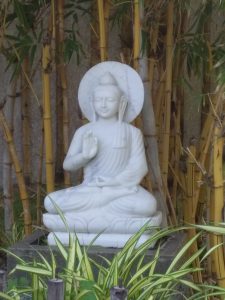
Shishya (disciple) like the Sad-guru is really embodiment of Jnana.
The difference between the two lies in the attitude, high realization, marvellous super-human Sattva (beingness) and unrivalled capacity and Aishwarya Yoga (divine powers).
The Sad-guru is Nirguna, Sat-Chit-Ananda. He has indeed taken human form to elevate mankind and raise the world. But his real Nirguna nature is not destroyed thereby, even a bit. His beingness (or reality), divine power and widsom remain undiminished.
The disciple also is in fact of the same swarupa. But, it is overlaid by the effect of the samaskaras of innumerable births in the shape of ignorance, which hides from his view that he is Shuddha Chaitanya (see B.G. Ch. V-15). As stated therein, he gets the impressions – “Iam Jiva, a creature, humble and poor.”
The Guru has to root out these offshoots of ignorance and has to give upadesh or instruction.
To the disciple, held spell- bound for endless generations by the ideas of his being a creature, humble and poor, the Guru imparts in hundreds of births the teaching – “You are God, you are mighty and opulent.” Then, he realizes a bit that he is God really.
The perpetual delusion under which the disciple is labouring, that he is the body, that he is a creature (jiva) or ego, that God (Paramatma) and the world are different from him, is an error inherited from innumerable past births. From actions based on it, he has derived his joy, sorrows and mixtures of both.
To remove this delusion, this error, this root ignorance, he must start the inquiry.
How did the ignorance arise? Where is it? And to show him this, is called the Guru’s upadesh.
SSSC-Ch 29
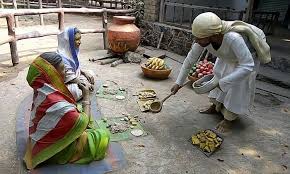
Let us see how Baba prepared food and distributed it.
Baba required very little food for Himself and what little He wanted, was obtained by begging from a few houses.
But when He took it into His mind to distribute food to all, He made all preparations from beginning to end, Himself.
He depended on nobody and troubled none in this matter. First He went to the bazar and bought all the things, corn, flour, spices etc., for cash. He did also the grinding.
In the open courtyard of the Masjid, He arranged a big hearth and after lighting a fire underneath kept a Handi over it with a proper measure of water…
Sometimes He cooked ‘Mitthe Chaval’ (sweet rice), and at other times ‘pulava’ with meat. At times in the boiling varan (soup), He let in small balls of thick or flat breads of wheat flour. He pounded the spices on a stone-slab, and put the thin pulverized spices into the cooking-pot. He took all the pains to make the dishes very palatable.
He prepared ‘Ambil’ by boiling jawari-flour in water and mixing it with butter-milk. With the food He distributed this Ambil to all alike.
To see whether the food was properly cooked or not, Baba rolled up the sleeve of His Kafni. He put His bare arm in the boiling cauldron without the least fear. He churned (moved) the whole mass from side to side and up and down. There was no mark of burn on His arm, nor fear on His face.
When the cooking was over, Baba got the pots in the Majid, and had them duly consecrated by the moulvi.
First He sent part of the food as prasad to Mhalasapati and Tatya Patil. Then, He served the remaining contents with His own hand to all the poor and helpless people. They ate to their hearts’ content.
Really blessed and fortunate must be those people who got food prepared by Baba and served by Him.

“If I take one rupee as Dakshina from anybody I have to return it tenfold to him.
I never take anything gratis. I never ask any one indiscriminately.
I only ask and take from him whom the Fakir (My Guru) points out. If any one is indebted formerly to the Fakir money is received from him.
The donor gives, i.e. sows his seeds, only to reap a rich harvest in future.
Wealth should be the means to work out Dharma. If it is used for personal enjoyment, it is wasted.
Unless you have given it before, you do not get it now. So the best way to get is to give.
The giving of Dakshina advances Vairagya (Non-attachment) and thereby Bhakti and Jnana. Give one and get tenfold”.
Sai Baba in SSS- Ch31

The last wish or thought that a man has at the hour of death, determines his future course.
Shri Krishna has said in Gita (VIII-5-6) that “he who remembers Me in his last moments, comes verily to Me, and he who meditates otherwise at that time, goes to what he looks for.”
We cannot be certain that we can entertain a particular good thought at our last moment, for, more often than not, we are more likely to be frightened and terrif ied by death.
Hence constant practice is necessary, for enabling us to fix our mind on any desired good thought at any moment.
All Saints, therefore, recommend us to always remember God and chant His name always, so that we may not be puzzled when the time for departure comes.
The devotees on their part surrender themselves completely to the Saints, fully believing that the all-knowing Saints (Sai Baba) would guide and help them in their last moments.

Give up the notions of one’s own doership, man must regard God alone as the doer.
He is the giver, He is the recipient and He is also the object that is given.
Time is the very form of God. Birth and death are encompassed by Time. Everyone, therefore, should regard Time as Divine and utilise it for performing sacred actions.
You should not waste a single moment. Time wasted is life wasted.
The fruits of your actions are determined by Time. All your experiences are the results of your actions, whether it is happiness or sorrow, affluence or poverty. Hence, good and bad depend on what you do. As are your actions, so are the fruits thereof.
The way you utilise your time determines the outcome.
Hence, this new year, which is a form of the Divine, should be put to right use.
– Puttaparti Satya Sai Baba in the Divine Discourse on Jan 01, 1991

Mere appearance of worldly joy is not true happiness. The worldly man is forcibly drawn to it, as he believes it to be true happiness.
According to the Prarabdha (accumulated karma) of each, one gets delicacies (Panchamrita): one, stale crumbs, and one, mere bran-gruel; The latter fancy themselves unhappy at that, and the former fancies he lacks nothing. But the result of eating any of these is merely the satisfaction of hunger.
Some cover themselves with laced shawls, others with barks. Both serve only one purpose, covering the body.
This joy and this sorrow is due to opinion, which is mere illusion and is ruinous.
Whenever any idea of joy or sorrow arises in your mind, resist it. Do not give room to it. It is pure delusion.
The ‘Shadripus’ -six enemies (Lust, Anger, Covetousness, Delusion, Pride and Jealousy) are all misleading Illusion; they make the unreal appear as real.
If a rich man wears a gold ornament, the poor man gets jealous, and thinks he must have one. This is Lobha.
All are like this. So one must conquer the six enemies. If they are conquered, waves of passion will not arise. Else they will enslave you.
If they are subordinated and reason made the commandant, then the delusive pressures and pains will no longer hold sway over you.

Baba in SSSC-Ch 22

 Welcome to https://ShirdiSaiBaba.InterNational