"I draw to Me, My man from far off or even across the seven Seas to Shirdi, like a sparrow with a string fastened to its feet"-Shirdi Sai Baba, Indian Spiritual Guru-God
Baba loved Chandrabhan shet Marwadi of Rahata. After the demise of the Shet, Baba loved his nephew Khushalchand equally or even perhaps more, and watched his welfare, day and night.
Sometimes in a bullock cart, at other times in a tanga with intimate friends, Baba went to Rahata. People of that village came out, with band and music, and received Baba at the Ves or gate of the village and prostrated before Him. Then He was taken into the village with great pomp and ceremony.
Khushalchand took Baba to his house, seated Him on a comfortable seat and gave Him a good lunch. Then they talked freely and merrily for some time, after which Baba returned to Shirdi, giving delight and blessing to all.
Shirdi is midway between and equidistant from Rahata on one side (south) and Nimgaon on the other (north). Baba never went beyond these places during His life time. He never saw any railway train nor travelled by it.
Still, He knew exactly the timing of arrival and departure of all trains. Devotees who acted according to Baba’s instructions (re : their departure)which were given by him at the time of taking His leave fared well, while those who disregarded them suffered many a mishap and accident
Mr. Nanasaheb Chandorkar, who was a great devotee of Baba, was Mamlatdar at Nandurbar in Khandesh. He got an order of transfer to Pandharpur. His devotion to Sai Baba bore fruit, as he got an order to go and stay at Pandharpur which is regarded as the ‘BHUVAIKUNTHA’ – Heaven on earth.
Nanasaheb had to take immediate charge, so he left, immediately, for the place, without even writing or informing anybody at Shirdi. He wanted to give a surprise visit to Shirdi – his Pandharpur, see and salute his Vithoba (Baba), and then proceed.
Nobody dreamt of Nanasaheb’s departure for Shirdi, but Sai Baba knew all about this, as His eyes were everywhere (omniscient). As soon as Nanasaheb approached Neemgaon, a few miles from Shirdi, there was stir in the Masjid at Shirdi.
Baba was sitting and talking with Mhalsapati, Appa Shinde and Kashiram, when He at once said, “Let us all four do some Bhajan, the doors of Pandhari are open, let us merrily sing.” Then they began to sing in chorus, the burden of the song being “I have to go to Pandharpur and I have to stay on there, for it is the house of my Lord.”
Baba sang and the devotees followed Him. In a short time Nanasaheb came there with his family, prostrated before Baba and requested Him to accompany them to Pandharpur and stay with them there. This solicitation was not necessary, as the devotees told Nanasaheb that Baba was already in the mood of going to Pandharpur and staying there.
Hearing this Nanasaheb was moved and fell at Baba’s Feet. Then getting Baba’s permission, Udi (sacred ashes) and Blessings, Nanasaheb left for Pandharpur.
Govind Raghunath Dabolkar, called Anna Saheb Dabolkar, was Mamlatdar and first class resident Magistrate.
His work ‘Sai Satcharitra’ in Marathi Ovi verse extends to a thousand pages. Maharashtra Sai bhaktas treat it as Sai Ramayana or modern Guru Charitra. They give it the respect due to ancient puranas. Even others respect it when they gain access through N.V. Gunjaji’s English adaptation or translations in Telugu, etc.
This work is highly meritorious and has been the instrument for many people becoming Sai bhaktas. The verses are highly sonorous. The stories about Sai Baba collected from various individuals are based on actual experiences. These stories have great charm and are always fresh.
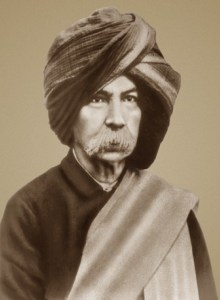
On his first visit to Shirdi and Sai Baba in 1910, went to the mosque. He and his friend Bala Saheb Bhate prostrated before Baba. Baba pointed to Dabolkar and said, ‘What talk was going on there at the wada? And what did this Hemad Pant say (pointing his chin to Dabolkar)?’. Dabolkar’s name was not Hemad Pant at all.
Hemadpant-“I began to think why Sai Baba should call me by the name Hemadpant. This word is a corrupt form of Hemadripant.
This Hemadripant was a wellknown Minister of the kings Mahadev and Ramadev of Devgiri of the Yadav dynasty. He was very learned and good-natured. He authored good works, such as Chaturvarga Chintamani (dealing with spiritual subjects) and Rajprashasti. He invented and started new methods of accounts and was the originator of the Ovi (Marathi Shorthand) script.
But I was quite the opposite, an ignoramus, and have dull, mediocre intellect. I could not understand why the name or title was conferred upon me. However, after thinking seriously about it, I thought that the title was a dart to destroy my ego. This way, I should always remain meek and humble. It was also a compliment paid to me for the cleverness in the discussion#. (# before he started from Wada/Lodge to Sai Temple, he had some hot discussion with Bala Saheb Bhate about”Guru’s essential ” for 30 minutes)”.
Looking to the future history, we think that Baba’s word (calling Mr. Dabholkar by the name Hemadpant) was significant and prophetic, as we find that he looked after the management of Sai Sansthan very intelligently, kept nicely all the accounts and helped greatly in the publications of ‘Sai Lila Masik (Magazine)’ also as the author of such a good work “Shri Sai Satcharita (SSSC)”, which deals with such important and spiritual subjects as Jnana, Bhakti and dispassion, self-surrender and self-realization.
One day at noon, Baba came near Radha-Krishna-Mai’s house and said – “Bring Me a ladder.” Some men brought it and set it against a house as directed by Baba.
He climbed up on the roof of Vaman Gondkar’s house, passed the roof of Radha-Krishna-Mai’s house and then got down from the other corner.
What object Baba had, none could know. Radha-Krishna-Mai was, at that time, shivering with Malaria. It may be to drive off that fever, that He may have gone there.
Immediately after getting down, Baba paid Rupees two to the persons who brought the ladder. Somebody asked Baba, why he paid so much for this.
He replied that nobody should take the labour of others, in vain. The worker should be paid, his dues promptly and liberally.
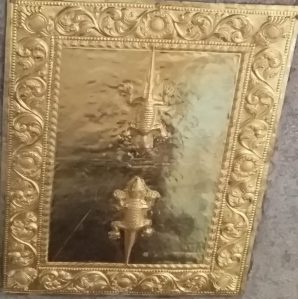
Once Baba was sitting in the Masjid. A devotee sat in front of Him, when a lizard tick-ticked. Out of curiosity, the devotee asked Baba whether this tick-ticking of the lizard signified anything; was it a good sign or a bad omen?
Baba said that the lizard was overjoyed as her sister from Aurangabad was coming to see her. The devotee sat silent, not making out the meaning of Baba’s words.
Immediately, a gentleman from Aurangabad came on horse-back to see Baba. He wanted to proceed further, but his horse would not go, as it was hungry and wanted grams.
He took out a bag from his shoulders to bring grams and dashed it on the ground to remove dirt. A lizard came out therefrom and in the presence of all, climbed up the wall.
Baba asked the questioner devotee to watch her, well. She at once went strutting to her sister. Both sisters met each other after a long time, kissed and embraced each other, whirled round and danced with love!
Where is Shirdi and where is Aurangabad? How should the man on horse-back come there from Aurangabad with the lizard? And how should Baba make the prophesy of the meeting of the two sisters? All this is really very wonderful and proves the omniscience — the all-knowing nature of Baba.
Woman and wealth are the two main obstacles in the way of our Pramartha (spiritual life); and Baba and provided in Shirdi two institutions, viz., Dakshina and Radha- Krishna-Mai. Whenever they came to Him, He demanded Dakshina from them, and asked them to go to the ‘SCHOOL’ (Radha-Krishna-Mai’s house). If they stood these two tests well, i.e. if they showed that they were free from attachment for woman and wealth, their progress in spirituality was rapid and assured by Baba’s grace and blessings.




 Welcome to https://ShirdiSaiBaba.InterNational