

- 💞I remember Sai Baba with love, for this is the easiest of Sadhanas, solving the riddle of life and death.
- 🚣I easily cross over the sea of all my pains and sorrows, by making Sai Baba my Helmsman.
- 🧑🤝🧑I strive for national unity, knowing that Rama (Hindu God) and Rahim (Muslim God) are one and the same .
- 😲I don’t retaliate but will strive to do some good, even if anyone does evil unto me.
- 📿I always remember and chant “Sai” “Sai,”; and all my shackles will be removed .
- 📖I find strength in the stories of the Saints; they remove all fear of Samsar (worldly existence).
- 🌐I attend to my worldly duties but give my mind to Sai and His stories .
Category: Publications
Media, Books, Magazines on Sai Baba
-
Self-Affirmation from Chapter X of SSSC for Sai Baba devotees
-

Self-Affirmation from Chapter IX of SSSC for Sai Baba devotees
- 🖕I follow Sai Baba’s orders and suggestions at the time of taking leave, knowing that obedience ensures safety and happiness .
- 🧑🧒I recognize that Sai Baba’s mendicancy teaches householders the sacred duty of atoning for their daily sins, by providing Alms .
- 🎭I understand that Sai Baba knows my mind completely, and nothing is veiled from Him .
- 🥁I perform my worship with sincere intent, ensuring it is not merely a ‘formal drill’ .
- 🧜I abandon the sense of duality and distinction and serve Sai Baba, who is roaming in the forms of all creatures
- 🐕I am heartily contented by acting on compassion like giving food to the hungry creature (even dog ), before eating myself .
-

Self-Affirmation from Chapter VIII of SSSC for Sai Baba devotees
- 🧍I got lucky a human body, which is essential for attaining God-vision.
- 🧘I use my body to achieve God-vision or self-realization, the supreme end of life, without neglecting or pampering it .
- 🏃I strive with all earnestness and speed to attain my end-goal, casting aside sloth and laziness .
- ☀️My mind is filled with bliss and joy in the company of the Saint (Sai Baba)
- 👁️I accept the moral to “See God in all beings,” so I always feed the hungry, first.
- 🛐I consistently remember the service and penance (Upasana) I practice, which benefits me greatly.
- 📿I believe Sai Baba is a liberal and charitable Fakir, always engrossed in the Self .
- 🧚I trust that Sai Baba will make me happy in this world and the next .
-

Self-Affirmation from Chapter VII of SSSC for Sai Baba devotees
- 🧎I am grateful for the moments I have experienced by sitting at Sai Baba’s feet; the joy and delight I embrace are truly incomparable.
- 🩺I am healthy, and my connection with Sai Baba empowers my well-being.
- 🪶I surrender myself completely to God Sai Baba, by getting rid of my egoism and body consciousness.
- 🔥I trust that Sai Baba, the perfect Siddha, is always working for the good and welfare of others, even suffering pain Himself.
- 🌿I look to faith and devotion (represented by Bhagoji Shinde’s service) as the true Upasana (worship).
- 🚀I trust solicitation is not necessary since Sai Baba, the omnipresent, is always ready to stay with us.
-

Self-Affirmation from Chapter VI of SSSC for Sai Baba devotees
- ❇️I embrace the wonderful power of the Guru’s touch, which destroys the sins of my past births and cleanses my subtle body.
- 🦶I touch Sai Baba’s hand and feet, and awaken my ‘I am He (Brahman)’ consciousness, manifesting the joy of self-realization.
- 🧎I prostrate before Sai and surrender heart and soul. As a result, the four chief objects of life (Dharma -Righteousness, Artha -Wealth, Kama -Desire, Moksha -Deliverance) are easily attained.
- 🚶I walk the difficult path of Bhakti straight by relying on my Sadguru.
- 🍞I am surrounded by an abundance of food and clothing in my home.
- 🧏I fix the form of the Sai firmly in my mind, so that it doesn’t wander.
- 😌I fix my mind on remembering Sai always, so that it is calm, peaceful, and carefree.
-

Self-Affirmation from Chapter V of SSSC for Sai Baba devotees
- 🪄I believe Sai Baba fully. HE just dashed the Sanka (small stick) on the ground to get water; then thrust the prong into the ground to get a live ember.
- 🌌I always utter Allah Malik (God is the sole owner).
- 🪔I am unperturbed even in scarcity, because Sai Baba can perform the miracle of turning water into oil.
- 🧿I surrender my ego completely and accept Sai Baba’s authority, knowing that He leads me to the highest end “self-realization”.
- 🙏I am meek and humble as Sai Baba, a Siddha (one with powers) acts like a Sadhaka (aspirant).
- 🦶I believe that Padukas (footprints) under the Shirdi Temple Neem tree grant blessings and are the feet of the Sai Baba’s Guru.
- ⛱️My resting place is Shirdi; I go there and offer my worship to Sai.
-

Self-Affirmation from Chapter IV of SSSC for Sai Baba devotees
- ✨I conquer this Samsara (worldly existence) by following Sai Baba, who is the repository of wisdom and peace.
- 🛕I have been drawn to Shirdi by Sai Baba, because HE remembers my family/merit and desires my spiritual welfare.
- 🔱I trust that Sai Baba is Pandharinath Vithal (God) incarnate, the merciful Lord of the poor and helpless.
- 🛕Pandhari and Dwarka, I seek are here with Sai Baba; Shirdi is my sacred place.
- 🛐As I am earnest and devout with Love, Vithal (God) will manifest Himself.
- 💞I catch the vision of God firmly, as HE will escape if I am a little inattentive.
- 🏊Placing my head on Sai Baba’s Feet in Shirdi is equal to bathing in the holy Tirth of Prayag, and all my desires are destroyed.
-

Self-Affirmation from Chapter II of SSSC for Sai Baba devotees
🌸 Daily Affirmation Flow
- Morning Invocation 🌞“My heart feels faith in Sai Baba’s stories and teachings, leading me to Bliss.” → Begin the day by reading or listening to Sai Baba’s leelas.
- Work & Service 🔧“I am only an outward instrument; my work is accomplished by HIS grace.” → Remind yourself that every task is service.
- Ego Surrender 🧎“I will surrender my ego completely at Sai Baba’s feet.” → Pause before decisions, offering them inwardly to Baba.
- Transformation 🤞“My thoughts are changed, past karmic force abated, and non-attachment grows upon seeing Sai Baba.” → Reflect on detachment during challenges.
- Grace Received 🧚“I have received Sai Baba’s divine presence and glance, by the merit of past births.” → Acknowledge gratitude for spiritual progress.
- Renewal 🚵“I begin a new lease of life, the moment I touch Sai Baba’s feet.” → Use this as a mantra when starting new ventures.
- Recognition of Divinity 👑“I recognize Sai Baba as omniscient and the Inner Ruler of all.” → Close the day with surrender to Baba’s universal presence.
-

Self-Affirmation from Chapter I of SSSC for Sai Baba devotees
💡 Suggestions for using this Affirmation/Chart:
- Day 1 (Margazhi 1, period suitable for meditation. And Pray God Vishnu for Eternity and Mahalaxmi for Wealth, in India)
- Serve as a Daily Meditation Tool.
- It is a visual reminder of your spiritual journey.
- This makes it easy to reflect on one Chapter at a time, from Sai SatCharitra (SSSC)
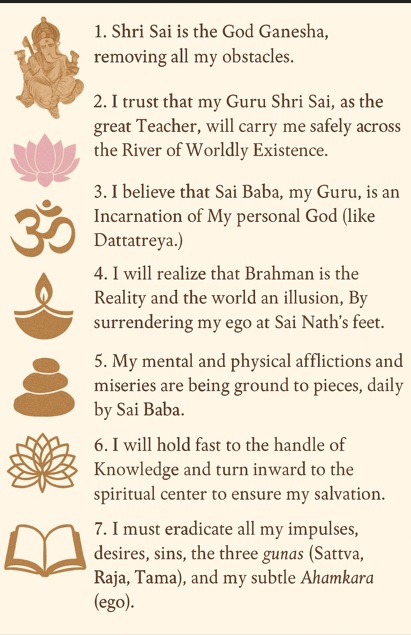
-

🌸 Daily Self- Affirmations for Shirdi Sai Baba Devotees’ Journey into 2026.
Dear New Seeker / Sai Baba’s Devotee, by joining this sacred circle, you are stepping into 2026 Journey, guided by Shirdi Sai Baba’s timeless wisdom.
🕉️ What You Will Receive
- Affirmations inspired by Chapters of the Shri Sai Satcharitra (SSSC), carrying the fragrance of faith, surrender, and transformation
- Visual motifs and meditations to anchor your practice
🌺 Your First Companion: Download your free PDF BOOK on Shirdi SaiBaba’s spirituality: “ Glossary on the spirituality of Shirdi Sai Baba” — a spiritual BASIC guide to update your practice.
📖Example of Affirmations Rooted in Sai’s Teachings
- Chapter 2: “I recognize Sai Baba as omniscient and the Inner Ruler of all.”
- Chapter 10: “I will always remember and chant “Sai” “Sai,” and all my shackles will be removed.”
- Chapter 33: “I believe that Sai Baba’s help is most opportune, coming exactly when I need it most .”
💡 Suggestions for using these Affirmations / Chart:
- Morning practice: Read each affirmation aloud to set your intention for the day.
- Read before sleeping, at your heart, to calm your thoughts and peaceful dream.
- Meditation aid: Focus on one affirmation per session, allowing its meaning to deepen.
🙏 Let Indian Spiritual Gure-God, Sai Baba Guide You:-
- Let this be your year of transformation.
- Let each affirmation be a step toward self-realization.
- Let you visualize Sai Baba
- Let Sai Baba’s grace carry you across
The most compelling fact about adopting the first few affirmations, grounded in Chapters I, II, and III, is that “Shirdi Sai Baba physically lived during the time these chapters were written by Mr. Hemadpant”; following Sai Baba’s blessing for him to write Sai Baba’s biography.
 Welcome to https://ShirdiSaiBaba.InterNational