

Shirdi, Maharashtra: The Shri Saibaba Sansthan Trust has received a distinguished offering from a Dubai-based devotee, who has donated an intricately carved, gold‑plated frame for the northern window, inside the Shirdi Temple. This window is deeply revered by pilgrims as it provides the sacred Mukhashadarshan—a direct view of Shri Saibaba’s idol in the Samadhi Mandir.
The newly installed frame, crafted with detailed gold workmanship, has already become a point of admiration for thousands of devotees visiting the shrine each day. Its presence enhances both the devotional atmosphere and the architectural beauty of the Temple.
Ceremonial Installation
Before installation, the Sansthan performed a traditional vidhivat puja, marking the auspicious beginning of the offering. Following the ceremony:
– Official Felicitation: Sansthan Chief Executive Officer Goraksha Gadilkar formally honored the devotee for their generous contribution.
– Respecting Donor’s Wishes: In accordance with the donor’s request, the Sansthan has maintained complete confidentiality regarding their identity.
A Continuing Tradition of Devotion
The Shri Saibaba Sansthan Trust continues to welcome heartfelt acts of devotion from devotees across the world. Contributions such as this not only enrich the spiritual ambience of the Temple but also strengthen Shirdi’s role as a global center of faith and inspiration.
Category: Worship of Objects
-

Dubai Devotee Donates Gold‑Plated Frame to Shri Saibaba Sansthan
-
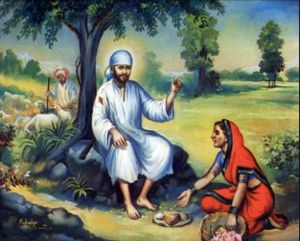
Various teachings and practices, prescribed by Baba
- Baba lovingly urged many to remember His name and to surrender to Him,
- Yet for those seeking to understand ‘who they truly were’ (the ‘Who am I’ enquiry), He gently recommended Shravanam (study) and Mananam (meditation).
- To some, He lovingly guided
- the remembrance of God’s name,
- to others, the joy of hearing HIS Leelas /Plays,
- to some, the sacred worship of His Feet,
- and to others, the reading and studying of the Adhyatma Ramayan, Jnaneshwari, and more sacred scriptures.
- Some He tenderly invited to sit near His Feet,
- while others He lovingly sent to Khandoba’s temple,
- He advised some
- to repetition the thousands of names of Vishnu,
- and others to engage in the study of the Chhandogya Upanishad and Geeta.
- To some, He offered His guidance directly in person, and to others, through the precious visions in their dreams.
- He lovingly explained certain Mantras, such as ‘Guru Brahma’, “Raja Ram’ in their dreams.
- To one devotee,
- who was earnestly practicing Hath-Yoga,
- HE conveyed a gentle message to leave those practices aside,
- to sit in quiet and embrace patience (Saburi).
- Truly, it is an immense task to describe all of His ways and methods, each filled with love and compassion.
-
Baba is a Liturgiology Scientist
Liturgiology is study the rituals and practices of religious worship, including understanding the structure, significance, and evolution of the ceremonies.
Baba is good at Liturgiology. One of the Example, on evaluation in the rituals and practices is given below:-
Early one morning, when Megha (Devotee) was still lying down on his bed, with eyes closed but internally awake, he saw clearly Baba’s Form.
- Baba knowing him to be awake threw Akshata (rice-grains marked red with Kumkum) and
- He said, “Megha, draw a Trident” and disappeared.
- Hearing Baba’s words, he eagerly opened his eyes, saw no Baba there, but saw only rice grains spread here and there.
He then went to Baba, told Him about the vision and asked permission to draw Trident.
- Baba said – “Did you not hear My words asking you to draw Trident? It was no vision, but direct order; My words are always pregnant with meaning and never hollow.”
- Megha said – “I thought you woke me up, but all the doors were closed, so I was doubtful and thought it was a vision”.
- Baba rejoined – “I require no door to enter. I have no form; I always live everywhere. As a wire-puller, I carry on all the actions of the man, who trusts Me and merges in Me.”
Megha returned to the Wada, and drew a red Trident on the wall near Baba’s picture. Next day a Ramadasi Bhakta came from Poona, saluted Baba and offered Him Pindi (an image of Shiva). At this time Megha also turned up there.
- Baba said to him – “See, Shankar has come, protect (i.e., worship) Him now.”
- Megha was pleasantly surprised to see Pindi, following Trident.
Also in the Wada, Kakasaheb Dixit (another devotee) was standing with a towel on his head after having taken his bath, and was remembering Sai, when he saw a Pindi in his mental vision. While he was wondering about this, Megha came and showed him the Pindi, presented to him by Baba. Dixit was happy to know that the Pindi exactly tallied with the One, he saw a few minutes before in his vision.
In a few days after the drawing of the Trident was completed, Baba installed the Pindi near the big picture, which Megha was worshipping. The worship of Shiva was dear to Megha and by arranging the drawing of the Trident and the installation of the Pindi, Baba confirmed his faith therein.
In SSSC Ch-28
-
WORSHIP III- Hindu Upanishads
According to higher systems of thought (In Hindu System) , every object in the Universe is a manifestation of God, and therefore might be or ought to be worshipped.
The Upanishads recommend the worship of the mother, the father, the teacher and the guest (particularly, at Lunch time in olden India; even now by few)
If any particular Guru happens to be possessed of noble virtues or of siddhis, superhuman or extraordinary powers, then he is worshipped more naturally and readily not only by the mass, but by the intelligentsia and the critics.
-

Praying the God- The Order under Hindu System
1–2 minutesAccording to the ancient and revered custom of Hindus, Pray deities in this order
- First, make obeisance to the God Ganesha to remove all obstacles and make the work a success
- Then, the Goddess Saraswati to inspire to write out or Do our work
- Then, the Gods ; Brahma, Vishnu and Siva – the Creating, Preserving and Destroying Deities respectively.
- Then, ones tutelary Deity- Family God
- Then, the Rishis , into whose gotra (clan) one was born & then other Rishis
- Then, one`s grandfather, father, mother
- Finally, Our Guru Sai Baba,
-Various Modes of devotion, prescribed by according to Parashara, Vyasa and Shandilya etc
SSSC -Ch 1
-
God Formless: then why Manifested
There are two aspects of God or Brahman : (1) the Unmanifested (Nirgun) and (2) the Manifested (Sagun).The Nirgun is formless, while the Sagun is with form, though both denote the same Brahman. Some prefer to worship the former, some the latter.
As stated in the Gita (chapter XII) the worship of the latter is easy and preferable. As man has got a form (body, senses, etc.), it is natural and easy for him to worship the God with form.
Our love and devotion do not develop unless we worship Sagun Brahman for a certain period of time, and as we advance; it leads us to the worship (meditation) of Nirgun Brahman.
So let us start with Sagun worship. Image, altar, fire, light, sun, water, Brahman are the seven objects of worship, but Sadguru is better than all these.
Let us, on this occasion, bring to our mind the form of Sai, Who was non-attachment Incarnate, and Who was a resting-place for His whole-hearted devotees.
SSSC ch 11
 Welcome to https://ShirdiSaiBaba.InterNational
