"I draw to Me, My man from far off or even across the seven Seas to Shirdi, like a sparrow with a string fastened to its feet"-Shirdi Sai Baba, Indian Spiritual Guru-God
Thanks SSS Trust, Shirdi
People from different Religious, Geographical, Economic, and Social backgrounds are brought together here. Their prayers are delivered and successfully resolved with the grace of the Indian spiritual SadGuru-God, Shirdi Sai Baba.
Believe that the Lord’s Name is the boat, which will take you across the sea of worldly life. The Name is more efficacious than the contemplation of the Form.
Draupadi did not send a chariot to bring Krishna to her rescue; she uttered the Name in agony and Krishna responded and saved her from imminent dishonour.
In the Treta yuga, in Ramayana, Nala and his monkeys were building a bridge over the sea to Lanka;
the boulders on which they inscribed the sacred name Rama, floated on the waters, but they found that the boulders floated away due to wind and waves. They did not form a continuous bridge for the army to pass over. Some ingenious person gave a suggestion to write ‘RA’ on one boulder and ‘MA’ on another and they found that the two stuck hard together.
The name will serve as a float for you too; it will keep you attached to God and bring on you His Grace!
– Puttaparti Satya Sai Baba in Divine Discourse on Oct 24, 1965
When you repeat the Name, all the sweetness of the Form and its associated glory must come to memory and, just as your mouth waters when you remember some sweet dish you relish, your mind must ‘water’ when you contemplate the Name.
Choose the Name that captivates your heart.
Why run after riches when all the pleasure and satisfaction that riches can offer – and even a hundred-fold more – can be got by dwelling on the Name?
The Lord has said that where His Name is sung, “There I am present”. He establishes Himself there! He will not move from that place.
So, the tongue is enough to win Him, when the tongue that speaks the language of the pure mind.
The Lord is a Wish-fulfilling Tree (Kalpavriksha). You must approach Him and develop attachment to Him.
You must win His grace and be ever near Him, keeping back all the forces that draw you away from Him.
– Divine Discourse by Puttaparti Sai on Apr 29, 1963.
Spirituality means destroying the animal nature in man and making him realise his divine consciousness.
Spirituality implies that one should not develop egoistic pride on account of the divine potencies in man but utilise them for achieving spiritual strength.
Spirituality calls for recognition of the manifold capacities manifesting in man as emanating from the Spirit and not from the mind. It means developing faith that all powers come from the Divine.
Spirituality does not mean proceeding from the human to the Divine. It seeks to unfold the divinity in man.
Spirituality does not mean passing from the mundane to the Divine. Spirituality means making man manifest the divinity in him.
People today have the wrong impression that spirituality is concerned with the journey from the mundane world to the higher realm and vice versa. Because of this mistaken view, students today are confused about spirituality and it appears meaningless to them.
Spirituality is the realisation of the role of the Spirit in daily life. It is a way of life.
– Divine Discourse by Puttaparti Satya Sai Baba, May 24, 1992
Earnest readers, who are anxious to study the history of Sai Baba (who realised in himself the perfection of Godhead by attaining Purnalaya)
–concentrating his mind always on God with intense love from his earliest period of life; and
–thereby attained Aikya (merge with God),
–so that he could say Mainm Allahum, that is Aham Brahmasm and
–could exhibit all the powers of God
Sai identified himself with Krishna and with every other form of God. As the object of everyone should be to please God in Sai form or in any other form, one may note how in point of historical fact, from this biography (LoSB), numbers of people were drawn to Sai Baba and achieved the love of Sai Baba, and thereby achieved every object of human existence.
The devout reader would like to have a further sketch of the nature and the works of devotion at this stage . So, we may refer to Sri Adi Sankaracharaya who, describes what Bhakti is as the
i) seeds of the or plant are re-grasped by the parent tree,
ii) parent magnetic block attracts needles one behind another,
iii) Chaste wife clasps her husband,
iv) tendril (creeper) clings to the adjoining tree and mounts upward and upward,
v) waters of the rivers are for ever drawn downward and downward, till they reach the ocean and get inextricably and indistinguishably lost in it,
similarly the heart of the devotee longs after the Divine feet of Pasupati, God Siva to be ever there. This is called Bhakti.
Each illustration takes bhakti one stage further up.
I. Ankolam– even vegetables is to get back to the original source and get reabsorbed in it. Similarly, we are parts/ sparks from God, must reach the original source of all creation, namely, God.
II. Magnetic stone -a string of even seven needles might be found attached one behind another to a big magnet. Similarly every growing bhakta tends to attract others and impart his devotion to them; and through them to others ad infinitum.
III. Chaste wife longs for her husband, and even his slightest absence for even a short period makes her full of unrest, (EVEN now, wife calling husband frequently and asking Where are you? When are you coming? etc.). Similarly The Bhagavata treats all devotees as females, Gopis, and the only male in the Universe is Krishna.
iv) The creeper– go further and further upward and upward till the top of the tree is reached, to get more light from the Sun, more of air and more of freedom and safety from animals. Similarly, devotee tends to mount up higher and higher in his spiritual levels to achieve nobler and nobler objects; and to transform himself into more and more of the like-ness of God, till he reaches full Sarupyam, Sameepyam and Sayujyam (Bliss)
v) Rivers – The waters of the rivers were originally part of the ocean, and after being held up in the form of water vapour, cloud and rain, they take the shape of a river. Similarly Purnalaya is the end of the devotion and that is obtained by the Jivas surrendering themselves, that is, making Atma-nivedana, which is the ninth mode mentioned in the Navavidha bhakti.
That is both devotion and also absorption. After that there is nothing further to reach. Thus the various stages, attitudes, and relations of a bhakta can be very well dwelt upon and learnt by studying the above illustrations and applying them to oneself.
Loving bhaktas/ Important Devotees:
The Names of a number of loving bhaktas; so that they may ever remain in one’s heart and show how bhakti achieves its ends. The end of bhakti is not achieved by the offer of money to God or by mere learning or by age or beauty of a person, God does not want any of these. “God wants only your heart, that is, your self”,
As ,
1. For the hunter Kannappa, what Achara or religious course of conduct had he?
2. For Dhruva, what was his age? (At the age of 5, God appeared before him. Also His name is given to Pole Star)
3. For the elephant Gajendra, what education or degrees and titles had he?
4. Had Vidura (favourite of Krishna) any qualification in respect of caste? He was the son of a slave dancing girl.
5. For the king of Yadavas called Ugrasena,who was favoured by Krishna what manliness had he? He was a great coward
6. For Kubja also was favoured by Krishna, had she any great beauty? She was deformed in person.
9. For Sudhama, known as Kuchela ( favoured by Krishna), had he any wealth?
God is pleased by bhakti/Devotion alone and bhakti can capture Him. This contains the essence of the doctrine of bhakti or devotion
Especially the nine modes of worship mentioned in the Bhagavata and stressed by Sri Sai Baba often have to be attended to and followed.
In setting out those nine forms, one can see how the external and internal are inextricably interwoven and combined and how one gradually progresses with lower and external forms till his inner kernel of devotion attains maturity and perfection.
The nine modes of Devotion are,
1) Sravana– Listening to accounts of the deeds of God, his Avataras and Saints.
2) Kirtana– reciting these or repeating God’s names and praise,
3) Smarana– constantly recalling these, especially uttering God’s names
4) Padasevanam– falling at the feet of God and Saints
5) Archana– formal worship, for example with flowers, water, food, scents and all the 16 upacharas etc
6) Vadana– prostration before God and the saints.
7) Dasya– Eg. service, doing every work for God or Saint.
8) Sakhya– remaining in the company of God or Saint and
9) Atma Nivedana-surrender of the self that is forgetting oneself entirely in the contemplation of God, after formally offering the self as a gift to God.
So far we have been dealing mainly with the externals of worship, and it is to be feared that some highly refined and sensitive souls might have been displeased there by.
These worthy persons wish to have the kernel, the very essence of the fruit of worship, without having to deal with any shell or bark, skin or other outer coverings.
If one do puja (offer flowers, water, food, scents; and praise to a person or an image of a divine being) and upasana, simultaneously using speech and thought; he utters words, mostly mantras and slokas and his mind turns to their meanings for most of the time.
Occasionally he may be merging himself in the object of worship mentally – attaining Poorna laya, or feeling perfect bliss and forgetting all ideas of his self being the actor.
The ordinary man has to remember that his gentle plant of devotion has to be grown; Bhajanas and other ceremonies must be followed for a long time before attaining full fruition of Bhakti.
To make the congregational worship more advanced and attractive, there was an enthusiastic set gathering at Shirdi.
One Ramakrishna Ayi, a young widow, being highly accomplished, was intent upon using all her gifts and cleverness for developing Sai Baba’s worship. She drew a large number of people to herself and made them more enthusiastic in the cause of Sai Worship
Ramakrishna Ayi introduced silver whisks, silver maces, silver umbrellas, silver candelabras, moons, and artificial gardens to deck the chavadi, where Baba was worshipped on alternate nights. A (ratha) car, a palanquin with silver appurtenances, a horse, and other regal paraphernalia were furnished on her insistence and the insistence of other devotees to make Baba worship run exactly like Vittal worship or the worship of great Acharyas in their mutts.
The next step was from individual worship to congregational worship. It was in 1908 that the change was started. Congregational worship implied that there would be some one to officiate as the pujari (Priest) and that he would be available at various periods of worship viz. Matins, vespers, night artis and noon artis etc.
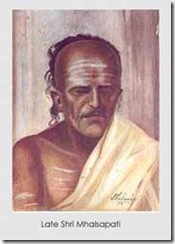
For this purpose, Hari Vinayak Sathe, a Settlement Officer, (who in 1905 was blessed by Baba, with the promise of a son in case he married, and who got married in consequence) sent up one Megha-shyam called Megha to Shirdi. So that he might officiate as the pujari and carry on congregational worship.
Megha usually went out five miles to fetch Godavari water for the daily worship, and three or four miles to fetch bel leaves which are said to be specially appropriate for Siva (=Sai, for Megha) worship (Eka Bilvam Sivarpanam that is one bel leaf even is sufficient offering to Siva). When the very orthodox Megha thus became an ardent devotee of Baba, others followed suit and joined in the congregational worship.
The benefits attending Baba-worship were quickly seen and hence Devotees from outside the Shirdi village, that is, from the immediate neighbourhood were drawn to the worship. This spread gradually from place to place and people from even remote parts were attracted to the worship.
Individual worship itself was first not systematic, nor organised. But K.G. Bhishma, a good Kirtankar and a great adherent of Vittal-worship at Pandharpur, drew up the ritual for Sai-Baba-worship on practically the same lines as the Pandharpur-worship.
He brought a set of artis that is ritualistic; verses for use by individuals at Shirdi, (and these were sent up by Baba to Nana Saheb Chandorkar at Jamnere) were approved of by HIM.