

- 🛐I meditate on Sai Baba’s Holy Feet, as they are the only means of my happiness and attaining the supreme goal of life .
- 🪔I am egoless and humble and meditate on Sai Baba Light (His toe & spread of index and middle figures on it) to attain devotion .
- 🏥I trust that the Dwarakamayi (Mosque) wards off all dangers and anxieties from those who sit on her lap and gets Bliss.
- 💆I trust Sai Baba prophecy, knowing that He anticipates my calamities and wards them off in time .
- 💃I believed that Sai Baba’s words are promises of fearlessness .
- 🐍I accepted the spiritual truth that God lives in all beings and creatures, even serpents or scorpions .
- 🥰I love and take pity on all creatures, leave off adventurous fights and killings, and be patient .
- 🤡I trust that unless God wills it, nobody can do any harm to others .
- ⛽I realized that Sai Baba, by His actions, shows Himself to be the Controller and All-pervading .
- 🚪I hold fast to Sai Baba, knowing that He has the capacity to save me from any danger .
Category: Baba and Creatures
See God in ALL
-

Self-Affirmation from Chapter XXII of SSSC for Sai Baba devotees
-

Self-Affirmation from Chapter VIII of SSSC for Sai Baba devotees
- 🧍I got lucky a human body, which is essential for attaining God-vision.
- 🧘I use my body to achieve God-vision or self-realization, the supreme end of life, without neglecting or pampering it .
- 🏃I strive with all earnestness and speed to attain my end-goal, casting aside sloth and laziness .
- ☀️My mind is filled with bliss and joy in the company of the Saint (Sai Baba)
- 👁️I accept the moral to “See God in all beings,” so I always feed the hungry, first.
- 🛐I consistently remember the service and penance (Upasana) I practice, which benefits me greatly.
- 📿I believe Sai Baba is a liberal and charitable Fakir, always engrossed in the Self .
- 🧚I trust that Sai Baba will make me happy in this world and the next .
-

Sai Baba Temples in Canada
These Sai Baba temples in Canada including prayer centers, offer important spaces for worship, spiritual practices, and community interaction.
Readers are invited to share their experiences and offer any updates on the temple information. Such contributions are essential in ensuring the directory remains a reliable and beneficial tool for the broader Sai community.
1. The Shirdi Sai Mandir and Cultural Centre – Located at 2721 Markham Road Unit 8, Toronto, Ontario (ON) M1X 1L5. It’s a well-loved spiritual hub in Scarborough. Map
2. Jai Shirdi Sai Baba Samasthanam Canada – at 2605 Eglinton Ave E #1, Scarborough, Ontario. Phone & WhatsApp-14163578884 Map
3. Sai Illam Spiritual Centre – Located at 67 Commander Blvd, Toronto, ON. Established in 1996, this temple has been a spiritual home for devotees in Scarborough. Map4. Sai Bhakti Dham, located at 52 McIntyre Pl Unit A, Kitchener, ON N2R 1G3. Map
5. Sai Dham Canada, located at 7140,Goreway Dr, Mississauga, ON L4T 2T6. Map
6. Satchidananda Sadguru Shirdi Sainath Maharaj Mandir – located at 173 Advance Blvd, Unit 26, Brampton, ON. Map
7. Shirdi Sai Baba Temple of Edmonton – Located at 5706 127 St SW, Edmonton, AB. A serene place for devotees in Alberta. Map
8. Aanantha Shirdi Sai Baba Temple of Montreal – A newer temple established in 2024, offering a tranquil space for worship at 7905 Av. Stuart, Montréal, QC H3N 2R9 Quebec. Map9. Shri Shirdi Sai Baba Temple Brampton. Located at 23 George St N, Brampton, Ontario L6X 1R3 Phone: 289-505-4446. Map
10. Shirdi Saibaba Dwarkamai Dham, located at 36-3100 Ridgeway Dr, Mississauga ON L5L 5M5. Map
II. You can also click the following link. It provides a list of around 10 SAI BABA temples or Prayer Centers in Canada.
https://maps.app.goo.gl/x1gBivvkNU5R3UoQA
Please click the link, check the reviews, ensure the correct route, and cross-check the timing without fail.
III. Decide the suitable Sai Temple and
Go there, sit and do meditation; and feel the eternal bliss.
IV. OM SAI BABA, GUIDE AND BLESS YOUR CHILDREN, please.
PS: 1. This list is for informational purposes only. We are not sponsoring. Check before proceeding.
2. If this above List/link hasn’t included any Sai Baba Temple or Prayer Place you know in Canada, please add it to Google Maps. Then send that Google Map link with Temple’s Name, Address and other details to us.
3. For any such addition, correction or deletion in the above list, inform us here.
-
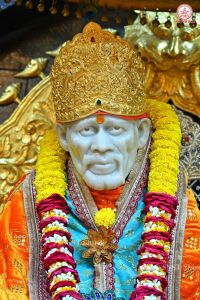
Why Shirdi Sai Baba is a Universal Spiritual Guide
A captivating exploration of the profound themes and vital truths surrounding Shirdi Sai Baba reveals a figure of immense spiritual significance.
I. The Nature and Identity of Sai Baba
Sai Baba is a divine, omniscient, and omnipresent, being whose true nature transcends conventional human and religious classifications.
- Ambiguity of Origin and Faith:
- Baba’s identity as Hindu or Muslim is deliberately obscured, highlighting his universality.
- He celebrated both Hindu festivals (Rama-Navami, Gokul Ashtami) and allowed Muslim practices (Sandal procession, Namaj in Masjid).
- His physical attributes (pierced ears like a Hindu, advocacy of circumcision, but not circumcised himself) further blurred the lines.
- No one definitely knew whether He was a Hindu or a Mahomedan.
- Divine Incarnation and Sadguru:
- Baba is depicted as a “Wonderful Incarnation,” a “precious Jewel,” and a “precious Diamond.”
- He is the “crest-jewel of the Saints, who is the home of all auspicious things, who is our Atmaram (Dear Self), and who is the able refuge of the devotees.”
- He is explicitly referred to as a “Sadguru,” a true spiritual master.
- “Lord (God) dwells in the Saints.
- In fact they are not different from Him.
- Our Sai is One of these,
- Who incarnated for the welfare of the devotees,
- Supreme in knowledge and surrounded with divine lustre.”
- Omniscience and Omnipresence: Baba has absolute knowledge of the past, present, and future.
- He knew Mr.Damu Anna’s secret thoughts about cotton speculation and his desire to offer Baba a share of profits.
- He knew Mr. Cholkar’s secret vow regarding sugar and his decision to forego sugar. Baba remarked, “Though, I am here bodily, still I know what you do; beyond the saven seas. Go wherever you will, over the wide world, I am with you. My abode is in your heart and I am within you.”
- He knew Mr.Hari Kanoba’s name, parentage, and other details about him, even though it was Hari’s first visit to Shirdi.
- He read Somadeva Swami’s critical thoughts about the flags at the Mosque, directly addressing them.
- He knew about one pleader’s slander behind His back at Bar Council, demonstrating “His omniscience and His using it for correcting people and setting them on the right path.”
- He correctly predicted and averted the death of Ramachandra Patil and foresaw Tatya Patil’s passing.
- He is described as “omnipresent, occupying land, air, country, world, light and heaven, and that He was not limited.”
- Detachment and Humility: Despite his divine powers, Baba lived a life of extreme simplicity and humility. He lived on alms, possessing nothing, and residing in a deserted Masjid. He begged for food daily, mixing all offerings together, and “His tongue knew no taste.” Dogs, cats, and crows freely ate from his earthen pot, and “Baba never drove them away.”
II. The Role and Importance of the Sadguru
The Sadguru (Guru, who realized Self) as the sole means to spiritual liberation and worldly well-being.
- Bridge to Salvation:
- The Sadguru is essential for crossing the “worldly ocean.”
- “Where Real or Sadguru is the helmsman, he is sure to carry us safely and easily beyond the worldly ocean.”
- The Vedas alone cannot achieve this; “It is only the Sad-guru, who can do so and make you, see the Lord in all creatures.”
- Destroys Egoism and Sins:
- The touch of the Guru’s hand is described as having “wonderful… power.”
- It can destroy the “subtle-body (consisting of thoughts and desires)” and cleanse “sins of many past births.”
- M. Hemadpant said, when starting writing Shri Sai SatCharitra, “Sai Baba took away my egoism and wrote Himself His stories.”
- Catalyst for Transformation:
- Baba’s darshan (sight) leads to profound inner change:
- “by His darshana our thoughts are changed,
- the force of previous actions is abated and
- gradually non-attachment of dispassion towards worldly objects grows up.”
- He transforms his devotees into “Himself (His nature).”
- Baba’s darshan (sight) leads to profound inner change:
- Teacher and Guide:
- The Sadguru Sai teaches based on the disciple’s qualifications, without unsettling their minds.
- He dispels ignorance (“Destroying ignorance is Jnana”) and
- He helps the disciple realize their true Self (“You are God, you are mighty and opulent.”).
- Unconditional Love and Service:
- A true Sadguru expects no service or profit,
- but instead wishes to serve his disciples, treating them as equals or even as Brahma.
- “Baba had great love for the disciples.”
- He “loved all beings equally.
- He was unattached. Foes and friends, kings and paupers, were the same to Him.”
III. Key Teachings and Practices Advocated by Sai Baba
Baba’s teachings, though sometimes indirect, emphasized faith, surrender, moral conduct, and devotion.
- Faith (Nishtha) and Patience (Saburi): These were presented as two coins of devotion by Baba to His Guru.
- Baba said: “This is one pice -Faith. Patience or perseverance is the other pice. I waited patiently and very long on My Guru and served him. This Saburi will ferry you across the sea of this mundane existence.” (pice=1/100 INR)
- Complete Surrender: “If any one prostrates before Sai and surrenders heart and soul to Him,
- then unsolicited, all the chief objects of life viz. Dharma (righteousness), Artha (wealth), Kama (Desire) and Moksha (Deliverance), are easily and unsolicitedly attained.”
- “The best way, therefore, to get free from the shackles of Maya is our complete and whole-hearted surrender to Baba.”
- Charity and Non-Attachment to Wealth: Baba frequently extracted “Dakshina” (offerings),
- not for personal gain, but “to teach the devotees the lesson of charity and to remove their attachment to money and thus to purify their minds.”
- He asserted that “He had to give back hundred times more of what He received.”
- He discouraged debt for spiritual purposes: “Baba never liked people to run into debt for taking His darshan, or celebrating any holiday or making any pilgrimage.”
- He considered “money as a danger or bar to spiritual progress.”
- Ethical Conduct and Self-Correction:
- He advised against discourteously turning away those who come to you, emphasizing:
- “Shri Hari (God) will be certainly pleased, if you give
- water to the thirsty,
- bread to the hungry,
- clothes to the naked, and
- your verandah of your Home to strangers for sitting and resting.”
- Baba condemned slander:
- “Let anybody speak hundreds of things against you,
- do not resent by giving any bitter reply.
- If you always tolerate such things, you will certainly be happy.”
- He used the example of a pig eating filth to correct a slanderer, stating, “Your conduct is similar. You go on reviling your own brethren to your heart’s content.”
- Baba taught the importance of offering everything to the Guru before enjoyment:
- “before the senses, mind and intellect enjoy their objects, Sai should first be remembered, and if this be done, it is in a way an offering to Him...
- all the Vrittis (thoughts) regarding Desire, Anger, Avarice etc. should first be offered and directed to the Guru.”
- He guided devotees to remain calm and composed, engage in good actions, and perform duties without attachment.
- Remembrance of God/Guru (Dhyana/Bhajan): Baba advised various forms of devotion, including
- “remembering My name,”
- “hearing His Leelas,”
- “worship of His Feet,” and
- studying sacred scriptures like Shri Sai SatCharitra, Bhagwat, Jnaneshwari, and Vishnu-Sahasra-Nam.
- He stated, “If you always say ‘Sai, Sai’ I shall take you over the seven seas.”
IV. The Human and the Divine
- Interaction with Devotees:
- Baba allowed devotees to serve him in their own way,
- demonstrating his “dependency on Bhaktas” (in the sense that he allowed their devotion to manifest).
- He engaged in normal conversation, jokes, and sometimes strong reprimands, always with a deeper purpose.
- The Guru-Disciple Relationship: The relationship is central. Disciples are encouraged to fully surrender and trust the Guru. The Guru sees beyond superficiality and acts for the disciple’s ultimate good.
- Transcending Form:
- While he had a physical form, Baba’s true nature was “unattached and indifferent” and “the state of Brahman.”
- He demonstrated “Khandayoga, i.e., separating His limbs and joining them again,”
- His visible form was merely a “mould” for the “liquid essence of Pure Self.”
V. Miraculous Powers (Leelas) and Their Purpose
Baba’s “Leelas” (divine plays or miracles) are frequently cited, serving not as ends in themselves, but as tools to deepen devotees’ faith, teach spiritual lessons, and alleviate suffering.
- Manifestation of Divine Power:Grinding Wheat: Initially misunderstood as mundane, Baba’s grinding of wheat was a symbolic act to “destroy the cholera epidemic in Shirdi” with the flour.
- Turning Water into Oil: This demonstrated his control over natural elements(fire) and taught the Banias (Oil Traders) a lesson in /
- ‘truthfulness.
- Curing Diseases: He cured various ailments, including eye problems with Beeba (marking nuts-Carpus Ana Cardium) and diarrhea with groundnuts, emphasizing that “The true medicine… was Baba’s word.”
- Saving from Calamities: He averted the snake bite for Shama and predicted/averted the death of Ramachandra Patil. He also saved Mr. Mirikar from a potential snake bite.
- Fulfilling Desires (within divine plan):
- The “Amra-Leela” story illustrates his power. Four mangoes, given by Sai resulted in four sons and four daughters for Damu Anna. This happened despite astrological predictions.
- He facilitated the return of a stolen jewel-box and a stolen sum of money.
- Disguised Blessings and Tests:Baba’s “rage” and “abuses” were often a “blessing in disguise,” as seen with Somadeva Swami, or a direct command to the poison in Shama’s case.
- Drawing Devotees and Confirming Faith:
- The numerous anecdotes of individuals being drawn to Shirdi, despite their initial reluctance (Hemadpant’s own journey, Kakaji Vaidya being directed by Goddess Sapta-Shringi, the “idolater” friend of Kaka Mahajani) highlight Baba’s magnetic spiritual pull.
- His precise knowledge of hidden thoughts or distant events served to “create faith and devotion” in his devotees.
- Guaranteeing the Welfare of His devotees:
- “There will never be any dearth or scarcity, regarding Food and clothes in My devotee’s home.”
- In a nutshell
- Baba’s teachings
- emphasize love, compassion, and faith,
- uniting all religions and
- inspiring devotion beyond boundaries.
- His miraculous acts instill hope, and
- His wisdom fosters inner peace.
- Baba’s teachings
- Ambiguity of Origin and Faith:
-

Promoting Love
Sai Baba actively promoted love and unity, both among his devotees and towards animals, through his teachings, actions, and the examples he set. Here’s how the sources illustrate these aspects:
- Unification and Harmony:
- Sai Baba worked towards the unification of communities, particularly Hindus and Muslims.
- He celebrated Hindu festivals like Rama-Navami with all due formalities.
- He also permitted the ‘Sandal’ procession of Mahomedans and allowed Muslims to offer prayers (Namaj) in his Masjid. This demonstrated his disregard for religious distinctions and his wish for communal harmony.
- His constant advice was that “Rama (the God of the Hindus) and Rahim (the God of the Mahomedans) were one and the same.” He emphasized that their devotees should not quarrel. Instead, they should “join hands and bring both the communities together” for national unity.
- Fostering Unity and Eradicating Duality: Baba emphasized the importance of dissolving the sense of difference between individuals and with God.
- He explicitly stated, “Demolish the wall of difference that separates you from Me; and then the road for our meeting will be clear and open. The sense of differentiation, as I and thou, is the barrier that keeps away the disciple from his Master, and unless that is destroyed the state of union or atonement is not possible“.
- This teaching directly supports universal love by promoting the realization of oneness.
- He also encouraged his devotees to love their Guru with whole-hearted affection. He advised them to surrender completely. He suggested prostrating reverentially before Him to attain this unity.
- Direct Instruction on Conduct:
- Baba provided invaluable general advice for interacting with others:
- “If any men or creatures come to you,
- do not discourteously drive them away,
- but receive them well and treat them, with due respect.
- Shri Hari (God) will be certainly pleased, if you give water to the thirsty, bread to the hungry, clothes to the naked, and your verandah to strangers for sitting and resting“.
- This emphasizes hospitality, compassion, and respectful treatment of all.
- Discouraging Slander and Gossip: Baba strongly disliked slander.
- He stated, “He who carps and cavils at others, pierces Me in the heart and injures Me, but he that suffers and endures, pleases Me most“.
- In one instance, he corrected a slanderer by pointing to a pig eating filth and comparing the slanderer’s actions to the pig’s,
- thereby teaching a powerful lesson against reviling others.
- Personal Relationships and Care: Baba demonstrated deep personal love and care for his close devotees.
- He shared his dormitory with Tatya Kote Patil and Bhagat Mhalsapati for 14 years, showing immense affection and intimacy.
- He loved Khushalchand of Rahata and “watched his welfare, day and night,” even visiting him.
- He exhibited “motherly love” towards his disciples, knowing their wants and feeling boundless joy when they were adorned.
- He ensured the proper execution of religious functions in devotees’ homes, even attending a dinner in Mr. B.V. Deo’s house through an appearance.
- His “anger” was often a disguise for blessings or tests, as seen
- when he appeared enraged with the women grinding wheat but later smiled at their devotion, or
- when he seemingly scolded Haji Sidik Falke only to then show him great favor.
- He sometimes appeared in dreams or visions to guide and comfort his devotees, like the instance of Hemadpant’s Shimga dinner.
- Importance of Guru-Disciple Relationship: Baba emphasized
- complete surrender and unwavering faith in the Guru, assuring that such
- devotion leads to spiritual progress and self-realization. This deep bond fosters profound love and trust.
- Saints, like Baba and Shri Tembye Swami, are shown to love each other with “fraternal affection,” indicating a wider spiritual family bound by love.
Promoting Love with Animals:
- Oneness with All Creatures: Sai Baba explicitly taught the principle of seeing God in all beings, including animals. When Mrs. Tarkhad fed a hungry dog, Baba told her, “The dog which you saw before meals and to which you gave the piece of bread is, one with Me, so also other creatures (cats, pigs, flies, cows etc.) are one with Me. I am roaming in their forms. He, who sees Me in all these creatures is My beloved. So abandon the sense of duality and distinction, and serve Me, as you did today“. This is a profound teaching that directly connects compassion for animals with devotion to God.
- Compassion and Non-violence: Baba’s conduct consistently demonstrated compassion for animals. He never drove away dogs, cats, or crows that ate from his food pot, indicating his acceptance and care for them. He also gave a clear opinion on the killing of serpents, stating, “God lives in all beings and creatures, whether they be serpents or scorpions… So we should take pity and love all creatures, leave off adventurous fights and killings and be patient. The Lord (God) is the Protector of all“.
- Reminiscences of Past Lives: In a remarkable instance, Baba purchased two goats for a significantly high price, explaining to his surprised devotees that these goats were formerly two human brothers who had fought bitterly and killed each other. He bought them out of pity, fed them, and then returned them. This story highlights Baba’s boundless love and compassion for all creatures, acknowledging their karmic journeys.
- Protection of Animals:
- Baba saved his devotees from potential harm from animals like snakes,
- sometimes by foretelling the danger and
- other times by direct intervention,
- but he always advised against killing them,
- emphasizing universal love and the divine presence in all creatures.
- Even a fierce tiger was drawn to his feet and found a blessed end in his presence, demonstrating Baba’s all-encompassing mercy towards even wild animals.
- Unification and Harmony:
-
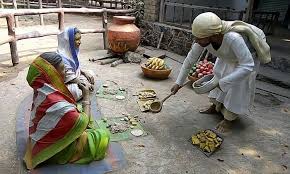
Baba’s Compassion and Love
Shirdi, Shri Sai Baba’s life is a testament to His boundless compassion, profound gentleness, and unwavering selflessness. He consistently demonstrated these qualities through His actions, teachings, and interactions with His devotees. Here are instances:
Baba’s Compassion:
- Protection from Epidemics: Baba displayed compassionate foresight by grinding wheat and having the flour thrown on the Shirdi village borders to curb a cholera epidemic.
- Villagers understood that He was not only grinding wheat.
- He was also grinding the cholera itself to pieces. This act pushed cholera, out of the village. This led to the epidemic’s subsidence.
- Encouragement of Hemadpant: When Hemadpant expressed self-doubt about writing Baba’s biography,
- Baba gently encouraged him. He blessed him with Udi (sacred ashes) and placed His boon-bestowing hand on his head.
- Baba assured,
- “I will help him.
- He is only an outward instrument.
- I should write Myself My autobiography and
- satisfy the wishes of My devotees”.
- This shows His desire for devotees’ spiritual growth and His loving support.
- Motherly Love for Disciples: Baba exhibited a unparalleled motherly love towards His disciples. He was always attending to their needs. Sadgurus like Baba have this peculiar and extraordinary love for their disciples.
- All-Embracing Love and Tolerance:
- Baba’s all-embracing love was evident in His defense of the Rohilla, who disturbed villagers with loud prayers.
- Baba took the villagers to task, explaining that the Rohilla’s prayers kept away “Durbuddhi” (bad thoughts),
- thus protecting even those perceived as troublesome.
- All-Embracing Love and Tolerance:
- Omnipresence and Constant Protection: Baba’s statement: “I am the Inner Ruler of all and seated in their hearts. I envelope all the creatures, the movable and immovable world.“
- Curing Ailments through Grace: Baba cured numerous diseases without using conventional medicine. He did so through His Grace, Words, or Udi. This demonstrated His compassion for the suffering. Examples include:
- Bhimaji Patil’s severe tuberculosis, cured by Baba’s words of hope and mercy, through two dreams.
- Bala Ganapat Shimpi’s malaria, cured by instructing him to feed a black dog, with rice mixed with curds.
- Bapusaheb Booty’s dysentery and vomiting, instantly cured by Baba’s command, “Now take care, you should not purge any more” and “The vomiting must also stop”. He also cured in another time, Booty’s cholera with a seemingly fatal remedy, effective due to Baba’s word.
- A Swami from Alandi’s ear pain, relieved by Baba saying, “Alla Accha Karega (God will do good)”.
- Madhavrao Deshpande’s piles and Gangadharpant’s stomach-pain, cured by simple words and touch, and Nanasaheb Chandorkar’s stomach-pain with a sweetmeat.
- A doctor’s nephew of tubercular bone-abscess, cured with Udi and Baba’s “loving glances”.
- Dr. Pillay’s excruciating guinea-worm pain, relieved by Baba’s command to be ‘fearless’ and allowing an accidental step on the wound, to expel the worms.
- Shama’s sister-in-law’s bubonic plague, cured overnight by sending Udi and giving instructions.
- A Harda gentleman’s bladder stone, dissolved with Udi mixed with water.
- A Bombay lady’s painless delivery, despite a stillborn issue, by her praying to Baba and consuming Udi-mixture.
- Acceptance of Sincere Offerings: Baba lovingly accepted offerings made with devotion, such as
- Mr. Cholkar’s small offering of sugar-candy, knowing his secret vow to save money for his trip by abstaining from sugar.
- He knew devotees’ sincere intentions,
- even reminding them if they
- forgot to offer something,
- demonstrating His acceptance of their inner devotion over the material value.
- Teaching Non-duality through Action: Baba profoundly taught the principle of “See God in all beings”
- when He told Mrs. Tarkhad, “Mother, you have fed Me sumptuously… The dog which you saw before meals and to which you gave the piece of bread is, one with Me, so also other creatures… I am roaming in their forms. He, who sees Me in all these creatures is My beloved.“. This practical demonstration encouraged compassion for all life.
- Drawing Devotees and Fulfilling Desires: Baba had an incredible ability to draw devotees to Shirdi, “like a sparrow, with a thread tied to its feet.” He was omniscient and knew their innermost thoughts and desires. Often, His compassion led Him to fulfill them. Examples include:
- Knowing Lakhamichand’s taking a loan for his darshan and forgetting to buy guavas, but arranging for an old woman to sell him the fruits.
- Knowing Damu Anna’s secret thoughts about speculative business and gently dissuading him, saving him from financial ruin. He blessed Damu Anna’s wife with four sons and four daughters, by gave her four mangoes as Prasad. This act overrode astrological predictions.
- Fulfilling Mrs. Tendulkar’s dream of her son passing his medical examination despite unfavorable astrological predictions, emphasizing faith. He also blessed Mr. Tendulkar with a higher pension after a dream.
- Ensuring painless death and salvation (Sadgati) for devotees like Sannyasi Vijayanand, Balaram Mankar, and Tatya Noolkar; Even showering flowers on Megha’s body and arranging his funeral rites after his passing shows, deep affection.
- Compassion for Animals: Baba displayed immense compassion for animals.
- Notably, he bought two goats for an exorbitant sum. He explained their past lives and their enmity in their previous human forms. Out of pity, he fed them.
- He also taught not to kill creatures, stating “God lives in all beings and creatures”.
- Personal Sacrifice for Devotees:
- A supreme act of compassion was when Baba
- sacrificed His own life to save Tatya Kote Patil’s life, fulfilling an earlier prophecy that Tatya would pass away, but Baba took his place.
Shirdi’s Shri Sai Baba exemplified unparalleled compassion and selflessness through numerous acts. He protected villagers from epidemics, encouraged disciples, healed ailments without medicine, and accepted sincere offerings. Baba’s teachings emphasized seeing God in all beings, fulfilling devotees’ desires, and displaying profound love for both people and animals, often embodying true sacrificial spirit.
- Protection from Epidemics: Baba displayed compassionate foresight by grinding wheat and having the flour thrown on the Shirdi village borders to curb a cholera epidemic.
-

Shirdi Sai Baba temples in UK
These Sai Baba Temples in UK, including Prayer Centers, offer important spaces for worship, spiritual practices and community interaction.
Readers are invited to share their experiences and offering any updates the temple information. Such contributions are essential in ensuring the directory remains a reliable and beneficial tool for the broader Sai community.
🛕 Shirdi Sai Baba Temple Association of London (SHITAL) Website
Temples (with daily aarti & services):
1. Wembley, London:
Union Hall, Union Road, Wembley, Middlesex, HA0 4AU.1 Map
Phone: 020 8902 2311
2. Leicester:
18 Melton Street, Leicester, LE1 3NB. Map
Phone: 0116 367 1833
3. Reading:
44 West Street (next to Primark), Reading, RG1 1TZ_ Map
Phone: 0118 959 1084
🛕 Additional Shirdi Sai Baba Temples & Organizations- Shirdi Sai Baba Temple Milton Keynes, 12 Winchester Cir, Kingston, Milton Keynes MK10 0BA Map
- Shirdi Sai Temple, 122 Ley Street, Ilford IG1 4BX. Map
- Sai Dham, Nottingham, Situated at 75–79 Egypt Road, Nottingham. Map
- Sree Sai Baba Shrine, Dudley Rd E, Tividale, Oldbury B69 3DU. Map
- Granite Shirdi Baba, 65 Downham Rd, London N1 5AH. Map
World Shirdi Sai Baba Organisation (UK): - Shirdi Sai Baba Temple – London, East Ham, 298 High St N, London E12 6SA. Map
- Shirdi Sai Baba Temple – London, Forest Gate: 370A Romford Road, E7 8BS .Map
II. You can also click the following link to get a Map list of around 10 SAI BABA temples or Prayer Centers in United Kingdom.
https://maps.app.goo.gl/N3h4LQA66jTDrqWw7
Please click the link, check the reviews, ensure the correct route, and cross-check the timing without fail.
III. Decide the suitable Sai Temple and
Go there, sit and do meditation; and feel the eternal bliss.
IV. OM SAI BABA, GUIDE AND BLESS YOUR CHILDREN, please.
PS: 1. This list is for informational purposes only. We are not sponsoring. Check before proceeding.
2. If this above List/link hasn’t included any Sai Baba Temple or Prayer Place you know in UK, please add it to Google Maps. Then send that Google Map link with Temple’s Name, Address and other details to us.
3. For any such addition, correction or deletion in the above list, inform us here.
-

Can we follow other Gods?
In BG VII(7) 21-2, Sri Krishna said “In whatever from people surrender to Me, in that very form, I serve them. Every one following his own form of worship is really following My worship’.
God can be approached under any name and in any manner, and
Mahlsapathy (Baba’s closest devotee),
- though sticking to the idea that Khandoba was his God,
- derived the advantage of getting all his
- other needs safeguarded and provided as far as possible
- by Baba acting as his Providence.
Other bhaktas also
- who have their own particular forms, who however note the need or importance of food, shelter and other things for themselves and their familes, being provided by Baba
- would be thus encouraged by Mahlsapathy’s example to seek Baba and place themselves under his protection.
- Baba never interfered with
- anybody’s orthodoxy or religious worship, and
- the orthodox now in various places need not have any fears about the loss of their existing spiritual position by contacting Baba.
- All the while, they would get unconscious expansion and refinement of their idea of God and Gods, and become ready for reaching the “Ekam Sat-That which exists is One”
LoSB-P245
-
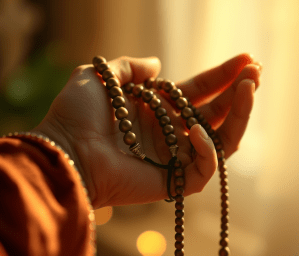
Complete surrender to Guru=Our mind gets calm and peaceful
- Baba, although we cannot see Your form now,
- those who believe in You, still have real experiences with You.
- Through an unseen thread, You bring devotees from near and far.
- You welcome them to Your Feet and embrace them like a loving mother.
The devotees may not know, where You are. You cleverly guide them. You help them realize that, You are there to support them.
- The intelligent, wise and learned folk fall into the pit of the samsar (worldly) due to their egoism.
- However, You save the poor, simple, and devout persons by Your power.
- The best way for us is to offer our
- body,
- speech, and
- mind to You and
- consistently chant Your name to remove our sins.
- You grant the
- wishes of those, who seek and
- provide ultimate bliss to those, who desire nothing.
Chanting your sweet name is the simplest practice for devotees. Through this practice, our sins and negative qualities will fade away, while goodness and righteousness will grow stronger. This will also lead to better judgment, detachment, and understanding.
- Then we shall abide in our Self and our Guru (Sai,who are one and the same).
- This is what is called complete surrender to the Guru.
- The only sure sign of this is that, our mind gets calm and peaceful
SSSC -Ch 46
-

Mastering Dispassion: A Guide to Spiritual Liberation with Baba
Baba’s physical or finite form has undoubtedly vanished from our sight; however, the infinite or spiritual essence (Spirit of Baba) endures eternally.
Baba’s plays continue:
- The divine Leelas (play) that transpired during His earthly existence have been extensively discussed till now.
- Since His departure, new Leelas (play) have emerged and continue to unfold even now.
- This clearly illustrates that Baba remains ever-living and extends His assistance to His devotees as before.
About Those contacted physically Baba:
- Those who were blessed to have contact with Baba during His lifetime were indeed fortunate;
- nevertheless, if any of them failed to cultivate dispassion for worldly possessions and pleasures, or did not turn their minds toward the Lord,
- it is purely a matter of their misfortune.
Now what is necessary:
- What was necessary then, as it is Now, is a wholehearted devotion to Baba.
- All our
- senses,
- organs-faculties, and
- minds should collaborate in worshiping and serving Baba:
- to engage only certain faculties in worship, while neglecting others is of no use.
- Should one partake in worship or meditation, it ought to be undertaken with one’s full mind and soul.
- All our
Can anyone assist us in achieving?
- The love that a devoted wife holds for her husband is frequently, likened to the devotion a disciple offers to his master (Guru).
- Yet, the latter is unparalleled and far surpasses the former.
- No individual, be it a father, mother, brother, or any other relative, can assist us in achieving the ultimate purpose of life (self-realization).
- We must delineate and navigate the path of self-realization independently.
- We are tasked with
- discerning the Unreal from the Real,
- renouncing the desires and pleasures of this world and
- the next, mastering our senses and minds, and
- aspiring solely for liberation.
- Rather than depending on others, we ought to place total faith in ourselves.
Practice What? and How?
- As we begin to practice discernment,
- we come to realize the transitory and illusory nature of the world, and
- our passions for worldly matters gradually diminish,
- ultimately leading to dispassion or non-attachment.
- We then acknowledge that the Brahma,
- which is none other than our Guru, is the sole reality;
- as it transcends and pervades the apparent universe,
- we begin to worship it in all beings.
- By wholeheartedly worshiping the Brahma or Guru, we become one with Him and attain self-realization.
- In summary:
- consistently chanting the name of the Guru and
- meditating on Him, enables us to
- perceive Him in all beings.
- It bestows upon us eternal bliss.
 Welcome to https://ShirdiSaiBaba.InterNational