Category: Company of saints

Satsang — the company of holy ones — is one of Baba’s most emphasised practices. Explore the lives of saints who walked alongside Baba, and the transformative power of holy association.

  • Baba is a Master of “Catechectics”

    Baba is a Master of “Catechectics”

    Catechectics is an Art of teaching by Question and answer (as a Part of ‘How emotional investments shape our behaviors and thoughts’). Baba is in very advanced stage in this science. This is an example:-

    It was in the year 1916, a Chennai Bhajani Mela (Party of the Ramadasi Panth) started on a Pilgrimage to the holy city of Kasi/Banaras. The Party consisted of a man, his wife, daughter and sister-in-law; and they had come to Shirdi to get Gift of money from Baba. There the husband got a wonderful vision in his dream one night as follows :-

    He was in a big city, the police there had arrested him, tied his hands with a rope, and put him up in lock-up. As the police were tightening the grip, he saw Sai Baba standing quiet outside, near the cage. On seeing Baba so near, he said in a plaintive tone – “Hearing Your fame, I came to Your Feet, and why should a calamity befall me, when You are standing here in person?”

    • Baba said – “You must suffer the consequences of your action”
    • He said – “I have not done anything in this life, which would bring such a misfortune on me.”
    • Baba said – “If not in this life, you must have committed some sin in your past life.”
    • He replied, “I do not know anything of my past life, but assuming that I did commit some sin; then why should it not be burnt and destroyed in Your presence, as dry grass before fire? “.
    • Baba – “Have you got such faith?”
    • He – “Yes.”
    • Baba then asked him to close his eyes.
    • No sooner did he shut them, than he heard a thumping sound of something falling down, opening his eyes,
      • he saw that he was free and the police had fallen down, bleeding.
      • Being much frightened, he began to look at Baba who said – “Now you are well caught, officers will now come and arrest you.”
      • Then he begged – “There is no other saviour except You, save me anyhow.”
    • Then Baba again asked him to close his eyes. He did so and when he opened them,
      • he saw that he was free, out of the cage and
      • that Baba was by his side.
      • He then fell at Baba’s Feet.
    • Baba then asked him –
      • “Is there any difference between this namaskar (Hello) and your previous ones? Think well and reply.”
      • He said “There is a lot of difference; my former namaskaras were offered with the object of getting money from You, but the present namaskar is one offered to You as God”
    • Then a desire arose in his mind, to get the darshan of his Guru Ramdas;
      • when Baba asked him to turn back and see. And when he turned,
      • lo, Ramadas was in front of him.
      • No sooner did, he begin to fall at His Feet, Ramadas vanished.
    • Then he inquisitively asked Baba,”You look old. Do You know Your age?”. Baba – “What! Do you say I am old! just run a race with Me and see.” Saying this, Baba began to run and he too followed. Baba disappeared in the dust raised by His foot-steps while running, and the man was awakened.
    • After awakening, he began to think seriously about the dream-vision. His mental attitude was completely changed and he realised the greatness of Baba. After this, his grabbing and doubting tendencies disappeared and true devotion to Baba’s Feet sprang in his mind.
    • The vision was a mere dream, but the questions and answers therein were most significant and interesting.
    • Next morning, when all the persons assembled in the Masjid for the Arati, Baba gave him as prasad two rupees’ worth sweetmeats and also two rupees from His pocket and blessed him.
    • Baba made him stay there for a few more days and gave him His blessing, saying, “Allah (God) will give you plenty and He will do you all good”. He did not get more money there, but he got far better things viz. Baba’s blessing, which stood him in good stead all along.
    • The party got plenty of money afterwards; and their pilgrimage was successful: as they had not to suffer any trouble or inconvenience during their journey.
    • They all returned home safe and sound, thinking of Baba’s words and blessings and the Anand(Bliss) they experienced by His grace.

    In SSSC Ch-29
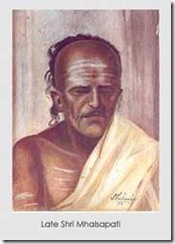
  • Mahlsapaty

    Mahlsapaty

    Mahlsapathy is the First & top most person in Sai Baba’s Court-Member of King’s Dharbar, and one among the VIBGYOR* member of Baba’s Dharbar.

    Sai Baba stayed at one Chandbhai’s [headman of Dhoopkheda village] home for some days. The nephew of Chandbhai’s wife got betrothed to a girl from Shirdi. So, Baba came to Shirdi in that wedding procession, in 1872.
    The marriage party had alighted at the pounding grounds, near Khandoba’s (incarnation of Shiva) temple, outside the village. When Baba went to the Khandoba temple, He met Mhalsapaty there.

    This Mhalsapaty was a resident of Shirdi and a goldsmith. As he was a devotee of Khandoba, and regular visitor of Khanderaya (Deity of Jejuri, who is also Khandoba), since many generations. As soon as Mhalsapaty saw Him, he welcomed Him with the words: “Welcome Sai”. Then, all the devotees of Sai Baba called Him “Sai Baba or Sai or Baba”.
    Mhalsapati brought Sai Baba into the village and introduced Him to his friends Kashiram Shimpi and Appa Jagale. These three usually served, according to their capacity, the sadhus, saints , fakirs and ascetics visiting the village, and graciously took care of them.

    Baba was an absolute “Vairagya Purusha” and never cared for wealth or women. Mahlsapalhy, being himself highly detached i.e. of a vairagya temperament and not being overned by lust or other low urges, could easily appreciate Baba, from the very beginning was drawn to Baba;

    when other people began to worship Baba, only when they saw Baba’s psychic powers e. g. when he turned water into oil to feed his lamps, and then they regarded him as God.

    An important event in Mahlsapathy’s life that was- “Baba’s trying to leave his body about 1886 and returning to it three days later”.

    Baba had made him the guardian of his body and told him, “Arre Bhagat, look after this body for three days. I am going to Allah. If I do not return, then get it buried in due course at that place, (that is, near the sacred gode neem tree).”

    Mahlsapathy supported Baba’s body on his own knee, and when officers, including the village headman karnam, etc., held an inquest over the body, declared it dead, and wanted it to be buried. Mahlsapathy with the help of others stoutly opposed their proposal, and saved Baba from losing his body.

    Thus, he rendered a valuable service in 1886, after which Baba lived for 32 years to create this huge Sai movement that has covered this World.

    If Mahlsapathy had failed in his duty, and Baba had been buried, perhaps the course of history might have been different.

    ‘Whatever a person thinks of at the time of death he reaches’. When Mahlsapathy’s death was approaching, he retained full-consciousness and control of his mind.

    That was on 11th Sep 1922, Monday (in the month of Badrapada, Ekadasi Somavara, sacred to Shiva and Khandoba), having finished all his puja, he said to his family, ‘To-day is my father’s Shraddha day. Finish cooking soon. To-day, I close my earthly life and go to Heaven’.

    So, a Brahmin came and finished the Sraddha at once; and finished the gift of balis to crows, cows, etc, and guests were fed. Then the family meals were finished.

    Mahlsapathy took betel and nuts after his meal. After chewing a bit, he put on a kupni. Having near him, Bala Gurav, Ramachandra Kothe, etc., he told them all to do Ramachandrajapa Japa.

    Muhlsapaty said to his son that ‘Spend time piously in Uttama Bhakti Marga i.e. in holy devotion. All that I told you will happen.” Then Mahlsapathy uttered the word ‘Ram’ and breathed his last.

    Thus he passed away in calm, faith and cheerfulness, on the 11th September 1922. This death was a fitting termination to a pure, lofty and dedicated life—a life of Love, faith and total surrender.

    His remains are interred in a tomb at Shirdi, which is still worshipped by many.

    * 1. Mahlsapathy 2. Narayan Govind Chandorkar 3. Das Ganu Maharaj 4. H.S. Dixit, 5. Hemadpant 6. Sri Upasani Baba and 7. G.S. Khaparde.

  • Who is Shirdi Sai Baba

    Who is Shirdi Sai Baba

    Sri Krishna, Sri Rama, Sai Baba, are all divinely gifted or perfected souls and expressions of divinity. They transform everyone who comes into contact with their divine personality. This is especially true for those who are drawn through Rinanubandha (karmic Bond) by their divinity. That is the purpose or mission of their lives.

    Baba’s Birth and Grown-up:

    • Sai Baba (1838-1918) was an Indian spiritual Guru, Yogi, and Fakir, revered as a saint by millions of devotees, both Hindu and Muslim, across the world.
    • Sai Baba stated that while still a young child, his parents entrusted him to the care of a fakir. The fakir raised him.
    • From this foster father, Baba acquired Vairagya (detachment from worldly pleasures and pains) and developed a spiritual mindset.
    • That fakir passed away within four or five years after taking charge of him.
    • This fakir instructed his wife to take the young Baba and leave him in the care of the renowned saintly zaminder, Gopal Rao Deshmukh (Provincial Governor) in Selu.
    • Gopal Rao was an exceedingly devout individual, deeply attached to Tirupati Lord Venkatesa. He was affluent and generous, and he supported education and piety.
    • A wealth of true education was available to the young Baba, as he was consistently in attendance on this master.
    • Gopal Rao, upon departing from this world peacefully, signaled to the young Baba with a wave of his hand, instructing him to leave Selu and proceed westward to his new abode. (Shirdi is situated along the banks of the Godavari river, directly west of Selu).
    • After some time, Chand Bhai Patel, the Headman of Dhoop (Dhukeda) Village in Nizam’s State, arrived in Shirdi with a grand procession. He had come for the marriage of his wife’s nephew at Shirdi, around 1872. Sai Baba accompanied him for this occasion. When the marriage party arrived in Shirdi, they halted at Mhalsapati’s land near the Khandoba temple.
    • Bhagat Mhalsapati noticed the young Fakir disembarking from the bullock cart and greeted him with “YA SAI” (Welcome Sai). Others began to address him as Sai, and henceforth he became known as Sai Baba.
    • Baba’s final residence was Shirdi, where he lived from 1872 until the end of his life in 1918.

    Baba’s Mission:

    Baba has not  one mission, but a hundred missions. Divine personalities have specific functions. They protect the good (virtuous). They only reform the wicked. They also establish Dharma (Virtue) or its hold on the people. And Baba was performing all these functions.

    His mission is to help every one, that means, of course,  everyone capable of benefiting, not persons who come in an unreceptive mood .

    Baba’s marga-Path:

    Studying  Gitas, one sees that there is no meaning in asking for ‘any one marga (path)‘ expounded by the Divine Person. Saints expound all the margas. They find which marga or combination of margas would suit each approaching devotee. Then they give the same to him.

    Thus Baba adopted every marga. In particular, one may note that the predominance in Sai’s methods was neither for ritual nor for Vedic study. Instead, it was for living in consonance with the Supreme manifestation of Divinity in himself.

    Baba distributes:

    Baba quoted his master’s or Guru’s  behest. “As he had received liberally from His master, He must similarly  distribute liberally amongst those that approached him.”  Baba was distributing not merely wealth, worldly relief and comforts; He was also giving spiritual gifts and spiritual blessings to all and sundry capable of receiving those benefits.

    Baba advises :

    • ‘Love all creatures.
    • Do not fight with  any.
    • Do not retaliate nor scandalize any.
    • When any one talks ill of you, that is,  against you, pass on unperturbed. His words cannot pierce into your body.  Others’ acts will affect them alone and not you.’

    Baba was ever active and never idle and His advice was,  ‘Do not be idle. Work, Utter God’s name. Read scriptures’.

    Baba is also advising:

    • ‘We should not harbour envy, rivalry, or combative disposition towards others.
    • If  others hate us, let us simply take to Nama Japa and avoid their company.
    • Hearken to the words of your parents. 
    • Help your mother in her tasks.
    • Speak the truth and truth alone’.

    Baba’s advice was  always simple and capable of being accepted and acted upon by even persons  of the meanest capacity.

    Baba’s moral teachings:

    Important thing for peace and happiness is love of all creation.  Baba’s moral teachings were conveyed by his own life and activity. Baba loved all creatures. The underlying motive of every act of his was love towards all human beings and all creatures.

    Baba’s Powers:

    He did not even appear to be  a teacher and was chiefly a granter of wishes. But all the same, he was a  powerful instiller of principles and virtue. He instilled these into the hearts of those capable of receiving such impress.

    Other Saints, about Sai Baba:

    The meaning of the name, ‘Sai Baba’:

    Sai Baba/ Sai/ Baba has achieved, the supreme task of:-

    • Sai has come to achieve the supreme task of uniting the entire mankind as one family, through the bond of brotherhood of affirming;
    • And illumining the Atmic Reality of each person. This is done in order to reveal the Divine, which is the basis on which the entire Cosmos rests.
    • And also instructing all to recognise the common Divine Heritage that binds man to man. This way, man can rid himself of the animal. He can rise into the Divine, which is his goal.

    The most important facts to remember about Baba is that,

    • Baba was the embodiment of all virtues,
    • Baba did, nothing  which he did not preach.
    • In Himself, all the virtues were the efflorescence of the  central root in Him, with which he began as a little child, namely:-
    • love for the Guru, 
    • love that knows no bounds of time, place, or circumstance, and
    • love that  sacrifices anything and everything at its altar.
    • Gratitude, service, equality, justice, consideration and so many other good qualities that were in him and taught by him were the direct issue of this love. These qualities could not have all been sustained without this love. This is the central point to remember about Baba.

    This enables  the sishya (student or Devotee) to get more and more like unto the Guru. By constant meditation  on him, the sishya becomes the soul of the Guru.ie

    • The sishya/Student/Devotee grows in love,
    • absorbs the love from the Guru, and
    • returns  it with all his soul and body.
    • Does not consider himself as anything except as  the lover and the beloved of the Guru.

    • Thus Devotee attains
    • moral perfection,
    • spiritual  perfection,
    • perfection of siddhis and
    • perfection of every sort .
    • This is the natural  result of Baba’s moral teachings. 
  • Hello Sai Devotee, Do You know this

    Hello Sai Devotee, Do You know this

    ← Back

    Your message has been sent, Thanks. Praying Sai Baba to bless you with Happy, Healthy and Wealthy life

    Source document (PDF or JPEG only)

    Drag and drop or click to select a file.

  • Baba’s Earlier Period

    Baba’s Earlier Period

    3–4 minutes

    Birth to Shirti:-

    Stage -1

    Very late in his life, Baba revealed to Mahlsapathy an interesting fact. He disclosed that his parents were from Patri in the Nizam’s State, India. Patri is part of Parvani taluk, near Manwath. Sai Baba added that when he was still a tender child, his parents handed him over to a fakir. The fakir brought him up. Sai Baba occasionally showed his interest in Patri and Parvani when people from those parts came to him, by questioning them about the residents of those places. This is practically all that, we  have about the birth and parentage of Sri Sai Baba.

    Stage -2

    But who ever his parents were, it is quite important to remember that from his earliest infancy, he experienced a true vairagi or jnani detachment. He had all the associations or dissociation needed for this. Having no parents or kinsmen, and being brought up by a fakir, he easily picked up his foster-father’s vairagya and spiritual turn of mind.

    Even that fakir passed away within four or five years after taking charge of him. The fakir directed his wife to take the young Baba, and  leave him in charge of a noted saintly zamindar, Gopal Rao Deshmukh at Selu.

    Stage -3

    Young Baba was left under the care of Gopal Rao Deshmukh. He spent the best and most impressionable part of his life at Selu. Selu had a fort and castle, where the Deshmukh resided.

    The young boy was very greatly attached to his master, and the master in turn was deeply interested in the boy. The boy stayed with the master at all times. He was present, whether the master was in the field or at puja, and whether he was in the garden or in the Court.

    Education:

    Baba seems to have had no formal education given to him at any time. He had no book study. There were no masters, either in the regional language (which must have been Marathi or Telugu) or in any other language.

    But real education of the highest sort, he had in plenty. This Deshmukh, was an extremely pious devotee greatly attached  to Tirupati Venkatesa, whose image he worshipped daily in his own castle. He  was rich, liberal, and patronised learning and piety. Hence an abundance of real education could be picked up by the young child Baba, when attending on his  master.

    Perfect chastity and thorough self-control were the leading characteristics of his Guru. Invariable rectitude and perfect truthfulness also defined him. Generosity and serviceability to all became transplanted and took deep root in the disciple, Sai Baba.

    Stage- 4

    Sai was very young, when he first came Shirdi. In the beginning he left Shirdi off and on, and returned to it. The date of his first arrival at Shirdi cannot be fixed.

    On one of his later visit to Shirdi, possibly the final one, Baba arrived on the momentous occasion of Chand Bhai Patel’s advent to Shirdi.

    Chand Bhai Patel was a rich and influential village Patel or Headman, of Dhupkeda village in the Nizam’s State, not far from Shirdi. His wife’s nephew was to be married to a bride at Shirdi. In 1872, he arrived with a huge marriage procession. Sai Baba accompanied Patel on that occasion from Dhupkeda to Shirdi. Sai Baba stayed there until Mahasamathi.

    After that time, except for two months when he was under Jawar Ali Maulana, Sai Baba never left Shirdi but only made a few occasional visits off and on to the neighbouring villages of Rahata or Nimgam, from which he immediately returned to Shirdi.

    So His final residence was Shirdi, from about 1872 till the end of his life in 1918.

  • BABA WORSHIP III -Kings Durbar

    To make the congregational worship more advanced and attractive, there was an enthusiastic set gathering at Shirdi.

    One Ramakrishna Ayi, a young widow, being highly accomplished, was intent upon using all her gifts and cleverness for developing Sai Baba’s worship. She drew a large number of people to herself and made them more enthusiastic in the cause of Sai Worship

    Ramakrishna Ayi introduced silver whisks, silver maces, silver umbrellas, silver candelabras, moons, and artificial gardens to deck the chavadi, where Baba was worshipped on alternate nights. A (ratha) car, a palanquin with silver appurtenances, a horse, and other regal paraphernalia were furnished on her insistence and the insistence of other devotees to make Baba worship run exactly like Vittal worship or the worship of great Acharyas in their mutts.

  • BABA WORSHIP I -Individual Worship

    The benefits attending Baba-worship were quickly seen and hence Devotees from outside the Shirdi village, that is, from the immediate neighbourhood were drawn to the worship. This spread gradually from place to place and people from even remote parts were attracted to the worship.

    Individual   worship itself was first not systematic, nor organised. But K.G. Bhishma, a good Kirtankar and a great adherent of Vittal-worship at Pandharpur, drew up the ritual for Sai-Baba-worship on practically the same lines as the Pandharpur-worship.

    He brought a set of artis that is ritualistic; verses for use by individuals at Shirdi, (and these were sent up by Baba to Nana Saheb Chandorkar at Jamnere) were approved of by HIM.

  • Earlier Years at Shirdi III- Age of 50+

    In his earliest days, even up to 1890, Baba had a youthful love of art and music; and at night he often went to the Takia, the resting place for visiting Muslims.

    There he would, with his very sweet and appealing voice, sing songs mostly of Kabir or songs in Persian or Arabic, which the local people could not understand.

    He seldom performed the five Namazes, never bending on the knees and rising, as most Muslims do. He was an adept in concentration and he had reached the perfection of Manolaya on the Atman, the merger of the self in the Self. That is why he could say as he did. “Maim Allah Hum ie. I am God.

    His worship never took him away from his social contacts with his neighbours, in relation to whom the key-note of all his thought and activity was service, absolutely selfless service.

  • Baba’s Earlier Years at Shirdi I-Khandoba temple

    Baba’s earliest years at Shirdi were passed in complete obscurity. Baba had no home; Fakirs have none. Hermits are, therefore, to reside either at a tree-foot or chavadi or temple or other public places.

    When he came into Shirdi, first Baba visited Khandoba temple at the outskirts of the village, and then noting how solitary and calm a place it was, exclaimed, ‘What a nice place this, for ascetics like me to live in.’ Mahlsapathy, the man then in charge objected to this observation and said that no Mohammadan would be allowed to put his foot into the Khandoba temple.

    He was evidently thinking that Baba was a Muslim and that he would break the images and defile the temple. But Baba was just the opposite.

  • WORSHIP V-Baba worship, Stages

    Baba worship had and has all stages in it, and all sorts of worshippers.

    Baba who first objected to his worship, did by his own Antarjnana or prophetic vision foreseeing what was to follow, namely, not only individual benefits to millions, but also national benefit and ultimately benefit to the cause of religion itself for the sake of humanity.

    That is why HE gradually promoted and then developed HIS worship:-

    • Individual worship of Baba attracted larger and larger numbers from the immediate neighbourhood and
    • from distant places and this developed into congregational worship;
    • and that again from simple congregational worship to the highly complicated forms, which are seen in famous places of worship like Pandharpur.
    • Worship like Pandarpur and Tirupati were developed for Baba worship at Shirdi, including ritual, hymnology, music, processions, cars, palanquin horse and pujaris.