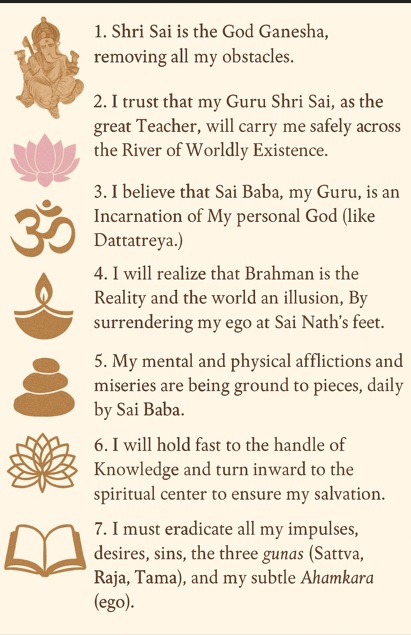
Complete surrender to the Guru encompasses several dimensions, as elucidated in the Shri Sai Sat Charitra:
Devotion and Remembrance: This entails a total surrender of oneself while consistently recalling the Guru’s presence, with the necessity of continually chanting the Guru’s name.
Seeing the Guru in all beings: Engaging in meditation on the Guru allows one to perceive Him within every being, thereby bestowing eternal bliss. A true devotee regards every Guru as Krishna.
Lack of Egoism: This principle mandates the relinquishment of pride and ego, thereby surrendering to the Guru who resides within one’s heart. The removal of egoism and the complete trust in the Lord liberates one from worldly constraints.
Service: True surrender requires Sarvaswa Sharangati (total surrender) to the Sad-guru, where one must recognize that they are not the sovereign of their own body; rather, the body belongs to the Guru and exists solely to serve Him.
Faith and compliance: A disciple’s duty and dharma necessitate implicit and prompt adherence to the Guru’s directives.
Channeling Senses to the divine: Prior to indulging the senses, mind, and intellect in their respective pursuits, it is incumbent to remember the Guru; such remembrance serves as an offering to Him.
Experiencing Oneness: The individual who approaches the Guru achieves oneness with Him, akin to a river merging with the sea.
Desirelessness: The Guru liberates His devotees from desires, rendering them free.
Love: The Guru desires nothing but love for all sentient beings. Genuine love requires earnest affection; thus, where there is true yearning and feeling, God reveals Himself.
Mindfulness: Regularly chanting the Guru’s name and engaging in meditation fosters the ability to perceive Him in all beings, which in turn grants eternal bliss. A definitive indication of this practice is the attainment of a calm and peaceful mind.
Category: Art of living
Ia Good standard of Living in this Materialistic World
-

Complete surrender to the Guru involves
-

Study materials available to Foreigners, interested in Shirdi Sai Baba.
Foreign individuals seeking to understand the life, teachings, and global influence of Shirdi Sai Baba have access to a wide array of study materials.1. Academic Works
Academic studies offer a structured, critical, and contextual understanding of Shirdi Sai Baba, often distinguishing historical facts from hagiographical embellishments.
As per (Thanks) Oxford Bibliographies:-
“Academic study of Shirdi Sai Baba has emerged within the past several decades as scholars of religion in South Asia began to engage in a wide array of studies of popular saints and gurus;
and as they observed the rapid growth in devotion to Shirdi Sai Baba in particular within the Indian subcontinent and, eventually, beyond India.
White 1972 provided the first academic analysis of Shirdi Sai Baba, noting his growing popularity in western India and attributing it to the unifying bond created between Sai Baba’s devotees, a bond that crosses distinctions of caste, class, and social status.
Antonio Rigopoulos 1993 is the first book-length academic study of Shirdi Sai Baba, which presents a biography of Sai Baba in the first half that draws upon Hindu-authored hagiographies, and presents Sai Baba’s key teachings in the second half with an emphasis on interreligious tolerance.
Warren 2004 includes a valuable translation of the diary kept by Abdul Baba, a Muslim follower of Sai Baba in Shirdi, and draws upon that to present an interpretation of Sai Baba as a Muslim fakir who traveled the Sufi path.
McLain 2016 traces Shirdi Sai Baba’s rise from small village guru to global phenomenon, using a wide range of textual, material, and visual sources to investigate the different ways that Sai Baba has been understood and the reasons behind his skyrocketing popularity among Hindus in particular.
The edited collection Srinivas, 2022 provides insight into the worship of Sai Baba beyond the village of Shirdi in the early twentieth century, with essays that examine more contemporary worship at multiple sites within India as well as in Asia and Africa.
Several articles also make valuable contributions to the study of Shirdi Sai Baba:
Hardiman 2015 analyzes the miracle healing cures associated with Sai Baba and the relationship between his spiritual power and secular science;
Rigopoulos 2012 analyzes some of Sai Baba’s miracles in connection with yoga powers;
Vicziany 2016 examines the worship of two syncretic figures, Shirdi Sai Baba and Haji Ali, in the city of Mumbai, India; and
Loar 2018 compares the hagiographies of Shirdi Sai Baba that were written by two of his Hindu followers, Dabholkar and Narasimhaswami.”- Thanks Oxford for your article at www.oxfordbibliogrsphies.com.
Cambridge University
Cambridge University have explored aspects of Sai Baba’s life and the movement he inspired.
1. Academic Research and Publications:
* Cambridge Core: Cambridge University Press has published academic works that discuss Shirdi Sai Baba and the broader Sai Baba movement.
* Smriti Srinivas’s article, “Sai Baba: The Double Utilization of Written and Oral Traditions in a Modern South Asian Religious Movement,” published in Diogenes, examines the origins of the Sai Baba movement rooted in Shirdi Sai Baba.
* Another article in Comparative Studies in Society and History titled “Miracle Cures for a Suffering Nation: Sai Baba of Shirdi” explores his popularity and perceived ability to provide miraculous cures.
* The “Cambridge Companion to New Religious Movements” features a chapter by Tulasi Srinivas on the Sathya Sai Baba movement, which originated from Shirdi Sai Baba’s legacy.
* Cambridge University Library: Kevin R.D. Shepherd, a British author, conducted private research at Cambridge University Library for twelve years, focusing on the history of religions and philosophy. He has authored books such as “Sai Baba of Shirdi: A Biographical Investigation” and “Investigating the Sai Baba Movement.”
2. Perspectives on Shirdi Sai Baba:
* Syncretism: Some scholars highlight Shirdi Sai Baba’s image as a unifying figure between Hindu and Muslim traditions, emphasizing the composite nature of Indian culture in the growth of his devotion.
* Miracles and Faith: His devotees often attribute miraculous abilities to him, which contributed to his widespread popularity. Academic analysis has also focused on these aspects.
* Historical Context: Research connects the rise of Shirdi Sai Baba’s popularity with the Indian nationalist movement and the search for unifying symbols.
3. Mentions in Other Contexts:
* Sathya Sai Baba: Sathya Sai Baba of Puttaparthi, and his movement have also been subjects of academic study, including publications by Cambridge University Press.
* Educational Initiatives: Cambridge University Press has collaborated with Indian educational institutions for programs like the “SAI-Cambridge Reading Quest,” although this is related to language skills development and not directly to the study of Sai Baba.
While Cambridge University’s press has published scholarly articles and books that analyze his life, teachings, and the socio-religious movements associated with him. Individual researchers connected to the university have also contributed significantly to this field of study.
Teachings and Philosophy
Social and Cultural Significance
- Karline McLain’s Be United, Be Virtuous: This work investigates the role of Sai Baba’s teachings in promoting religious harmony and examines the movement’s cultural impact within Indian society.
- Edited Volumes (e.g., Devotional Spaces of a Global Saint): These collections often feature contributions that analyze the institutional development of the Sai Baba movement and its place in the lives of modern devotees.
Miracles and Belief Systems
- Analytical Perspectives on Miracles: Academic literature explores the narrative function of miracles in constructing Sai Baba’s authority, examining their sociological and psychological dimensions and drawing comparisons with miracle traditions in other religions.
Global Spread and Contemporary Practices
- Studies on Globalization: Scholars analyze how Sai Baba’s devotion has transcended geographic boundaries, highlighting the establishment of temples and devotional practices in international contexts.
- Media and Technology: Contemporary research considers how digital media platforms are employed to maintain global devotional networks and disseminate teachings.
Methodological Approaches
Engagement with academic resources introduces foreign learners to various methodological frameworks—historical criticism, sociology of religion, and anthropology—that enable a comprehensive and critical study of religious figures and movements.
2. Devotional and Informational Websites
In addition to academic works, several online platforms provide accessible resources tailored to the needs of international devotees.
Websites for International Devotees (e.g., shirdisaibaba.international)
- Curated Publications: These platforms offer English-language articles, news updates, and publications, suited for global audiences.
- Translations of Key Texts: They often provide details of translated versions of significant devotional texts and biographies.
- Community Engagement: Discussion forums and community pages offer a space for interpretation, Lists of Sai Baba temples in countries like the USA, UK, Canada, Singapure, Dubai…and sharing of experiences, reflecting the living tradition of Sai Baba devotion.
Official Temple Trust Website (sai.org.in)
- Authoritative Information: Offers official narratives, details of temple rituals, and historical overviews from the perspective of the temple trust.
- Online Resources: Includes downloadable material, videos, and frequently asked questions, all primarily in English, facilitating introductory-level engagement.
3. Key Considerations for Foreigners
Language Accessibility
The wide availability of English-language materials—both academic and devotional—greatly enhances accessibility for non-Indian audiences.
Multiple Perspectives
A balanced approach that includes both academic and devotional materials provides a more nuanced and comprehensive understanding of Shirdi Sai Baba.
Cultural Context
Academic studies help situate Sai Baba within the broader Indian religious and cultural milieu, an essential context for foreigners unfamiliar with the subcontinent’s spiritual traditions.
Critical Engagement
By engaging with academic sources, foreigners are encouraged to critically examine the narratives surrounding Sai Baba, differentiating between historically substantiated facts and devotional interpretations.
-

Control senses to increase lifespan.
With determination, man can touch the sky and conquer the world. But today man is losing this strength. What is the reason for this?
He is losing his mastery over the senses. The more sensual he is, the lesser is the lifespan.
Today’s man is losing his physical strength and consequently destroying his inner strength completely. To remain immortal and retain youth, the power of the senses should be developed by controlling them.
There should be no body-attachment. If on one hand, man loses control over the senses and on the other hand, he develops body-attachment, then what will be his plight?
These two can be compared to two holes in a pot filled with water. Water is filled in such a pot, which gets drained.
Similarly, the pot of our heart is filled with nectarous grace of God. Man has to foster his heart. But without forbearance and sympathy, he has drilled holes into it. Consequently, his lifespan has decreased.
In this limited life span,
what good deeds can he do? How can he work for the welfare of the society? God-given strength should be utilized properly by Satsangam (Good Company), by Satpravartana (Good conduct) and by Seva (Service). Only then can your strength improve.
– Puttaparti Satya Sai Baba in the Divine Discourse, Oct 02, 2000. -

Where certain actions or entities are considered better than others
- A human body is better than other bodies–
- Despite its filth, mucus, and susceptibility to decay, disease, and death, the human body’s special value lies in its capacity to acquire knowledge and attain God-vision, which is impossible in any other birth.
- Love is better than intelligence-
- The pure love of Shirdi women, despite their ignorance, inspired them to compose poems, implying that love is more inspiring than intelligence.
- Giving food is better than other charities-
- While other charities like giving away wealth, property, and clothes require some discrimination, offering food requires no such consideration.
- Also, the merit of feeding lame, crippled, blind, and diseased paupers is much greater than that of feeding able-bodied persons and relations.
- Butter-milk (Leelas) is better than Milk (Darshan)-
- If one desires to see Sai Baba’s but they did not get any opportunity of taking His darshan, their quest for milk (darshan) will be, to a great extent, satisfied by the butter-milk (Leelas).
- Remembering and chanting Hari’s and Guru’s name confers salvation is better than getting the powerful Bhakti of the Nathas-
- one Madhavarao did not like Kakasaheb’s pessimistic attitude of how to get the powerful Bhakti of the Nathas, as he said, ‘has not Baba told us authoritatively that remembering and chanting Hari’s and Guru’s name confers salvation? Then where is the cause for fear and anxiety?’
- The observance of the vow of silence is the best way of praising the Sad-guru-
- In reality, the observance of the vow of silence is the best way of praising the Sad-guru.
- Having recourse to Sai Baba’s Feet and surrendering to Him is the best luck-
- The best luck is to get an opportunity to have recourse to Sai Baba’s Feet and surrender to Him, than any other
- A human body is better than other bodies–
-

Don’t entertain the sense of doership
Once Shri Vasudevanand Saraswati, known as Shri Tembye Swami, camped at Rajamahendri (Andhra State) by the river Godavari. He was a devoted Jnani and Yogi Bhakta of God Dattatreya.
Mr. Pundalikrao, a pleader from Nanded, visited him with friends, during which they mentioned Shirdi and Sai Baba.
The Swami bowed when Baba’s name was spoken. He gave Pundalikrao a coconut. The Swami asked him, to offer it to Baba, with his regards. He also wanted Pundalikrao, to remind Baba to remember him.
The Swami noted that he usually does not bow to others, but made an exception here. Pundalikrao agreed to take the fruit and message to Baba.
A month later, Pundalikrao and his friends traveled to Shirdi with the coconut. They stopped at a rivulet for water. Feeling hungry, they broke the coconut. They mixed it with their Chivda, making it tastier. Unfortunately, this was the coconut, meant for Baba.
When Pundalikrao reached Shirdi, he remembered the coconut and felt guilty. He saw Baba, Who already knew about the coconut and asked Pundalikrao, to give the items from his brother -swami.
Pundalikrao confessed his negligence. He sought forgiveness and offered to replace the coconut.
Baba declined his offer, saying its value was far greater than an ordinary one.
Baba also added- “
- Now you need not worry yourself any more about the matter.
- It was on account of my wish that the coconut was entrusted to you.
- Ultimately it was broken on the way.
- Why should you take the responsibility of the actions on you?
- Do not entertain the sense of doership in doing good, as well as for bad deeds; be entirely prideless and egoless in all things and
- thus your spiritual progress will be rapid
-

Qualities That Define a True Sadguru
who is Guru:
- He who teaches us Veda and Vedanta or the six Shastras (systems),
- He, who controls the breath, or
- brands his body with Mudras (metallic marks of Vishnu’s weapons) or
- gives pleasing discourses regarding Brahma.
- he who gives mantras (sacred syllables) to the disciples and
- orders them to chant the same a certain number of times,
- but does not assure them any result in a definite time.
- He who by his spacious wordy knowledge, explains beautifully the Ultimate Principle,
- but has himself got no experience or self-realization is not a Sad-guru.
- How can he, who is himself devoid of self-realization, give it to the disciples?
Who is SadGuru:
- But He, who by his discourse creates in us,
- a distaste for the enjoyments of this world and
- the next, and gives us a taste of self-realization.
- who is well-versed in both the theoretical and practical knowledge (self-realization) deserves to be called a Sad-guru.
- He is never restless nor ruffled.
- He has no pride of his learning.
- The poor and the rich, the small and the great are the same to him.
- A Sad-guru does not, even in his dream, expect any service or profit from his disciples.
- On the contrary, he wishes to serve them.
- He does not think that he is great and the disciple small.
- Not only he loves him, as his son but regards him, as equal to himself or as Brahma.
- The main characteristic of a Sad-guru is that he is the abode of peace.
-

When failure is nobler than success
Man still believes that Ananda (Happy) can be obtained from the external world.
- Man hoards
- wealth,
- authority,
- fame and
- learning, to acquire happiness.
- But he finds that they are fraught with
- fear,
- anxiety and
- pain.
- The millionaire is beset
- by the tax-gatherer,
- the cheat,
- the donation hunter, and
- the house-breaker.
- His sons and
- kinsmen also clamor for their share.
- The happiness of material origin is short-lived and has misery as its obverse.
‘Struggle to realise the Atma and to visualize God’. Even failure in this struggle is nobler than success in other worldly attempts.
- The buffalo has horns; the elephant has tusks. But what a difference.
- To live in the body, with the body, for the body is the life of a worm.
- To live in the body, with God, for God is the life of man.
The dull, activity-hating tamasik persons cling to the ego and to kith and kin; their love is limited to these.
The rajasik (active, passionate) persons seek to earn power and prestige, and love only those who will contribute to these.
But the satwik (the pure, the good, the equanimity-filled) love all as embodiments of God. They engage themselves in humble service.
– Puttaparti Satya Sai Baba in the Divine Discourse, May 24, 1967 - Man hoards
-

Mastering Dispassion: A Guide to Spiritual Liberation with Baba
Baba’s physical or finite form has undoubtedly vanished from our sight; however, the infinite or spiritual essence (Spirit of Baba) endures eternally.
Baba’s plays continue:
- The divine Leelas (play) that transpired during His earthly existence have been extensively discussed till now.
- Since His departure, new Leelas (play) have emerged and continue to unfold even now.
- This clearly illustrates that Baba remains ever-living and extends His assistance to His devotees as before.
About Those contacted physically Baba:
- Those who were blessed to have contact with Baba during His lifetime were indeed fortunate;
- nevertheless, if any of them failed to cultivate dispassion for worldly possessions and pleasures, or did not turn their minds toward the Lord,
- it is purely a matter of their misfortune.
Now what is necessary:
- What was necessary then, as it is Now, is a wholehearted devotion to Baba.
- All our
- senses,
- organs-faculties, and
- minds should collaborate in worshiping and serving Baba:
- to engage only certain faculties in worship, while neglecting others is of no use.
- Should one partake in worship or meditation, it ought to be undertaken with one’s full mind and soul.
- All our
Can anyone assist us in achieving?
- The love that a devoted wife holds for her husband is frequently, likened to the devotion a disciple offers to his master (Guru).
- Yet, the latter is unparalleled and far surpasses the former.
- No individual, be it a father, mother, brother, or any other relative, can assist us in achieving the ultimate purpose of life (self-realization).
- We must delineate and navigate the path of self-realization independently.
- We are tasked with
- discerning the Unreal from the Real,
- renouncing the desires and pleasures of this world and
- the next, mastering our senses and minds, and
- aspiring solely for liberation.
- Rather than depending on others, we ought to place total faith in ourselves.
Practice What? and How?
- As we begin to practice discernment,
- we come to realize the transitory and illusory nature of the world, and
- our passions for worldly matters gradually diminish,
- ultimately leading to dispassion or non-attachment.
- We then acknowledge that the Brahma,
- which is none other than our Guru, is the sole reality;
- as it transcends and pervades the apparent universe,
- we begin to worship it in all beings.
- By wholeheartedly worshiping the Brahma or Guru, we become one with Him and attain self-realization.
- In summary:
- consistently chanting the name of the Guru and
- meditating on Him, enables us to
- perceive Him in all beings.
- It bestows upon us eternal bliss.