"I draw to Me, My man from far off or even across the seven Seas to Shirdi, like a sparrow with a string fastened to its feet"-Shirdi Sai Baba, Indian Spiritual Guru-God
This incident is said as ‘happened in the Life of Sai Baba/ His devotees’
“Sai Baba was born in very early hours of September 27 or 28, 1835 to a poor Hindu couple, Gangabhavadya and Devagiriamma. The newborn infant is left in the woods, abandoned. The infant is immediately discovered and adopted by a childless Muslim fakir and his wife“.
“There has not been a good biography containing a fair, full and faithful description of Sai baba’s life.
In Marathi, the work that can be thought of when facts about Sai Baba are wanted is Hemad Pant’s alias Anna Saheb Dabolkar’s “Sai Satcharitra. ”
This is a brilliantly written poetical work extending to 53 chapters and over 1000 pages narrating incidents connected with Sai Baba’s life, and written in highly florid and resonant Marathi, serving excellently the purpose of Puranic study and daily parayana.
There is a good adaptation of this Marathi work in an English garb by Sri Gunaji. -ie. Shri Sai Satcharitra.
Other small sketches or introduction to Baba’s life have been published in English and other languages, but these also are too tiny to deserve the name of a biography, sketches of a few early incidents in Baba’s life were issued as :
Poetic pieces by Das Ganu Maharaj of Nanded, during the life time of Baba in about 1906. He wrote 6 or 7 chapters on the whole about Sai Baba, and he published them as part of big books namely, Bhakta Leelamrutha, Santha Kathamrutha and Bakthi Saramrutha. These 7 chapters are printed in Marathi.
H.S. Dixit wrote a short biographical preface to Mrs. & Mr. Tendulkar’s Sai Bhajan Mala in 1917.
A very short sketch of Sai Baba’s life was issued in Gujarati by Amidoss Mehta. This was also before Baba’s Mahasamadhi in 1918.
A slightly more ambitious work was the Life of Baba in Tamil written by the present author. Actually only Part I of it appeared, but even that was not a full account.
Subsequent to Baba’ mahasamadhi, there have appeared a few statements or sketches about Sai Baba, but they are scattered and do not deserve the name of a regular biography.
Sai Samasthan itself published Rao Bahadur M.W. Pradhan’s book ‘A glimpse of Indian spirituality’, but it ran upto only about 25 to 30 pages and set out just a handful of facts about Baba.
This list practically exhausts all attempts made hitherto to publish a biography of Sai Baba. A faithful and full account of Sai Baba’s life based on a careful and critical study of the available material regarding his life and the incidents and anecdotes narrated about him by those who contacted him before and after 1918 is therefore urgently called for and will it is hoped be appreciated by his innumerable devotees.
The author has undertaken this work in a spirit of humility and as a true service of Sai Baba and in the sincere belief that Sai himself has directed him to undertake it. ” -Author Pujyasri H.H. Narasimhaswamiji.
To create faith and evoke confidence, God or a God-man Guru has to confer wished for benefits on the disciple or devotee and the conferring of such benefits is the instrument with which God works. The less care a devotee has about his bodily or material comforts, the more perfectly he can carry out His will and programme.
This book proves beyond doubt how Sai Baba took upon his shoulders the responsibility of looking after the maintenance, health and prosperity of his disciples and devotees (Author’s).
The advent of Sai Baba was for the uplift of man-kind and a study of this work describing it will, shower upon the readers incalculable benefits both spiritual and temporal in this world and beyond.
183A. Baba to (a) H.S.Dixit- “Kaka, these two are quite enough.’
They were (1) ‘Adhyatma Ramayana: and (2) Ekanath Bhagavata.’”
183B“Kaka, read this.
Soon after H.S.D. lost his daughter. Baba made him read in Adhyatma Ramayana, Sree Rama’s consolation to Mandodari.
184. Baba to Lakshman- “This (i.e., Tilak’s Gita Rahasya) is good.” Baba gave him Rs.l/- with the book.
185A. Baba to Kusa Bhav- “Come here to this mosque and be reading “Guru Charitra.”
185B. Baba to Kusa Bhav: “Read Dasa Bodha.”
186.Baba (to G.G. Narke): You are reading an excellent book (Yoga Vasishta). Get me Rs.15/- dakshina[donation] from that.
That is, Baba wanted him to read certain passages from Y.V., relating to 15 items and meditate on them and apply them to his heart, thus making a present of them to Baba in his heart.
187.Baba to Upasani Maharaj- “This (Panchadasi) is our treasury (i.e.. it contains all that we want).”
188. Baba (to Mukunda Lele Sastri): “Go on for ten days, repeating in this Dwaraka Mayi, Narayan Upanishad Taittariya Bhaga. (And that was done).
Baba (to B.V.Dev): “Read Jnaneswari (a well-known Mahratti commentary on Bhagavad Gita).” (cf 126 )
Baba (in his last days): Go on reading Rama Vijaya here so thatMrityunjaya may be pleased thereby. (And that was done.)
190A. ‘Rege, Do not read any book, but keep me in your heart.“
191. Baba on each Guru Poornima day was seated at the Dwaraka Mayee. Devotees came to him, each with a book in hand; gave it to him for receiving it back with His blessings for the fruition of his study.
Baba generally returned the books to the giver. Sometimes he gave the book of one to some other, substituting some other’s book for his. On one such occasion a Bhaktha M.B.Rege had brought no book at all.
Baba (to M.B.R, looking at him): “You are right DO NOT READ ANY BOOK.”
“These people think they will find Brahman (God)in these books, but they find Brama (confusion)in them. It is enough if you KEEP ME IN YOUR HEART, and make your heart harmonise with the head.}”
Para Number in the Book-BCS and Baba’s saying on His Own Nature
I am god (Allah) I am Mahalaxmi: I speak the truth-sitting as I do at the Mosque. (I am Vittobha of Pandhari) Baba to NG Chandorkar: Go, I am at Pandhari (I am Ganapathi): Mother, all offerings you made to Ganapathi have reached Me. (I am Dattatreya): Are you puffed-up? Where was male progeny in your destiny? I tore up this body and …..gave you a son. (In answer to the prayer, you offered before Datta at Gangapur) (I am Laxmi Narain): Why go for Ganga elsewhere. Hold your palm at my feet. Here flows Ganga. What matters it, whether in your meditation you see this (Sai) figure or the figure of Laxmi Narayana? (I am Maruti): My father dedicated me to Maruti. I make gestures before his temple, telling him I am his brother.
(I am Krishna): Saibaba (seated in Dwaraka Mayi) to Uddhavesa Bua: “Give me Rs.11 dakshina”. Uddhavesa Bua: I have given my ten Indriyas(5 Sense organs & 5 Action organs) and mind. Baba: No. Who are you to give them? They are mine already. Read Pothi i.e., do Parayana. Uddhavesa Bua: Of what Purana? Baba: Of that in which I have spoken to you, and in which I still speak to you Uddhavesa Bua: Is it Gita? Jnaneswari? Baba: Go and fetch, what Bapu Saheb Jog is reading
Uddhavesa brought XI skanda of Srimad Bhagavatha from Jog. Baba: (slipped his finger into the book suddenly and said) Read this. [It opened at Krishna Uddhava samvada] Daily read this, and then sit at my feet and meditate on it. [N.B: That meditation is the gift of 11 INR, eleventh Skanda to Baba, Sai-Krishna, seated in the heart.]
All that (viz, other Gods) is Allah (to Rohilla)
Devotee: Baba, who are you? whence? Baba (in the absolute mood): I am the Attributeless, Absolute, Nirguna. I have no name, no residence. (Again in the mood of Duality): I got embroiled by Karma, and came to a body. (So) I got a name and abode. Dehi, i.e., the embodied, is my name; and the world is my abode. Brahman is my father and Maya, my mother. As they interlocked, I got this body. The world is evanescent, mutable.
I am Parvardigar (God). I live at Shirdi and everywhere. My age is lakhs of years. My business is to give blessings. All things are mine. I give everything to everyone.
I am in Gangapur, Pandharpur and in all places. I am in every bit of the globe.
All the universe is in me.
Stick to the one whom you worship or revere. God will protect you soon. 65-A. Baba To Shankar Rao Gowhanker : ‘”They had many, giving them trouble. As they were with me, they did not suffer by that trouble. God punished the troublers. See, God rewards the doers of good and punishes evil-doers.
I am the Progenitor of God. Mediate on me as pure Ananada Nirakara; but if you cannot do so, meditate on this this Sai Body exactly as it is.
I am not the body or the senses. I am the sakshi-witness of all these. I do nothing. I receive nothing.
Devotee: Baba burn on your hand to be treated. It must pain you so much. Baba: what fun will it be (for me) to stand by and see the whole of this (Sai Baba) body burning on a funeral pyre of cow dung cake fuel?
This is Dwaraka Mayi of ours on which you are setting. This wards off all dangers and anxieties from her children. Highly merciful is this Masudi Ayi. She is the mother of those who place their entire faith in her. If they are in danger, she will save them. Once a person climbs into her lap, all his troubles are over. He who sleeps in her shade attains bliss.
What can the snake do to Dwarakamayi’s children? They look on amused, when the snake appears. When Dwaraka Mayi protects, can the snake strike?.
We have no need to fear. Strike, let me see how you can strike and kill (ef-36,473)
This is not a mosque. It is Dwaraka. Those who seek refuge in her will never be harmed.
As soon as one climbs the steps of the mosque, suffering due to Karma are at end and, joy begins. That Fakir (God) is very kind and will relieve your troubles.
When any one enters this Dwaraka Mayi, his goal (object) is achieved.
This place (Dwaraka Mayi) is for Tarana i.e., saving people, and not marana ie., killing them.
I do nothing. I receive nothing. Datta calls for his own. He has called for Rs.15/-, his due and given it to Masudi Ayi. So the money has been received (By me)
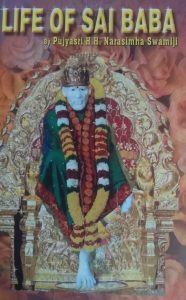
The author of this Book is Pujya Sri H.H. Nara Simha Swamiji- Founder & First President of All India Sai Samaj, Chennai , India.
A) Shirdi Sai Baba:–
Baba’s training, teachings and achievements were of widely different sorts. They were suited to the conditions of each person who approached him. They are also suited to the conditions of those who approach him now.
Baba is still a Guru, a Divine Personality. He is not a mere abstraction. He can be seized by those who are in dead earnest.
Unfortunately for mankind, very few are so earnest. Most stop with raising preliminary questions, as to the impossibility of such an experience or its undesirability and the various objections, from the standpoint of the learning that they have already acquired.
If the highest is not possible at the present moment, Baba suitably develops them. This development occurs either in this life or in the life beyond. Baba has repeatedly undertaken to guide his devotees. He promises to guide them life after life, and to be born with them for that purpose.
–By H.H. Narasimha Swamiji, Author of this Book, in his Preface
B) Parts of this Book-LoSB on Sai Baba.
The object of this book, is to help people to realise more and more the great work, that is being done by Shirdi Sai Baba and his essential greatness. This Book consists of four Volumes /Parts.
Part I- History, Personality, Nature, Functions of Sai Baba
The early history and accounts of Baba and the materials are necessary to understand Baba as a Samartha Sadguru. He will help one to attain the highest in life. At the same time, He enables one to get the other incidental benefits of contact with such a saint.
Part II -Sai’s Apostles and Mission
This second part mainly consist of Baba’s dealings with various prominent persons. It shows how they were drawn to him and influenced by him. It also illustrates what progress they made. Additionally, it details how they were helped to make it by reason of their contact with him.
Most of the Bhaktas were drawn for specific temporal gains, but they stuck on and became very good Adherents of Baba.
Part III. -Baba’s Lovers
Baba’s prominent devotees, not in Part II, must come into here. They like something unintelligible, “just like Love at first sight of a pure Girl with a pure bachelor”.
Part IV- Life and Teachings of Sai Baba
Which as the residuals and final part must include general matter not covered by the previous parts. The spiritual and mystical personalities, such as Saints like Sai, embody an adventurous and worthy life. They think intellectually in the pursuit of their lives.
The life of Sai Baba especially gives a very tough treat for the spiritual seekers. Only a few writings present so vivid a picture of the life and teachings of Sai Baba. They do so in such a descriptive form. For this reason, this volume stands out.
C) Baba provided Ankita children for this Book Project
Sri Krishna says, ‘Those who rescue my entirely devoted bhakta from his troubles, I shall rescue and help them. I will save them from all troubles and calamities. A boat rescues one in the ocean in the same way’. Baba somehow gives the feeling to the author’s helpers, that they are being looked after by him.
Baba provided his Ankita child with a stenographer who, out of modesty, wishes to conceal his light under a nom-de-plume R.R. Without the help of a stenographer, turning out any work would be impossible. This applies to work for the book, for the Sai Sudha, or for the numerous pamphlets constantly requisitioned by others from this author.
Since October 1953, the author’s health has been extremely unreliable. The work would have been impossible without the due provision of medical help. Here again Baba’s help to his Ankita child is remarkable. Baba designated a doctor in a very good position. The doctor had excellent knowledge. Baba made him repeatedly attend without receiving any recompense at all.
Baba’s grace alone made the work see the light of day. It also aided in getting the means for publication. The royal present of Rs.5,000 by His Highness The Maharaja of Mysore, enabled the All India Sai Samaj to purchase a Press and Types.
There may be numerous others (Sri Dewan Bahadur R.V. Krishna Ayyar and Miss Indira, Professor of English, etc) who have helped this author in the course of getting up this book.
Stage after stage, idea after idea, and reference after reference, the remarkable help that was suddenly forthcoming was the clearest evidence to the Author that, Baba is giving unstinted support for this publication. Fact it is not mere modesty, but love of truth that makes the author say that, “the real producer of this book is Baba himself“.
– By B.V. NARASIMHA SWAMI, Author in Preface to Part I in 1955
D) After studying “Life of Sai Baba”
A properly written life of Sai (like all saintly biography, cf. “Jo Sant, Toch Dev” i.e. Saint is himself God) would be a scripture in itself.
One should rise from that study with the feeling that they have been through scripture. They should mentally keep in touch with God. This allows them to derive all benefit necessarily flowing from such contact.
The benefits are temporal, intellectual, moral, spiritual, etc. There is no limit to the benefit one can derive from such contact.
A saint’s life is like the milk of the ocean. From it, one might extract, a few interesting bits of saintly biography. It also offers a collection of apothegms, counsels, reflections and other miscellaneous items. But the main interest is still the milk of ocean. It will yield an infinite and inexhaustible supply of divine nectar.
The essentials of the Bhagavad Gita, for instance, have always been regarded as a valuable religious mine. They have been found to embody what is contained in Sri Sai’s life. Sri Krishna and Jesus Christ are better understood, after studying Sai Baba’s life than without such study.
PS: The collection of data was made for this book project, by the great author, after 36 years of Sai Baba’s Mahasamadhi. (LoSB-Ch 1)
“It is our earnest desire and intention that, the book of “Life of Sai Baba” written by our revered Founder and First President H.H. Narasimha Swamiji, to reach the hands of numerous Sai Devotees, who are earnestly interested in attaining “Sai Bliss”. –By the Publisher, Management of All India Sai Samaj, Chennai-600004, India
“Presenting the Great Master Sri Sai Baba to the world through his intensely dedicated service, Sri Narasimha Swamiji has made himself into a living golden link between the present generation and Sri Sai Baba. Yes, Sri Swamiji is still active from His tomb. He guides millions of devotees to the feet of his Master.
This book will surely fulfill its glorious task of helping, guiding and transforming countless lives on their onward progress towards Divine Perfection. All glory to Sri B.V. Narasimha Swamiji Maharaj! Glory, Supreme glory to Samartha Sadguru Sai Baba!” – In Foreword to Part 1 by -By His Holiness Sri Swami Sivananda of Divine Life Society, Rishikesh, India.
“During the last 20 years, thanks to Swamiji’s energetic propaganda and publicity, Shri Sai Baba has attracted devotees from far and near, as also from all sects, communities and religions. They come from all sections of the society and, in particular, from its intelligentsia. In the case of the latter, one has to carry them across the fields of doubt and scepticism before they reach the other shore of spiritual enlightenment; and are safely and for ever established on the bedrock of faith in and devotion to the Divinity that Shri Sai Baba WAS and IS”. -In Foreword to Part II by Sri B N Datar, then Home Minister, Government of India
Extract from Pujyasri H.H. Nara Simha Swamiji’s ‘Life of Sai Baba’ book-LoSB
Correct knowledge of facts connected with the lives of saints is good for the individual who knows them. It is also beneficial to society. In the long run, it promotes social unity. It encourages ethical, spiritual, and religious study and endeavor. Lives of saints provide more than information, for the reader’s brain. They offer sustenance…
Earnest readers, who are anxious to study the history of Sai Baba (who realised in himself the perfection of Godhead by attaining Purnalaya) -concentrating his mind always on God with intense love from his earliest period of life; and -thereby attained Aikya (merge with God), -so that he could say Mainm Allahum, that is Aham…
“There has not been a good biography containing a fair, full and faithful description of Sai baba’s life. Other small sketches or introduction to Baba’s life have been published in English and other languages, but these also are too tiny to deserve the name of a biography, sketches of a few early incidents in Baba’s…
“5 minutes Nov 7, 2024 4:45 PM The author of this Book is Pujya Sri H.H. Nara Simha Swamiji- Founder & First President of All India Sai Samaj, Chennai , India. A) Shirdi Sai Baba:– Baba’s training, teachings and achievements were of widely different sorts. They were suited to the conditions of each person who approached…
I request the readers to leave out the various hindrances viz. indolence, sleep, wandering of mind, attachments to senses, etc. and turn their whole and undivided attention to these stories of Sai Baba. Let their love be natural, let them know the secret of devotion; let them not exhaust themselves by other Sadhanas, let them…
Govind Raghunath Dabolkar, called Anna Saheb Dabolkar, was Mamlatdar and first class resident Magistrate.
His work ‘Sai Satcharitra’ in Marathi Ovi verse extends to a thousand pages. Maharashtra Sai bhaktas treat it as Sai Ramayana or modern Guru Charitra. They give it the respect due to ancient puranas. Even others respect it when they gain access through N.V. Gunjaji’s English adaptation or translations in Telugu, etc.
This work is highly meritorious and has been the instrument for many people becoming Sai bhaktas. The verses are highly sonorous. The stories about Sai Baba collected from various individuals are based on actual experiences. These stories have great charm and are always fresh.
On his first visit to Shirdi and Sai Baba in 1910, went to the mosque. He and his friend Bala Saheb Bhate prostrated before Baba. Baba pointed to Dabolkar and said, ‘What talk was going on there at the wada? And what did this Hemad Pant say (pointing his chin to Dabolkar)?’. Dabolkar’s name was not Hemad Pant at all.
Hemadpant-“I began to think why Sai Baba should call me by the name Hemadpant. This word is a corrupt form of Hemadripant.
This Hemadripant was a wellknown Minister of the kings Mahadev and Ramadev of Devgiri of the Yadav dynasty. He was very learned and good-natured. He authored good works, such as Chaturvarga Chintamani (dealing with spiritual subjects) and Rajprashasti. He invented and started new methods of accounts and was the originator of the Ovi (Marathi Shorthand) script.
But I was quite the opposite, an ignoramus, and have dull, mediocre intellect. I could not understand why the name or title was conferred upon me. However, after thinking seriously about it, I thought that the title was a dart to destroy my ego. This way, I should always remain meek and humble. It was also a compliment paid to me for the cleverness in the discussion#. (# before he started from Wada/Lodge to Sai Temple, he had some hot discussion with Bala Saheb Bhate about”Guru’s essential ” for 30 minutes)”.
Looking to the future history, we think that Baba’s word (calling Mr. Dabholkar by the name Hemadpant) was significant and prophetic, as we find that he looked after the management of Sai Sansthan very intelligently, kept nicely all the accounts and helped greatly in the publications of ‘Sai Lila Masik (Magazine)’ also as the author of such a good work “Shri Sai Satcharita (SSSC)”, which deals with such important and spiritual subjects as Jnana, Bhakti and dispassion, self-surrender and self-realization.
The premier poet-saint of Maharashtra (India), Shri Jnaneshwar Maharaj, has stated that the Lord loves those who write the lives of saints;
and the saints also have a peculiar method of their own of getting the service, which the devotees long for, successfully accomplished.
The saints inspire the work; the devotee becomes only an indirect cause or instrument to achieve the end.
For instance, in 1700 Shaka* year (AD year=78 + Shaka year) the poet Mahipati aspired to write the lives of saints. Saints inspired him, and got the work done;
So also in 1800 Shaka year, Das Ganu’s service was accepted.
The former wrote 4 works-Bhakta Vijaya, Santa Vijaya, Bhakta Leelamrit and Santa Kathamrit, while the latter wrote two – “Bhakta Leelamrit and Santa Kathamrit“, in which the lives of modern Saints were described. In chapters 31,32,33 of Bhakta Leelamrit and in chapter 57 of Santa Kathamrit, the sweet life and teachings of Sai Baba are very well depicted. These have been separately published in Sai Leela Magazine, Nos. 11 and 12, Vol. 17; the readers are advised to read these chapters.
So also Sai Baba’s wonderful Leelas are described in a small decent book named Shri Sainath Bhajana Malaby Mrs. Savitribai Raghunath Tendulkar of Bandra.
Das-Ganu Maharaj also has composed various sweet poems on Sai Baba.
A devotee named Amidas Bhavani Mehta has also published some stories of Sri Baba in Gujarathi;
some Nos. of Sainath Prabha, a magazine published by Dakshina Bhiksha Sanstha of Shirdi, are also published
Sai Samasthan itself published Rao Bahadur M.W. Pradhan’s book ‘A glimpse of Indian spirituality‘ but it ran upto about 25 to 30 pages and set out just a handful of facts about Baba.
When devotees came to Baba and asked Him certain questions. He sometimes answered them in part, and asked them to go and listen to the readings of the following* works, which are the main treatises of Bhagwat Dharma. When the devotes went and listened, they got full and satisfactory replies to their questions
* well known Marathi book named ‘Nath-Bhagwat.’ This is a commentary by the Saint Ekanath, on the eleventh Skandha (chapter) of the bigger Sanskrit work, the Bhagwat.
At the suggestion or recommendation of Sai Baba, Messrs. Bapusaheb Jog and Kakasaheb Dixit read daily in Shirdi,
BhagwadGeeta with its Marathi commentary named Bhawartha-Deepika or
Jnaneshwari (A dialogue between Krishna and His friend devotee Arjuna) and
Nath Bhagwat (A dialogue between Krishna and His servant devotee Uddhava) and also
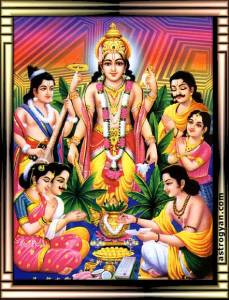
People in the Maharashtra, India always celebrate God Satya-Narayana Puja in their homes every fortnight or month.
When they are suffering from any problem, they say, ‘I do Satya Narayana Pooja.’ After getting rid of the problem, they performed the Satya Narayana Puja.
In all Sai Baba Temples, Sai Satya-vrata Puja is performed instead of Satya Narayana Pooja. People choose to recite the Sai story. It was told in three figurative verses. These were from the book “Bhakta Liyamaruth” composed by Daskanu Maharaj.
Satya Narayana Puja will be held daily at 7 am and 9 am in Shirdi. At the end of the prayer, the priest reads the three stories in Marathi. He reads them on behalf of all the devotees present. Then the offering will be given.
If you have time, please attend the Sai Satya Narayana puja, at Shirdi Mandir(RS.100 per couples), and also do monthly Pooja at your home in front of Satya Narayana picture and get Health, Wealth and Happiness









 Welcome to https://ShirdiSaiBaba.InterNational