
Welcome to https://ShirdiSaiBaba.InterNational

Thanks SSS Trust, Shirdi

"I draw to Me, My man from far off or even across the seven Seas to Shirdi, like a sparrow with a string fastened to its feet"-Shirdi Sai Baba, Indian Spiritual Guru-God


Tag: Kindness

  • Devotees need one? then SSST is providing

    Devotees need one? then SSST is providing

    Yes, Shirdi Sai Sansthan Trust is providing all services and amenities needed for every devotees, viz: –

    Free Darshan

    • General Free Darshan: Visitors can enjoy free darshan at Shirdi Sai Baba Temple.
    • Senior Citizen Free Darshan: Senior citizens are entitled to free darshan along with one accompanying person.
    • Free Darshan for Parents of Infants: Parents visiting with infants can avail of free darshan.
    • Free Darshan for Pregnant Women: Pregnant women are also granted access to free darshan.
    • Special Free queue for Differently abled persons.
    • Quick darshan pass for all at Rs.200, including foreigners with other country passports. Buy it Even at Airport.
    • DIY kiosks for Online Paid pass at Rs.200

    Prasadalaya and Refreshments

    • Free Food at Prasadalaya: A complimentary meal service is available to all visitors. 4000 seats. Between 10AM to 10PM
    • Free Tea/Coffee in Darshan Complex: Refreshments in the form of tea and coffee are offered free of charge.
    • Free Bundhi Prasadam: Visitors can receive free Bundhi prasadam along with Udhi/ Holy Ash.

    Facilities

    • Free Bus for transit between temple, accommodations, and Prasadalaya.
    • Reading Hall: A dedicated reading hall is available with multi-language books for visitors to enjoy a peaceful reading experience.
    • Free Meditation Hall: The meditation hall is open for visitors seeking tranquility and spiritual connection.
    • Free Shoe Stand: Shoe stand service are provided at no cost for the convenience of visitors.
    • Mobile stands to keep phone at Rs. 5 only
    • Luggage Lockers.

    Affordable Refreshments and Shops

    • Less Cost Tea, Coffee, Water Bottles, Cool Drinks, Ice Cream: Refreshments are available at reasonable prices.
    • Flower Shop: A flower shop is near Gate No.1, for those wishing to purchase offerings.
    • Prasadam Shop: Visitors can also buy prasadam from the Staffs co-operative store.

    Accommodation and Health Services

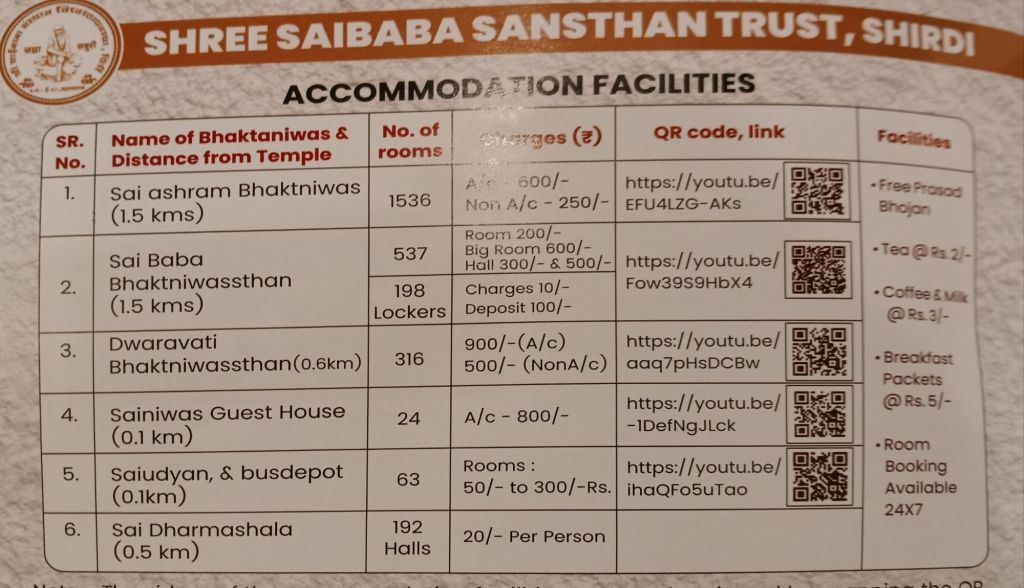
    • Moderate Rental Rooms for Families: Comfortable and safe rooms are available for families at moderate rates.
    • Dormitory for Individuals: There is a dormitory facility for individual visitors seeking budget-friendly accommodation.
    • Baby feeding Cubicles for Mother feeding.
    • Free Hospital Services: A hospital is available for visitors in need of medical attention; in addition to First Aid.

    These services aim to enhance the spiritual experience and comfort of all visitors to avoid private, at Shirdi by SSST.

    In addition to the above, SSST is also supporting many community service Schemes.
    Thanks SSST Souvenir
  • Self-Affirmation from Chapter XXII of SSSC for Sai Baba devotees

    Self-Affirmation from Chapter XXII of SSSC for Sai Baba devotees

    1. 🛐I meditate on Sai Baba’s Holy Feet, as they are the only means of my happiness and attaining the supreme goal of life .
    2. 🪔I am egoless and humble and meditate on Sai Baba Light (His toe & spread of index and middle figures on it) to attain devotion .
    3. 🏥I trust that the Dwarakamayi (Mosque) wards off all dangers and anxieties from those who sit on her lap and gets Bliss.
    4. 💆I trust Sai Baba prophecy, knowing that He anticipates my calamities and wards them off in time .
    5. 💃I believed that Sai Baba’s words are promises of fearlessness .
    6. 🐍I accepted the spiritual truth that God lives in all beings and creatures, even serpents or scorpions .
    7. 🥰I love and take pity on all creatures, leave off adventurous fights and killings, and be patient .
    8. 🤡I trust that unless God wills it, nobody can do any harm to others .
    9. ⛽I realized that Sai Baba, by His actions, shows Himself to be the Controller and All-pervading .
    10. 🚪I hold fast to Sai Baba, knowing that He has the capacity to save me from any danger .
  • Self-Affirmation from Chapter VIII of SSSC for Sai Baba devotees

    Self-Affirmation from Chapter VIII of SSSC for Sai Baba devotees

    1. 🧍I got lucky a human body, which is essential for attaining God-vision.
    2. 🧘I use my body to achieve God-vision or self-realization, the supreme end of life, without neglecting or pampering it .
    3. 🏃I strive with all earnestness and speed to attain my end-goal, casting aside sloth and laziness .
    4. ☀️My mind is filled with bliss and joy in the company of the Saint (Sai Baba)
    5. 👁️I accept the moral to “See God in all beings,” so I always feed the hungry, first.
    6. 🛐I consistently remember the service and penance (Upasana) I practice, which benefits me greatly.
    7. 📿I believe Sai Baba is a liberal and charitable Fakir, always engrossed in the Self .
    8. 🧚I trust that Sai Baba will make me happy in this world and the next .
  • FAQ about Sai

    FAQ about Sai

    Basic About Shirdi Sai Baba

    1. Who is Sai Baba according to spiritual understanding?

    Sai Baba is regarded as a divine and universal being who transcends religious boundaries. He embraced both Hindu and Muslim traditions, showing the unity of all paths to God. He is honored as a Sadguru and divine incarnation guiding humanity.

    2. Why did Sai Baba keep his religion and origins unclear?

    To emphasize that God is beyond caste, creed, or identity. His life showed that love, devotion, and righteousness matter more than religious labels. His universality is a teaching in itself.

    3. How did Sai Baba show omniscience and omnipresence?

    Baba revealed people’s inner thoughts, distant events, past karmas, and future happenings. He knew vows, secrets, and life circumstances of devotees. He declared, “My abode is in your heart,” indicating His ever-present awareness.

    4. Why did Sai Baba live such a simple and humble life?

    Baba lived in a simple mosque, begged for food, and owned nothing. This demonstrated His perfect humility, detachment, and closeness to all beings—including animals that freely ate from His bowl.

    5. What is the role of a Sadguru?

    The Sadguru removes the disciple’s ignorance, destroys ego, purifies past karmas, and leads them across the worldly ocean. Baba, as a Sadguru, transforms devotees from within and reveals their true divine Self.

    6. How did Sai Baba transform the inner lives of devotees?

    His darshan purified thoughts, weakened past karmas, awakened devotion, and increased dispassion. Baba transformed the character and consciousness of devotees, making them peaceful, compassionate, and spiritually aware.

    7. What were Sai Baba’s central teachings?

    Faith (Shraddha), Patience (Saburi), complete surrender, charity, non-attachment to wealth, truthfulness, service to others, and constant remembrance of God or Guru. He taught devotion through simple living and pure heart.

    8. What was Baba’s teaching about slander or criticism?

    Baba taught tolerance and silence in the face of criticism. “Let anyone speak hundreds of things; do not retaliate.” He taught that slander harms the one who spreads it—reducing them spiritually.

    9. Why did Baba accept service from devotees?

    Baba accepted service only to bless and purify devotees, not because He needed anything. Service transformed the devotee’s heart, deepening humility and devotion.

    10. Why did Sai Baba perform miracles?

    Baba’s miracles—healing, protection from danger, guiding events, fulfilling worthy desires—strengthened faith, removed suffering, taught lessons, and drew devotees closer to God. They were never for display.

    11. How did Baba guide devotees during hardships?

    Sometimes with love, sometimes with sternness. His scolding was often a “blessing in disguise” meant to remove karmic impurities or redirect devotees to the right path.

    12. What is Sai Baba’s ultimate spiritual message?

    That God lives in all beings, love is the highest path, and surrender to the Guru brings inner peace, spiritual protection, and liberation. Baba unites all religions and teaches devotion beyond boundaries.

  • Baba inspires New Seekers. See How

    Baba inspires New Seekers. See How

    New seekers can find immense inspiration in the accounts of Sai Baba for several reasons, primarily stemming from His divine characteristics, accessible teachings, and the profound impact He had on His devotees:

    • Omniscience and All-pervasiveness:

      • New seekers are inspired by Sai Baba’s ability to know all events, past, present, and future, regardless of distance.
      • This quality reassures devotees that Baba is aware of their struggles and intentions, no matter where they are.
    • Curing Maladies and Fulfilling Desires:

      • Baba’s power to cure ailments and fulfill desires inspires many.
      • Stories of His miraculous healings, including serious diseases, highlight His divine capability.
      • He has helped childless devotees and resolved various life challenges, fostering hope for others.
    • Ease and Simplicity of Devotion:

      • The simplicity of devotion to Baba is appealing to newcomers.
      • He did not require complex rituals but encouraged remembering His name, listening to His stories, and meditating on Him.
      • These practices promote spiritual growth accessible to everyone.
    • Nature as a Sadguru and Divine Incarnation:

      • Baba is viewed as a true guru and a manifestation of God, aiming to uplift humanity.
      • His compassion and unconditional love exemplify his divine nature.
    • Acceptance and Unity:

      • Baba’s disregard for caste or religious distinctions inspires many.
      • He honored festivals from both Hindu and Muslim traditions, promoting unity and acceptance in devotion.
    • Grace and Spiritual Progress:

      • Seekers find inspiration in the idea that Baba’s grace leads to rapid spiritual growth.
      • He emphasized surrendering ego and having faith for self-realization and bliss.
    • Ever-living Presence:

      • The belief that Baba remains “ever alive” after His passing provides comfort to devotees.
      • His tomb is thought to still communicate with those who devote themselves to Him.
    • Being “Drawn” to Shirdi:

      • The notion that devotees are “drawn to Shirdi” suggests a divine guidance in their journey.
      • This belief brings comfort and assurance that their arrival is orchestrated by Baba.
  • Selflessness

    Selflessness

    Baba’s Selflessness:

    • Life of Mendicancy: Despite His divine status, Baba lived a life of mendicancy. He begged for food from five houses daily and did not care for the taste of the mixed food. He also did His own grinding for cooking.
    • Generous Distribution of Wealth: “The money He used to collect as Dakshina was freely distributed, Rs.20 to some, Rs.15 or 50, to others everyday.”. He “would distribute the whole amount the same day, and the next morning He would become a poor Fakir as usual”. He only used a very small portion for Himself (chilam and fuel).
    • Taking on Devotees’ Suffering: Baba literally absorbed the ailments and sufferings of His devotees onto Himself.
      • He displayed four bubos on His own body, stating to Mrs. Khaparde, “See, how I have to suffer for My devotees; their difficulties are Mine.“.
      • Similarly, He burnt His arm to save a blacksmith’s child from a furnace, proclaiming, “I do not mind My arm being burnt, but I am glad that the life of the child is saved”.
      • He “always worked for the good and welfare of others, Himself suffering unbearable and terrible pain many a time in the process”.
    • He readily allowed a peculiar devotee named Nanavalli to take His seat, showing not “the slightest displeasure”. He was described as “meek, humble and egoless”.
    • Disregard for Worldly Possessions and Fame:
      • He had “no love for perishable things” and
      • “never cared for wealth and fame”.
      • His entire “property” consisted of a koupin, a piece of cloth, a Kafni, and a tinpot, and He disliked devotees bringing costly articles.
      • He was “indifferent” to pleasures and misfortunes, treating kings and paupers alike, and did not care for honor or dishonor.
    • Focus on Spiritual Welfare: Baba’s actions and teachings were consistently aimed at the spiritual welfare and liberation of His devotees.
      • He stated, “The Lord (God) is the Protector of all.“.
      • He emphasized simple devotion and faith over complex rituals. He asked devotees to remember “Sai, Sai” to remove shackles and attain freedom.
      • He guided devotees to self-realization by diverse methods suited to individual needs.
    • Disapproval of Fasting:
      • Baba neither fasted nor encouraged it in others, believing that “God is not attained on an empty stomach”. He would gently insist that devotees eat, as seen
      • when He made Mrs. Gokhale prepare and eat Puran Polis despite her vow to fast.
      • This illustrates His care for devotees’ physical well-being as a foundation for spiritual pursuit.
    • Teaching Renunciation and Purification:
      • Baba’s act of asking for Dakshina was not out of desire for money,
      • but to teach devotees “the lessons of Renunciation and Purification” and
      • to remove their “attachment to money”.
      • He clarified that whatever was given to Him, He had to return a hundredfold, showing it was a means for the devotee’s benefit rather than His own
    • Profound Humility: Baba lived a life of immense humility. He referred to Himself as “Slave of slaves,” “your debtor,”; considering Himself blessed by His devotees’ presence.

    Baba exemplified selflessness through his mendicant lifestyle, generously distributing wealth collected as Dakshina. He absorbed his devotees’ suffering, prioritizing their welfare over his own desires. Indifferent to worldly possessions, Baba focused on spiritual liberation, advocating simple faith and rejecting fasting. His teachings emphasized renunciation and humility, reflecting profound devotion to others.

  • Promoting Love

    Promoting Love

    Sai Baba actively promoted love and unity, both among his devotees and towards animals, through his teachings, actions, and the examples he set. Here’s how the sources illustrate these aspects:

    • Unification and Harmony:
      • Sai Baba worked towards the unification of communities, particularly Hindus and Muslims.
      • He celebrated Hindu festivals like Rama-Navami with all due formalities.
      • He also permitted the ‘Sandal’ procession of Mahomedans and allowed Muslims to offer prayers (Namaj) in his Masjid. This demonstrated his disregard for religious distinctions and his wish for communal harmony.
      • His constant advice was that “Rama (the God of the Hindus) and Rahim (the God of the Mahomedans) were one and the same.” He emphasized that their devotees should not quarrel. Instead, they should “join hands and bring both the communities together” for national unity.
    • Fostering Unity and Eradicating Duality: Baba emphasized the importance of dissolving the sense of difference between individuals and with God.
      • He explicitly stated, “Demolish the wall of difference that separates you from Me; and then the road for our meeting will be clear and open. The sense of differentiation, as I and thou, is the barrier that keeps away the disciple from his Master, and unless that is destroyed the state of union or atonement is not possible“.
      • This teaching directly supports universal love by promoting the realization of oneness.
    • He also encouraged his devotees to love their Guru with whole-hearted affection. He advised them to surrender completely. He suggested prostrating reverentially before Him to attain this unity.
    • Direct Instruction on Conduct:
      • Baba provided invaluable general advice for interacting with others:
      • If any men or creatures come to you,
        • do not discourteously drive them away,
        • but receive them well and treat them, with due respect.
      • Shri Hari (God) will be certainly pleased, if you give water to the thirsty, bread to the hungry, clothes to the naked, and your verandah to strangers for sitting and resting“.
      • This emphasizes hospitality, compassion, and respectful treatment of all.
    • Discouraging Slander and Gossip: Baba strongly disliked slander.
      • He stated, “He who carps and cavils at others, pierces Me in the heart and injures Me, but he that suffers and endures, pleases Me most“.
      • In one instance, he corrected a slanderer by pointing to a pig eating filth and comparing the slanderer’s actions to the pig’s,
      • thereby teaching a powerful lesson against reviling others.
    • Personal Relationships and Care: Baba demonstrated deep personal love and care for his close devotees.
      • He shared his dormitory with Tatya Kote Patil and Bhagat Mhalsapati for 14 years, showing immense affection and intimacy.
      • He loved Khushalchand of Rahata and “watched his welfare, day and night,” even visiting him.
      • He exhibited “motherly love” towards his disciples, knowing their wants and feeling boundless joy when they were adorned.
      • He ensured the proper execution of religious functions in devotees’ homes, even attending a dinner in Mr. B.V. Deo’s house through an appearance.
      • His “anger” was often a disguise for blessings or tests, as seen
        • when he appeared enraged with the women grinding wheat but later smiled at their devotion, or
        • when he seemingly scolded Haji Sidik Falke only to then show him great favor.
    • He sometimes appeared in dreams or visions to guide and comfort his devotees, like the instance of Hemadpant’s Shimga dinner.
    • Importance of Guru-Disciple Relationship: Baba emphasized
      • complete surrender and unwavering faith in the Guru, assuring that such
      • devotion leads to spiritual progress and self-realization. This deep bond fosters profound love and trust.
    • Saints, like Baba and Shri Tembye Swami, are shown to love each other with “fraternal affection,” indicating a wider spiritual family bound by love.

    Promoting Love with Animals:

    • Oneness with All Creatures: Sai Baba explicitly taught the principle of seeing God in all beings, including animals. When Mrs. Tarkhad fed a hungry dog, Baba told her, “The dog which you saw before meals and to which you gave the piece of bread is, one with Me, so also other creatures (cats, pigs, flies, cows etc.) are one with Me. I am roaming in their forms. He, who sees Me in all these creatures is My beloved. So abandon the sense of duality and distinction, and serve Me, as you did today“. This is a profound teaching that directly connects compassion for animals with devotion to God.
    • Compassion and Non-violence: Baba’s conduct consistently demonstrated compassion for animals. He never drove away dogs, cats, or crows that ate from his food pot, indicating his acceptance and care for them. He also gave a clear opinion on the killing of serpents, stating, “God lives in all beings and creatures, whether they be serpents or scorpions… So we should take pity and love all creatures, leave off adventurous fights and killings and be patient. The Lord (God) is the Protector of all“.
    • Reminiscences of Past Lives: In a remarkable instance, Baba purchased two goats for a significantly high price, explaining to his surprised devotees that these goats were formerly two human brothers who had fought bitterly and killed each other. He bought them out of pity, fed them, and then returned them. This story highlights Baba’s boundless love and compassion for all creatures, acknowledging their karmic journeys.
    • Protection of Animals:
      • Baba saved his devotees from potential harm from animals like snakes,
      • sometimes by foretelling the danger and
      • other times by direct intervention,
      • but he always advised against killing them,
        • emphasizing universal love and the divine presence in all creatures.
      • Even a fierce tiger was drawn to his feet and found a blessed end in his presence, demonstrating Baba’s all-encompassing mercy towards even wild animals.
  • Baba’s Compassion and Love

    Baba’s Compassion and Love

    Shirdi, Shri Sai Baba’s life is a testament to His boundless compassion, profound gentleness, and unwavering selflessness. He consistently demonstrated these qualities through His actions, teachings, and interactions with His devotees. Here are instances:

    Baba’s Compassion:

    • Protection from Epidemics: Baba displayed compassionate foresight by grinding wheat and having the flour thrown on the Shirdi village borders to curb a cholera epidemic.
      • Villagers understood that He was not only grinding wheat.
      • He was also grinding the cholera itself to pieces. This act pushed cholera, out of the village. This led to the epidemic’s subsidence.
    • Encouragement of Hemadpant: When Hemadpant expressed self-doubt about writing Baba’s biography,
      • Baba gently encouraged him. He blessed him with Udi (sacred ashes) and placed His boon-bestowing hand on his head.
      • Baba assured,
        • “I will help him.
        • He is only an outward instrument.
        • I should write Myself My autobiography and
        • satisfy the wishes of My devotees”.
        • This shows His desire for devotees’ spiritual growth and His loving support.
    • Motherly Love for Disciples: Baba exhibited a unparalleled motherly love towards His disciples. He was always attending to their needs. Sadgurus like Baba have this peculiar and extraordinary love for their disciples.
      • All-Embracing Love and Tolerance:
        • Baba’s all-embracing love was evident in His defense of the Rohilla, who disturbed villagers with loud prayers.
        • Baba took the villagers to task, explaining that the Rohilla’s prayers kept away “Durbuddhi” (bad thoughts),
        • thus protecting even those perceived as troublesome.
    • Omnipresence and Constant Protection: Baba’s statement: “I am the Inner Ruler of all and seated in their hearts. I envelope all the creatures, the movable and immovable world.
    • Curing Ailments through Grace: Baba cured numerous diseases without using conventional medicine. He did so through His Grace, Words, or Udi. This demonstrated His compassion for the suffering. Examples include:
        • Bhimaji Patil’s severe tuberculosis, cured by Baba’s words of hope and mercy, through two dreams.
        • Bala Ganapat Shimpi’s malaria, cured by instructing him to feed a black dog, with rice mixed with curds.
        • Bapusaheb Booty’s dysentery and vomiting, instantly cured by Baba’s command, “Now take care, you should not purge any more” and “The vomiting must also stop”. He also cured in another time, Booty’s cholera with a seemingly fatal remedy, effective due to Baba’s word.
        • A Swami from Alandi’s ear pain, relieved by Baba saying, “Alla Accha Karega (God will do good)”.
        • Madhavrao Deshpande’s piles and Gangadharpant’s stomach-pain, cured by simple words and touch, and Nanasaheb Chandorkar’s stomach-pain with a sweetmeat.
        • A doctor’s nephew of tubercular bone-abscess, cured with Udi and Baba’s “loving glances”.
        • Dr. Pillay’s excruciating guinea-worm pain, relieved by Baba’s command to be ‘fearless’ and allowing an accidental step on the wound, to expel the worms.
        • Shama’s sister-in-law’s bubonic plague, cured overnight by sending Udi and giving instructions.
        • A Harda gentleman’s bladder stone, dissolved with Udi mixed with water.
        • A Bombay lady’s painless delivery, despite a stillborn issue, by her praying to Baba and consuming Udi-mixture.
      • Acceptance of Sincere Offerings: Baba lovingly accepted offerings made with devotion, such as
        • Mr. Cholkar’s small offering of sugar-candy, knowing his secret vow to save money for his trip by abstaining from sugar.
        • He knew devotees’ sincere intentions,
          • even reminding them if they
          • forgot to offer something,
          • demonstrating His acceptance of their inner devotion over the material value.
      • Teaching Non-duality through Action: Baba profoundly taught the principle of “See God in all beings”
        • when He told Mrs. Tarkhad, “Mother, you have fed Me sumptuously… The dog which you saw before meals and to which you gave the piece of bread is, one with Me, so also other creatures… I am roaming in their forms. He, who sees Me in all these creatures is My beloved.“. This practical demonstration encouraged compassion for all life.
      • Drawing Devotees and Fulfilling Desires: Baba had an incredible ability to draw devotees to Shirdi, “like a sparrow, with a thread tied to its feet.” He was omniscient and knew their innermost thoughts and desires. Often, His compassion led Him to fulfill them. Examples include:
          • Knowing Lakhamichand’s taking a loan for his darshan and forgetting to buy guavas, but arranging for an old woman to sell him the fruits.
          • Knowing Damu Anna’s secret thoughts about speculative business and gently dissuading him, saving him from financial ruin. He blessed Damu Anna’s wife with four sons and four daughters, by gave her four mangoes as Prasad. This act overrode astrological predictions.
          • Fulfilling Mrs. Tendulkar’s dream of her son passing his medical examination despite unfavorable astrological predictions, emphasizing faith. He also blessed Mr. Tendulkar with a higher pension after a dream.
          • Ensuring painless death and salvation (Sadgati) for devotees like Sannyasi Vijayanand, Balaram Mankar, and Tatya Noolkar; Even showering flowers on Megha’s body and arranging his funeral rites after his passing shows, deep affection.
        • Compassion for Animals: Baba displayed immense compassion for animals.
          • Notably, he bought two goats for an exorbitant sum. He explained their past lives and their enmity in their previous human forms. Out of pity, he fed them.
          • He also taught not to kill creatures, stating “God lives in all beings and creatures”.
        • Personal Sacrifice for Devotees:
          • A supreme act of compassion was when Baba
          • sacrificed His own life to save Tatya Kote Patil’s life, fulfilling an earlier prophecy that Tatya would pass away, but Baba took his place.

        Shirdi’s Shri Sai Baba exemplified unparalleled compassion and selflessness through numerous acts. He protected villagers from epidemics, encouraged disciples, healed ailments without medicine, and accepted sincere offerings. Baba’s teachings emphasized seeing God in all beings, fulfilling devotees’ desires, and displaying profound love for both people and animals, often embodying true sacrificial spirit.

      • Complete surrender to the Guru involves

        Complete surrender to the Guru involves

        Complete surrender to the Guru encompasses several dimensions, as elucidated in the Shri Sai Sat Charitra:
        Devotion and Remembrance: This entails a total surrender of oneself while consistently recalling the Guru’s presence, with the necessity of continually chanting the Guru’s name.
        Seeing the Guru in all beings: Engaging in meditation on the Guru allows one to perceive Him within every being, thereby bestowing eternal bliss. A true devotee regards every Guru as Krishna.
        Lack of Egoism: This principle mandates the relinquishment of pride and ego, thereby surrendering to the Guru who resides within one’s heart. The removal of egoism and the complete trust in the Lord liberates one from worldly constraints.
        Service: True surrender requires Sarvaswa Sharangati (total surrender) to the Sad-guru, where one must recognize that they are not the sovereign of their own body; rather, the body belongs to the Guru and exists solely to serve Him.
        Faith and compliance: A disciple’s duty and dharma necessitate implicit and prompt adherence to the Guru’s directives.
        Channeling Senses to the divine: Prior to indulging the senses, mind, and intellect in their respective pursuits, it is incumbent to remember the Guru; such remembrance serves as an offering to Him.
        Experiencing Oneness: The individual who approaches the Guru achieves oneness with Him, akin to a river merging with the sea.
        Desirelessness: The Guru liberates His devotees from desires, rendering them free.
        Love: The Guru desires nothing but love for all sentient beings. Genuine love requires earnest affection; thus, where there is true yearning and feeling, God reveals Himself.
        Mindfulness: Regularly chanting the Guru’s name and engaging in meditation fosters the ability to perceive Him in all beings, which in turn grants eternal bliss. A definitive indication of this practice is the attainment of a calm and peaceful mind.

      • Where certain actions or entities are considered better than others

        Where certain actions or entities are considered better than others

        1. A human body is better than other bodies
          • Despite its filth, mucus, and susceptibility to decay, disease, and death, the human body’s special value lies in its capacity to acquire knowledge and attain God-vision, which is impossible in any other birth.
        2. Love is better than intelligence-
          • The pure love of Shirdi women, despite their ignorance, inspired them to compose poems, implying that love is more inspiring than intelligence.
        3. Giving food is better than other charities-
          • While other charities like giving away wealth, property, and clothes require some discrimination, offering food requires no such consideration.
          • Also, the merit of feeding lame, crippled, blind, and diseased paupers is much greater than that of feeding able-bodied persons and relations.
        4. Butter-milk (Leelas) is better than Milk (Darshan)-
          • If one desires to see Sai Baba’s but they did not get any opportunity of taking His darshan, their quest for milk (darshan) will be, to a great extent, satisfied by the butter-milk (Leelas).
        5. Remembering and chanting Hari’s and Guru’s name confers salvation is better than getting the powerful Bhakti of the Nathas-
          • one Madhavarao did not like Kakasaheb’s pessimistic attitude of how to get the powerful Bhakti of the Nathas, as he said, ‘has not Baba told us authoritatively that remembering and chanting Hari’s and Guru’s name confers salvation? Then where is the cause for fear and anxiety?’
        6. The observance of the vow of silence is the best way of praising the Sad-guru-
          • In reality, the observance of the vow of silence is the best way of praising the Sad-guru.
        7. Having recourse to Sai Baba’s Feet and surrendering to Him is the best luck-
          • The best luck is to get an opportunity to have recourse to Sai Baba’s Feet and surrender to Him, than any other