

Shirdi, Maharashtra: The Shri Saibaba Sansthan Trust has received a distinguished offering from a Dubai-based devotee, who has donated an intricately carved, gold‑plated frame for the northern window, inside the Shirdi Temple. This window is deeply revered by pilgrims as it provides the sacred Mukhashadarshan—a direct view of Shri Saibaba’s idol in the Samadhi Mandir.
The newly installed frame, crafted with detailed gold workmanship, has already become a point of admiration for thousands of devotees visiting the shrine each day. Its presence enhances both the devotional atmosphere and the architectural beauty of the Temple.
Ceremonial Installation
Before installation, the Sansthan performed a traditional vidhivat puja, marking the auspicious beginning of the offering. Following the ceremony:
– Official Felicitation: Sansthan Chief Executive Officer Goraksha Gadilkar formally honored the devotee for their generous contribution.
– Respecting Donor’s Wishes: In accordance with the donor’s request, the Sansthan has maintained complete confidentiality regarding their identity.
A Continuing Tradition of Devotion
The Shri Saibaba Sansthan Trust continues to welcome heartfelt acts of devotion from devotees across the world. Contributions such as this not only enrich the spiritual ambience of the Temple but also strengthen Shirdi’s role as a global center of faith and inspiration.
Category: NEWS
-

Dubai Devotee Donates Gold‑Plated Frame to Shri Saibaba Sansthan
-
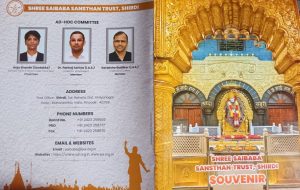
Shirdi Trust served 8 Lakh devotees
On the occasion of the Christmas holidays and the 2026-New Year celebrations, the Shri Saibaba Sansthan Trust, Shirdi organized the ‘Shirdi Festival’ from December 25, 2025, to January 2, 2026.
Goraksha Gadilkar (IAS), Chief Executive Officer of the Sansthan, reported that over 8 lakh devotees visited the shrine, contributing a total donation of approximately ₹23.29 crore.
- Viz: Total Cash collection of ₹22.03 crore through various channels. (Rs.16.83 lakh worth Foreign Currencies from 26 countries.)
- 293.91 grams of gold and 5.98 kg of silver &
- a gold and diamond-studded crown weighing 655 grams, valued at approximately ₹80 lakh.
Sansthan Trust served:
- Free Meals: Over 6 lakh devotees at the Shri Sai Prasadalaya.
- Food Packets: Over 1.09 lakh food packet service.
- Ladoo Prasad: 7.67 lakh packets were sold, for ₹2.30 crore.
- Free Boondi Prasad: 5.76 lakh packets were distributed.
CEO emphasized that these funds are utilized for the Shri Saibaba and Shri Sainath Hospitals, educational institutions, charitable medical aid for outpatients, and enhancing infrastructure and social welfare projects for devotees.
-
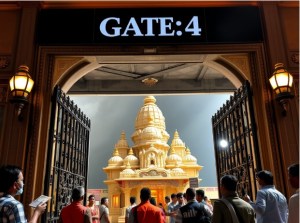
Entry Pass at Gate 4 of Shridi Mandir
New special initiative for devotees and local citizens.
An entry pass system has been implemented at Gate No. 4 of Sai Baba Mandir in Shirdi. This initiative has facilitated access to the temple premises; yet, it does not grant entry into the Main Mandir.
- Devotees engaging in visits
- to the Shree Shanaishwar, Shree Ganesh, and Shree Mahadev temples
- for meditation purposes (at the Reading and Meditation Hall)
- as visitors in the Administration Office
- all occurring within the Samadhi Mandir premises
(You) can use Gate No.4, avail this Entry pass and go for the above purposes
- Devotees engaging in visits
-
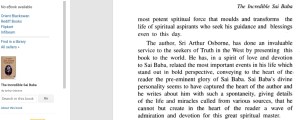
Study materials available to Foreigners, interested in Shirdi Sai Baba.
Foreign individuals seeking to understand the life, teachings, and global influence of Shirdi Sai Baba have access to a wide array of study materials.1. Academic Works
Academic studies offer a structured, critical, and contextual understanding of Shirdi Sai Baba, often distinguishing historical facts from hagiographical embellishments.
As per (Thanks) Oxford Bibliographies:-
“Academic study of Shirdi Sai Baba has emerged within the past several decades as scholars of religion in South Asia began to engage in a wide array of studies of popular saints and gurus;
and as they observed the rapid growth in devotion to Shirdi Sai Baba in particular within the Indian subcontinent and, eventually, beyond India.
White 1972 provided the first academic analysis of Shirdi Sai Baba, noting his growing popularity in western India and attributing it to the unifying bond created between Sai Baba’s devotees, a bond that crosses distinctions of caste, class, and social status.
Antonio Rigopoulos 1993 is the first book-length academic study of Shirdi Sai Baba, which presents a biography of Sai Baba in the first half that draws upon Hindu-authored hagiographies, and presents Sai Baba’s key teachings in the second half with an emphasis on interreligious tolerance.
Warren 2004 includes a valuable translation of the diary kept by Abdul Baba, a Muslim follower of Sai Baba in Shirdi, and draws upon that to present an interpretation of Sai Baba as a Muslim fakir who traveled the Sufi path.
McLain 2016 traces Shirdi Sai Baba’s rise from small village guru to global phenomenon, using a wide range of textual, material, and visual sources to investigate the different ways that Sai Baba has been understood and the reasons behind his skyrocketing popularity among Hindus in particular.
The edited collection Srinivas, 2022 provides insight into the worship of Sai Baba beyond the village of Shirdi in the early twentieth century, with essays that examine more contemporary worship at multiple sites within India as well as in Asia and Africa.
Several articles also make valuable contributions to the study of Shirdi Sai Baba:
Hardiman 2015 analyzes the miracle healing cures associated with Sai Baba and the relationship between his spiritual power and secular science;
Rigopoulos 2012 analyzes some of Sai Baba’s miracles in connection with yoga powers;
Vicziany 2016 examines the worship of two syncretic figures, Shirdi Sai Baba and Haji Ali, in the city of Mumbai, India; and
Loar 2018 compares the hagiographies of Shirdi Sai Baba that were written by two of his Hindu followers, Dabholkar and Narasimhaswami.”- Thanks Oxford for your article at www.oxfordbibliogrsphies.com.
Cambridge University
Cambridge University have explored aspects of Sai Baba’s life and the movement he inspired.
1. Academic Research and Publications:
* Cambridge Core: Cambridge University Press has published academic works that discuss Shirdi Sai Baba and the broader Sai Baba movement.
* Smriti Srinivas’s article, “Sai Baba: The Double Utilization of Written and Oral Traditions in a Modern South Asian Religious Movement,” published in Diogenes, examines the origins of the Sai Baba movement rooted in Shirdi Sai Baba.
* Another article in Comparative Studies in Society and History titled “Miracle Cures for a Suffering Nation: Sai Baba of Shirdi” explores his popularity and perceived ability to provide miraculous cures.
* The “Cambridge Companion to New Religious Movements” features a chapter by Tulasi Srinivas on the Sathya Sai Baba movement, which originated from Shirdi Sai Baba’s legacy.
* Cambridge University Library: Kevin R.D. Shepherd, a British author, conducted private research at Cambridge University Library for twelve years, focusing on the history of religions and philosophy. He has authored books such as “Sai Baba of Shirdi: A Biographical Investigation” and “Investigating the Sai Baba Movement.”
2. Perspectives on Shirdi Sai Baba:
* Syncretism: Some scholars highlight Shirdi Sai Baba’s image as a unifying figure between Hindu and Muslim traditions, emphasizing the composite nature of Indian culture in the growth of his devotion.
* Miracles and Faith: His devotees often attribute miraculous abilities to him, which contributed to his widespread popularity. Academic analysis has also focused on these aspects.
* Historical Context: Research connects the rise of Shirdi Sai Baba’s popularity with the Indian nationalist movement and the search for unifying symbols.
3. Mentions in Other Contexts:
* Sathya Sai Baba: Sathya Sai Baba of Puttaparthi, and his movement have also been subjects of academic study, including publications by Cambridge University Press.
* Educational Initiatives: Cambridge University Press has collaborated with Indian educational institutions for programs like the “SAI-Cambridge Reading Quest,” although this is related to language skills development and not directly to the study of Sai Baba.
While Cambridge University’s press has published scholarly articles and books that analyze his life, teachings, and the socio-religious movements associated with him. Individual researchers connected to the university have also contributed significantly to this field of study.
Teachings and Philosophy
Social and Cultural Significance
- Karline McLain’s Be United, Be Virtuous: This work investigates the role of Sai Baba’s teachings in promoting religious harmony and examines the movement’s cultural impact within Indian society.
- Edited Volumes (e.g., Devotional Spaces of a Global Saint): These collections often feature contributions that analyze the institutional development of the Sai Baba movement and its place in the lives of modern devotees.
Miracles and Belief Systems
- Analytical Perspectives on Miracles: Academic literature explores the narrative function of miracles in constructing Sai Baba’s authority, examining their sociological and psychological dimensions and drawing comparisons with miracle traditions in other religions.
Global Spread and Contemporary Practices
- Studies on Globalization: Scholars analyze how Sai Baba’s devotion has transcended geographic boundaries, highlighting the establishment of temples and devotional practices in international contexts.
- Media and Technology: Contemporary research considers how digital media platforms are employed to maintain global devotional networks and disseminate teachings.
Methodological Approaches
Engagement with academic resources introduces foreign learners to various methodological frameworks—historical criticism, sociology of religion, and anthropology—that enable a comprehensive and critical study of religious figures and movements.
2. Devotional and Informational Websites
In addition to academic works, several online platforms provide accessible resources tailored to the needs of international devotees.
Websites for International Devotees (e.g., shirdisaibaba.international)
- Curated Publications: These platforms offer English-language articles, news updates, and publications, suited for global audiences.
- Translations of Key Texts: They often provide details of translated versions of significant devotional texts and biographies.
- Community Engagement: Discussion forums and community pages offer a space for interpretation, Lists of Sai Baba temples in countries like the USA, UK, Canada, Singapure, Dubai…and sharing of experiences, reflecting the living tradition of Sai Baba devotion.
Official Temple Trust Website (sai.org.in)
- Authoritative Information: Offers official narratives, details of temple rituals, and historical overviews from the perspective of the temple trust.
- Online Resources: Includes downloadable material, videos, and frequently asked questions, all primarily in English, facilitating introductory-level engagement.
3. Key Considerations for Foreigners
Language Accessibility
The wide availability of English-language materials—both academic and devotional—greatly enhances accessibility for non-Indian audiences.
Multiple Perspectives
A balanced approach that includes both academic and devotional materials provides a more nuanced and comprehensive understanding of Shirdi Sai Baba.
Cultural Context
Academic studies help situate Sai Baba within the broader Indian religious and cultural milieu, an essential context for foreigners unfamiliar with the subcontinent’s spiritual traditions.
Critical Engagement
By engaging with academic sources, foreigners are encouraged to critically examine the narratives surrounding Sai Baba, differentiating between historically substantiated facts and devotional interpretations.
-

Proof Reading of Sai Literatures, Opportunity at Shirdi
Public Appeal from Shirdi, Shri Sai Baba Sansthan
Shri Saibaba Sansthan, Shirdi is planning to reprint its Literatures in Marathi, Hindi, Telugu, Tamil, Malayalam, Bengali, Odia, Kannada, Gujarati, Assamese, Punjabi, Sindhi, Urdu, Nepali etc.
For this purpose, Sansthan is inviting Sai Devotees, who have PHD to Form a Committee of 30/40 members.
The work involves i)corrections ii) proof reading of the text and iii) Helping Sansathan to resolve issues/doubt, raised by Sai Devotees, on a regular basis.
Since Sai Seva, there is no compensation for this project.

Thanks SSS Trust, Shirdi PS: please check their official website for latest updates.
-

Sai Devotees-Do Free Service at Shirdi Temple
Sai Devotees, You can now do Free Service at Shirdi, under Sai Sevak Scheme of Shirdi-Sai-Baba-Temple-Management.
Opportunity to do seva at/near our Sai Mandir at Shirdi, and get Sai Baba’s blessings, directly.
About Sai Sevak Scheme
- Sai Sevak ‘Group’ with maximum 21 members
- Seva period will be 7 days only ie Every Tuesday to Monday
- Sai Sevak Group should reach on Monday at Sansthan’s Sai Ashram No.2 (Dharmashala) by 2.00 p.m.
- Free facilities given:
- 21 members accommodation, at Sai Dharmshala
- Meals at Prasadalaya
- Breakfast packets at accommodation
- Tea at seva
- Daily Darshan
- Aarti once in 7 days.
- Documents required are
- 2 Passport size Photos.
- Aaadhar Card Xerox.
- Medical Fitness certificate.
- Police (On Line) Verification or Character Certificate from Corporation Ward Member/ Municipal Chairman /Gram President.
- No compensation/ claim for employment, against Seva.
- Only 10 groups will be accepted for service in each week by Temple.
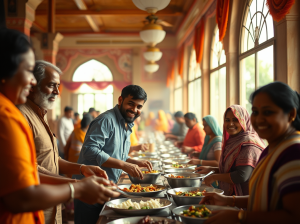
- Service Places offered at:-
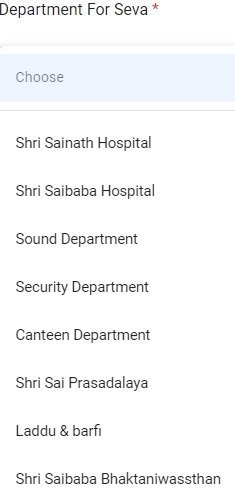
- Contact:-
- Website – online.sai.org.in
- Email: labour@sai.org.in
- Call: 02423 258811/10
PS. The above details are given for information only. Contact the above, for Registration and latest updates.
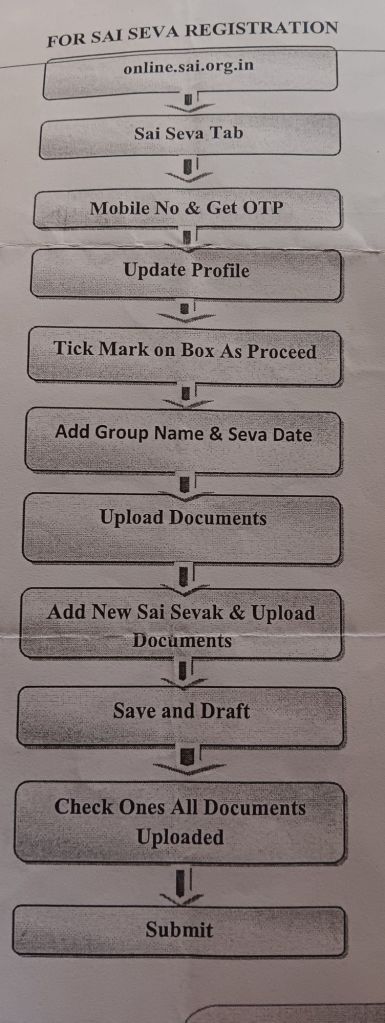
Steps in registration process
 Welcome to https://ShirdiSaiBaba.InterNational