Tag: India

  • โœˆ๏ธ Plan Your Journey from Dubai UAE to Shirdi (SAG)

    โœˆ๏ธ Plan Your Journey from Dubai UAE to Shirdi (SAG)

    ๐Ÿ•‰๏ธ Experience the Divine Presence of Shirdi Sai Baba

    Blessed Pilgrimage Awaits You! the sacred abode of Sri Sai Baba, Shirdi welcomes devotees from across the globe.

    Now, reaching Shirdi from Dubai, Sharjah, Ras Al-Khaimah or Abu Dhabi is easier with multi-leg flight options via major Indian hubs.

    ๐Ÿ›ซ Flight Options from UAE to Shirdi (SAG), India.

    International Airlines:

    Indian Arrival Hubs–

    • ๐Ÿ™๏ธ Ahmedabad (AMD), Delhi (DEL), Hyderabad (HYD), Bengaluru (BLR), Kochi (COK), Chennai (MAA), etc

    Transfer to Shirdi

    • ๐Ÿš ONLY Via Bengaluru (BLR), Hyderabad (HYD), Kochi (COK), Chennai (MAA)
    • ๐Ÿ›ฌ Final leg operation by IndiGo, regularly: Seasonally by Air India, Akasa Air, SpiceJet

    ๐Ÿ“Œ Important Notes (2025)

    • No direct flights from UAE to Shirdi
    • No direct flights from Mumbai to Shirdi!โ€”travelers must route via a secondary hub or Go by Train/Road
    • IndiGo only offers seamless multi-leg booking from UAE to Shirdi.
    • For step by step, about Tour and Shirdi Temple see this.

    ๐Ÿ™ Let Your Journey Beginโ€ฆ

    For Travel Assistance & Bookings: ๐Ÿ“ Book your journey today and experience the peace of Shirdi Sai Babaโ€™s darshan. ๐Ÿ“ž For bookings, contact at [Phone*/Email*].[๐ŸŒ [Website* or Above Airlines Booking Portal for updated status of operation.

    *Soon?

    ๐Ÿ•‰๏ธ โ€œSai Baba is always with youโ€”take the first step toward His darshan.โ€

    We invite you to reach out and enquire us whenever you have questions or require assistance.

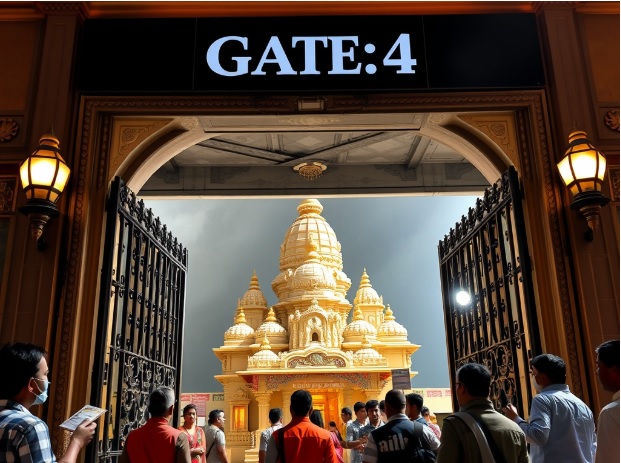
  • Entry Pass at Gate 4 of Shirdi Mandir

    Entry Pass at Gate 4 of Shirdi Mandir

    New special initiative for devotees and local citizens.

    An entry pass system has been implemented at Gate No. 4 of Sai Baba Mandir in Shirdi. This initiative has facilitated access to the temple premises; yet, it does not grant entry into the Main Mandir.

    • Devotees engaging in visits
      • to the Shree Shanaishwar, Shree Ganesh, and Shree Mahadev temples
      • for meditation purposes (at the Reading and Meditation Hall)
      • as visitors in the Administration Office
        • all occurring within the Samadhi Mandir premises

    (You) can use Gate No.4, avail this Entry pass and go for the above purposes

  • Sai Baba was there, truly!

    Sai Baba was there, truly!

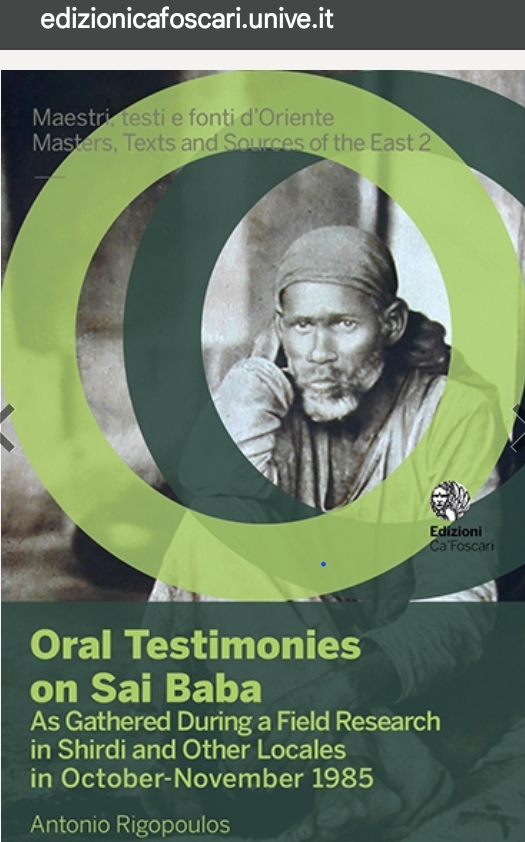
    Dr Antonio Rigopoulos, Italy in his ‘Oral Testimonies on Sai Baba As Gathered During a Field Research in Shirdi and Other Locales in October-November 1985′ (Venice Ca’ F Editions Oscar – Digital Publishing 2021) explained his own Experience that:-

    ”I went to the cฤvaแธฤซ and while I was casually sitting at the cฤvaแธฤซโ€™s entrance, looking at the raแน…golฤซs, the auspicious signs that some young women were skilfully drawing on the ground, a stray dog caught my attention. He was full of pustules and eczemas, of fleas, and was in a really bad shape. Then it suddenly flashed on me that that dog was Sai Baba. It was something stronger than a simple thought, like an insight or a sudden flash of awareness that I find hard to put into words. I really felt that he was that dog and that he was standing in front of me in that very form: it had the force of an incontrovertible truth. It was a strange and startling experience indeed. Sai Baba was that dog: the lowest, the despised, the most neglected creature. The dog had sweet and penetrating eyes, which called for sympathy and attention.

    I felt I finally understood something: not intellectually, i.e. with the head, but emotionally, i.e. with the heart. There was Sai Baba, truly and fully. It came like a revelation and I shed a few tears; couldnโ€™t help it. It was just so overwhelming”

    -On 21 Oct 1985 at 7.30 am

    Thanks / Reference:

    Rigopoulos, Antonio. โ€˜7 Shirdi-Kopargaon-Shirdi. Monday, October 21, 1985โ€™. Masters, Texts and Sources of the East (2020): n. pag. Crossref. Web.

  • Western Scholars Contributions on Sai Baba

    Western Scholars Contributions on Sai Baba


    Several scholars have made significant contributions to the academic understanding of Shirdi Sai Baba. Noteworthy contributions include:

    • Antonio Rigopoulos:
      • A distinguished scholar who authored the first book-length academic study of Shirdi Sai Baba, titled “The Life and Teachings of Sai Baba of Shirdi” (1993). His work emphasizes Sai Baba’s syncretic and tolerant nature while offering an analysis of his teachings and yogic powers.
    • Karline McLain:
      • Recognized for her work, “The Afterlife of Sai Baba: Competing Visions of a Global Saint,” she critically examines the diverse interpretations of Sai Baba and the Hinduization of his figure through textual, visual, and material culture.
      • Additionally, her study, “Be United, Be Virtuous,” investigates the role of Sai Baba’s teachings in fostering religious harmony and their broader cultural impact within Indian society.
    • Smriti Srinivas:
      • Investigates the devotional spaces and transnational reach of the Sai Baba movement, exploring how Sai Baba’s presence is constructed and experienced across various geographies, including Asia and Africa, as presented in her publication, “Devotional Spaces of a Global Saint: Shirdi Sai Baba’s Presence” (2022).
    • Jonathan Loar:
      • Makes noteworthy contributions to the comprehension of hagiographical interpretations, particularly in his work, “From Neither/Nor to Both/And: Reconfiguring the Life of Shirdi Sai Baba in Hagiography,” which explores the dynamics of defining Sai Baba’s religious identity.
    • David Hardiman:
      • Through his publication, “Miracle Cures for a Suffering Nation: Sai Baba of Shirdi,” provides valuable insights into the social and curative dimensions of Sai Baba’s miracles, with a particular emphasis on the significance of sacred ash (Udi) and its influence on the expansion of his following.
    • Charles White (1972)
      • His article โ€œThe Sai Baba Movement: Approaches to the Study of Indian Saintsโ€ was among the first to academically frame Babaโ€™s growing popularity as a pan-Indian phenomenon. White also coined the term โ€œSai Baba movement,โ€ which later scholars like Rigopoulos and McLain expanded upon. His work emphasized Babaโ€™s role in transcending caste and religious boundaries.
    • Arthur Osborne (1958)
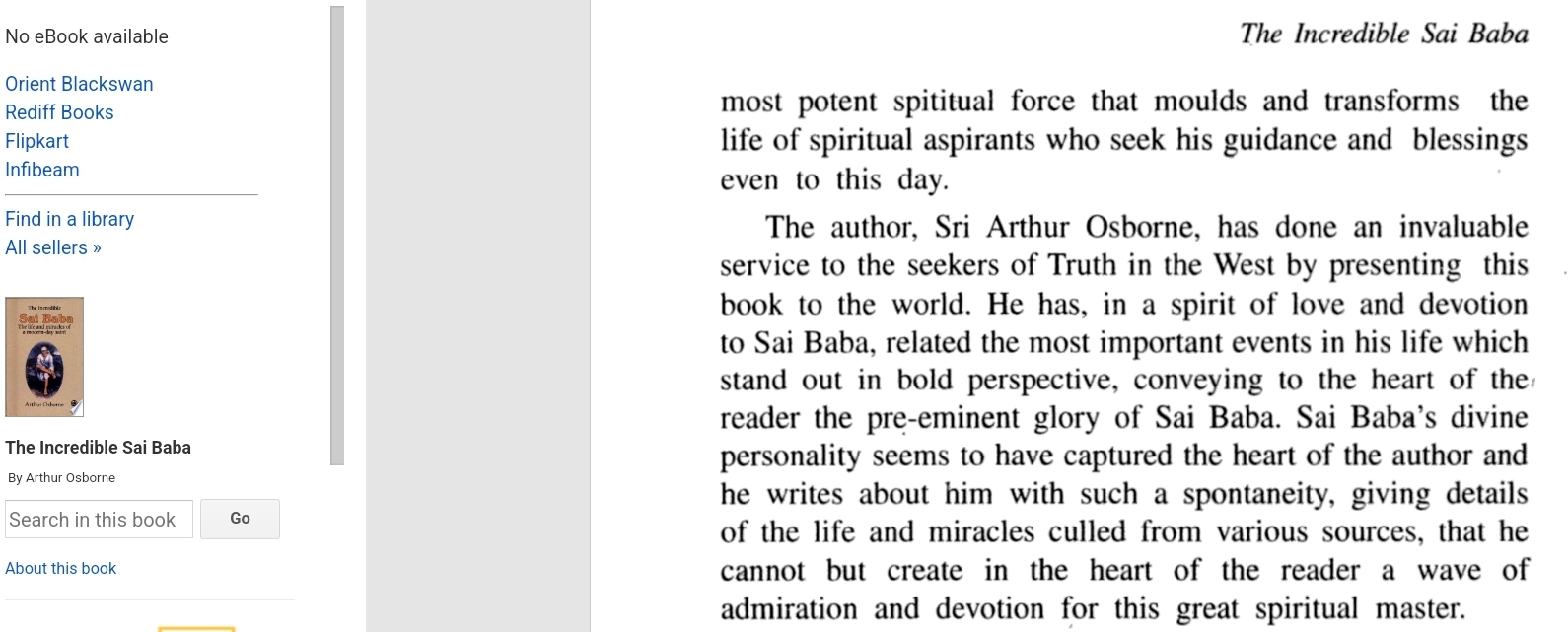
      • The Incredible Sai Baba is one of the earliest popular biographies written in English. Osborne, a devotee of Ramana Maharshi, approached Baba with reverence and spiritual admiration. While not academic in the modern sense, his book helped introduce Baba to Western audiences and shaped early devotional perceptions. Itโ€™s more hagiographic than critical, but still influential in its time.

    References:

    1. https://it.m.wikipedia.org/wiki/Antonio_Rigopoulos (it)
    2. https://www.bucknell.edu/fac-staff/karline-mclain
    3. https://anthropology.ucdavis.edu/people/smriti-srinivas
    4. https://wrldrels.org/?s=Jonathan+Loar
    5. https://www.researchgate.net/publication/
    6. https://core.ac.uk
  • Promoting Love

    Promoting Love

    Sai Baba actively promoted love and unity, both among his devotees and towards animals, through his teachings, actions, and the examples he set. Here’s how the sources illustrate these aspects:

    • Unification and Harmony:
      • Sai Baba worked towards the unification of communities, particularly Hindus and Muslims.
      • He celebrated Hindu festivals like Rama-Navami with all due formalities.
      • He also permitted the ‘Sandal’ procession of Mahomedans and allowed Muslims to offer prayers (Namaj) in his Masjid. This demonstrated his disregard for religious distinctions and his wish for communal harmony.
      • His constant advice was that “Rama (the God of the Hindus) and Rahim (the God of the Mahomedans) were one and the same.” He emphasized that their devotees should not quarrel. Instead, they should “join hands and bring both the communities together” for national unity.
    • Fostering Unity and Eradicating Duality: Baba emphasized the importance of dissolving the sense of difference between individuals and with God.
      • He explicitly stated, “Demolish the wall of difference that separates you from Me; and then the road for our meeting will be clear and open. The sense of differentiation, as I and thou, is the barrier that keeps away the disciple from his Master, and unless that is destroyed the state of union or atonement is not possible“.
      • This teaching directly supports universal love by promoting the realization of oneness.
    • He also encouraged his devotees to love their Guru with whole-hearted affection. He advised them to surrender completely. He suggested prostrating reverentially before Him to attain this unity.
    • Direct Instruction on Conduct:
      • Baba provided invaluable general advice for interacting with others:
      • “If any men or creatures come to you,
        • do not discourteously drive them away,
        • but receive them well and treat them, with due respect.
      • Shri Hari (God) will be certainly pleased, if you give water to the thirsty, bread to the hungry, clothes to the naked, and your verandah to strangers for sitting and resting“.
      • This emphasizes hospitality, compassion, and respectful treatment of all.
    • Discouraging Slander and Gossip: Baba strongly disliked slander.
      • He stated, “He who carps and cavils at others, pierces Me in the heart and injures Me, but he that suffers and endures, pleases Me most“.
      • In one instance, he corrected a slanderer by pointing to a pig eating filth and comparing the slanderer’s actions to the pig’s,
      • thereby teaching a powerful lesson against reviling others.
    • Personal Relationships and Care: Baba demonstrated deep personal love and care for his close devotees.
      • He shared his dormitory with Tatya Kote Patil and Bhagat Mhalsapati for 14 years, showing immense affection and intimacy.
      • He loved Khushalchand of Rahata and “watched his welfare, day and night,” even visiting him.
      • He exhibited “motherly love” towards his disciples, knowing their wants and feeling boundless joy when they were adorned.
      • He ensured the proper execution of religious functions in devotees’ homes, even attending a dinner in Mr. B.V. Deo’s house through an appearance.
      • His “anger” was often a disguise for blessings or tests, as seen
        • when he appeared enraged with the women grinding wheat but later smiled at their devotion, or
        • when he seemingly scolded Haji Sidik Falke only to then show him great favor.
    • He sometimes appeared in dreams or visions to guide and comfort his devotees, like the instance of Hemadpant’s Shimga dinner.
    • Importance of Guru-Disciple Relationship: Baba emphasized
      • complete surrender and unwavering faith in the Guru, assuring that such
      • devotion leads to spiritual progress and self-realization. This deep bond fosters profound love and trust.
    • Saints, like Baba and Shri Tembye Swami, are shown to love each other with “fraternal affection,” indicating a wider spiritual family bound by love.

    Promoting Love with Animals:

    • Oneness with All Creatures: Sai Baba explicitly taught the principle of seeing God in all beings, including animals. When Mrs. Tarkhad fed a hungry dog, Baba told her, “The dog which you saw before meals and to which you gave the piece of bread is, one with Me, so also other creatures (cats, pigs, flies, cows etc.) are one with Me. I am roaming in their forms. He, who sees Me in all these creatures is My beloved. So abandon the sense of duality and distinction, and serve Me, as you did today“. This is a profound teaching that directly connects compassion for animals with devotion to God.
    • Compassion and Non-violence: Baba’s conduct consistently demonstrated compassion for animals. He never drove away dogs, cats, or crows that ate from his food pot, indicating his acceptance and care for them. He also gave a clear opinion on the killing of serpents, stating, “God lives in all beings and creatures, whether they be serpents or scorpions… So we should take pity and love all creatures, leave off adventurous fights and killings and be patient. The Lord (God) is the Protector of all“.
    • Reminiscences of Past Lives: In a remarkable instance, Baba purchased two goats for a significantly high price, explaining to his surprised devotees that these goats were formerly two human brothers who had fought bitterly and killed each other. He bought them out of pity, fed them, and then returned them. This story highlights Baba’s boundless love and compassion for all creatures, acknowledging their karmic journeys.
    • Protection of Animals:
      • Baba saved his devotees from potential harm from animals like snakes,
      • sometimes by foretelling the danger and
      • other times by direct intervention,
      • but he always advised against killing them,
        • emphasizing universal love and the divine presence in all creatures.
      • Even a fierce tiger was drawn to his feet and found a blessed end in his presence, demonstrating Baba’s all-encompassing mercy towards even wild animals.
  • Study materials available to Foreigners, interested in Shirdi Sai Baba.

    Study materials available to Foreigners, interested in Shirdi Sai Baba.


    Foreign individuals seeking to understand the life, teachings, and global influence of Shirdi Sai Baba have access to a wide array of study materials.

    1. Academic Works

    Academic studies offer a structured, critical, and contextual understanding of Shirdi Sai Baba, often distinguishing historical facts from hagiographical embellishments.

    As per (Thanks) Oxford Bibliographies:-

    “Academic study of Shirdi Sai Baba has emerged within the past several decades as scholars of religion in South Asia began to engage in a wide array of studies of popular saints and gurus;

    and as they observed the rapid growth in devotion to Shirdi Sai Baba in particular within the Indian subcontinent and, eventually, beyond India.

    White 1972 provided the first academic analysis of Shirdi Sai Baba, noting his growing popularity in western India and attributing it to the unifying bond created between Sai Babaโ€™s devotees, a bond that crosses distinctions of caste, class, and social status.

    Antonio Rigopoulos 1993 is the first book-length academic study of Shirdi Sai Baba, which presents a biography of Sai Baba in the first half that draws upon Hindu-authored hagiographies, and presents Sai Babaโ€™s key teachings in the second half with an emphasis on interreligious tolerance.

    Warren 2004 includes a valuable translation of the diary kept by Abdul Baba, a Muslim follower of Sai Baba in Shirdi, and draws upon that to present an interpretation of Sai Baba as a Muslim fakir who traveled the Sufi path.

    McLain 2016 traces Shirdi Sai Babaโ€™s rise from small village guru to global phenomenon, using a wide range of textual, material, and visual sources to investigate the different ways that Sai Baba has been understood and the reasons behind his skyrocketing popularity among Hindus in particular.

    The edited collection Srinivas, 2022 provides insight into the worship of Sai Baba beyond the village of Shirdi in the early twentieth century, with essays that examine more contemporary worship at multiple sites within India as well as in Asia and Africa.

    Several articles also make valuable contributions to the study of Shirdi Sai Baba:

    Hardiman 2015 analyzes the miracle healing cures associated with Sai Baba and the relationship between his spiritual power and secular science;

    Rigopoulos 2012 analyzes some of Sai Babaโ€™s miracles in connection with yoga powers;

    Vicziany 2016 examines the worship of two syncretic figures, Shirdi Sai Baba and Haji Ali, in the city of Mumbai, India; and

    Loar 2018 compares the hagiographies of Shirdi Sai Baba that were written by two of his Hindu followers, Dabholkar and Narasimhaswami.”- Thanks Oxford for your article at www.oxfordbibliogrsphies.com.


    Cambridge University

    Cambridge University have explored aspects of Sai Baba’s life and the movement he inspired.

    1. Academic Research and Publications:
    * Cambridge Core: Cambridge University Press has published academic works that discuss Shirdi Sai Baba and the broader Sai Baba movement.
    ย ย  * Smriti Srinivas’s article, “Sai Baba: The Double Utilization of Written and Oral Traditions in a Modern South Asian Religious Movement,” published in Diogenes, examines the origins of the Sai Baba movement rooted in Shirdi Sai Baba.
    ย ย  * Another article in Comparative Studies in Society and History titled “Miracle Cures for a Suffering Nation: Sai Baba of Shirdi” explores his popularity and perceived ability to provide miraculous cures.
    ย ย  * The “Cambridge Companion to New Religious Movements” features a chapter by Tulasi Srinivas on the Sathya Sai Baba movement, which originated from Shirdi Sai Baba’s legacy.
    * Cambridge University Library: Kevin R.D. Shepherd, a British author, conducted private research at Cambridge University Library for twelve years, focusing on the history of religions and philosophy. He has authored books such as “Sai Baba of Shirdi: A Biographical Investigation” and “Investigating the Sai Baba Movement.”
    2. Perspectives on Shirdi Sai Baba:
    * Syncretism: Some scholars highlight Shirdi Sai Baba’s image as a unifying figure between Hindu and Muslim traditions, emphasizing the composite nature of Indian culture in the growth of his devotion.
    * Miracles and Faith: His devotees often attribute miraculous abilities to him, which contributed to his widespread popularity. Academic analysis has also focused on these aspects.
    * Historical Context: Research connects the rise of Shirdi Sai Baba’s popularity with the Indian nationalist movement and the search for unifying symbols.
    3. Mentions in Other Contexts:
    * Sathya Sai Baba: Sathya Sai Baba of Puttaparthi, and his movement have also been subjects of academic study, including publications by Cambridge University Press.
    * Educational Initiatives: Cambridge University Press has collaborated with Indian educational institutions for programs like the “SAI-Cambridge Reading Quest,” although this is related to language skills development and not directly to the study of Sai Baba.
    While Cambridge University’s press has published scholarly articles and books that analyze his life, teachings, and the socio-religious movements associated with him. Individual researchers connected to the university have also contributed significantly to this field of study.


    Teachings and Philosophy

    Social and Cultural Significance

    • Karline McLainโ€™s Be United, Be Virtuous: This work investigates the role of Sai Babaโ€™s teachings in promoting religious harmony and examines the movementโ€™s cultural impact within Indian society.
    • Edited Volumes (e.g., Devotional Spaces of a Global Saint): These collections often feature contributions that analyze the institutional development of the Sai Baba movement and its place in the lives of modern devotees.

    Miracles and Belief Systems

    • Analytical Perspectives on Miracles: Academic literature explores the narrative function of miracles in constructing Sai Babaโ€™s authority, examining their sociological and psychological dimensions and drawing comparisons with miracle traditions in other religions.

    Global Spread and Contemporary Practices

    • Studies on Globalization: Scholars analyze how Sai Babaโ€™s devotion has transcended geographic boundaries, highlighting the establishment of temples and devotional practices in international contexts.
    • Media and Technology: Contemporary research considers how digital media platforms are employed to maintain global devotional networks and disseminate teachings.

    Methodological Approaches

    Engagement with academic resources introduces foreign learners to various methodological frameworksโ€”historical criticism, sociology of religion, and anthropologyโ€”that enable a comprehensive and critical study of religious figures and movements.

    2. Devotional and Informational Websites

    In addition to academic works, several online platforms provide accessible resources tailored to the needs of international devotees.

    Websites for International Devotees (e.g., shirdisaibaba.international)

    • Curated Publications: These platforms offer English-language articles, news updates, and publications, suited for global audiences.
    • Translations of Key Texts: They often provide details of translated versions of significant devotional texts and biographies.
    • Community Engagement: Discussion forums and community pages offer a space for interpretation, Lists of Sai Baba temples in countries like the USA, UK, Canada, Singapure, Dubai…and sharing of experiences, reflecting the living tradition of Sai Baba devotion.

    Official Temple Trust Website (sai.org.in)

    • Authoritative Information: Offers official narratives, details of temple rituals, and historical overviews from the perspective of the temple trust.
    • Online Resources: Includes downloadable material, videos, and frequently asked questions, all primarily in English, facilitating introductory-level engagement.

    3. Key Considerations for Foreigners

    Language Accessibility

    The wide availability of English-language materialsโ€”both academic and devotionalโ€”greatly enhances accessibility for non-Indian audiences.

    Multiple Perspectives

    A balanced approach that includes both academic and devotional materials provides a more nuanced and comprehensive understanding of Shirdi Sai Baba.

    Cultural Context

    Academic studies help situate Sai Baba within the broader Indian religious and cultural milieu, an essential context for foreigners unfamiliar with the subcontinentโ€™s spiritual traditions.

    Critical Engagement

    By engaging with academic sources, foreigners are encouraged to critically examine the narratives surrounding Sai Baba, differentiating between historically substantiated facts and devotional interpretations.

  • Sai Devotees-Do Free Service at Shirdi Temple

    Sai Devotees-Do Free Service at Shirdi Temple

    Sai Devotees, You can now do Free Service at Shirdi, under Sai Sevak Scheme of Shirdi-Sai-Baba-Temple-Management.

    Opportunity to do seva at/near our Sai Mandir at Shirdi, and get Sai Baba’s blessings, directly.

    About Sai Sevak Scheme

    • Sai Sevak ‘Group’ with maximum 21 members
    • Seva period will be 7 days only ie Every Tuesday to Monday
    • Sai Sevak Group should reach on Monday at Sansthanโ€™s  Sai Ashram No.2 (Dharmashala) by 2.00 p.m.
    • Free facilities given:
      • 21 members accommodation, at Sai Dharmshala
      • Meals at Prasadalaya
      • Breakfast packets at accommodation
      • Tea at seva
      • Daily Darshan
      • Aarti once in 7 days.
    • Documents  required are 
      • 2 Passport size Photos.
      • Aaadhar Card Xerox.
      • Medical Fitness certificate.
      • Police (On Line) Verification or Character Certificate from Corporation Ward Member/ Municipal Chairman /Gram President.
    • No compensation/ claim for employment, against Seva.
    • Only 10 groups will be accepted for service in each week by Temple.
    • Service Places offered at:-
    • Contact:-
    • Website – online.sai.org.in
    • Email: labour@sai.org.in
    • Call: 02423 258811/10

    PS. The above details are given for information only. Contact the above, for Registration and latest updates.

    Steps in registration process
  • Who is Shirdi Sai Baba

    Who is Shirdi Sai Baba

    Sri Krishna, Sri Rama, Sai Baba, are all divinely gifted or perfected souls and expressions of divinity. They transform everyone who comes into contact with their divine personality. This is especially true for those who are drawn through Rinanubandha (karmic Bond) by their divinity. That is the purpose or mission of their lives.

    Baba’s Birth and Grown-up:

    • Sai Baba (1838-1918) was an Indian spiritual Guru, Yogi, and Fakir, revered as a saint by millions of devotees, both Hindu and Muslim, across the world.
    • Sai Baba stated that while still a young child, his parents entrusted him to the care of a fakir. The fakir raised him.
    • From this foster father, Baba acquired Vairagya (detachment from worldly pleasures and pains) and developed a spiritual mindset.
    • That fakir passed away within four or five years after taking charge of him.
    • This fakir instructed his wife to take the young Baba and leave him in the care of the renowned saintly zaminder, Gopal Rao Deshmukh (Provincial Governor) in Selu.
    • Gopal Rao was an exceedingly devout individual, deeply attached to Tirupati Lord Venkatesa. He was affluent and generous, and he supported education and piety.
    • A wealth of true education was available to the young Baba, as he was consistently in attendance on this master.
    • Gopal Rao, upon departing from this world peacefully, signaled to the young Baba with a wave of his hand, instructing him to leave Selu and proceed westward to his new abode. (Shirdi is situated along the banks of the Godavari river, directly west of Selu).
    • After some time, Chand Bhai Patel, the Headman of Dhoop (Dhukeda) Village in Nizam’s State, arrived in Shirdi with a grand procession. He had come for the marriage of his wife’s nephew at Shirdi, around 1872. Sai Baba accompanied him for this occasion. When the marriage party arrived in Shirdi, they halted at Mhalsapati’s land near the Khandoba temple.
    • Bhagat Mhalsapati noticed the young Fakir disembarking from the bullock cart and greeted him with โ€œYA SAIโ€ (Welcome Sai). Others began to address him as Sai, and henceforth he became known as Sai Baba.
    • Babaโ€™s final residence was Shirdi, where he lived from 1872 until the end of his life in 1918.

    Baba’s Mission:

    Baba has notย  one mission, but a hundred missions. Divine personalities have specific functions. They protect the good (virtuous). They onlyย reform the wicked. They also establish Dharma (Virtue) or its hold on the people. And Baba was performing all theseย functions.

    His mission is to help every one, that means, of course,  everyone capable of benefiting, not persons who come in an unreceptive mood .

    Baba’s marga-Path:

    Studying  Gitas, one sees that there is no meaning in asking for โ€˜any one marga (path)โ€˜ expounded by the Divine Person. Saints expound all the margas. They find which marga or combination of margas would suit each approaching devotee. Then they give the same to him.

    Thusย Baba adopted every marga. In particular, one may note that the predominance in Sai’s methods was neither for ritual nor for Vedic study. Instead, it was forย living in consonance with the Supreme manifestation of Divinity in himself.

    Baba distributes:

    Baba quoted his master’s or Guru’sย  behest. “As he had received liberally from His master, He must similarlyย  distribute liberally amongst those that approached him.”ย  Baba was distributing not merely wealth, worldly relief and comforts; He was also giving spiritual gifts and spiritual blessings to all and sundry capable of receiving those benefits.

    Baba advises :

    • ‘Love all creatures.
    • Do not fight with  any.
    • Do not retaliate nor scandalize any.
    • When any one talks ill of you, that is,  against you, pass on unperturbed. His words cannot pierce into your body.  Others’ acts will affect them alone and not you.’

    Baba was ever active and never idle and His advice was,  ‘Do not be idle. Work, Utter God’s name. Read scriptures’.

    Baba is also advising:

    • ‘We should not harbour envy, rivalry, or combative disposition towards others.
    • If  others hate us, let us simply take to Nama Japa and avoid their company.
    • Hearken to the words of your parents. 
    • Help your mother in her tasks.
    • Speak the truth and truth alone’.

    Baba’s advice was  always simple and capable of being accepted and acted upon by even persons  of the meanest capacity.

    Baba’s moral teachings:

    Important thing for peace and happiness is love of all creation.  Baba’s moral teachings were conveyed by his own life and activity. Baba loved all creatures. The underlying motive of every act of his was love towards all human beings and all creatures.

    Baba’s Powers:

    He did not even appear to be  a teacher and was chiefly a granter of wishes. But all the same, he was a  powerful instiller of principles and virtue. He instilled these into the hearts of those capable of receiving such impress.

    Other Saints, about Sai Baba:

    The meaning of the name, โ€˜Sai Babaโ€™:

    Sai Baba/ Sai/ Baba has achieved, the supreme task of:-

    • Sai has come to achieve the supreme task of uniting the entire mankind as one family, through the bond of brotherhood of affirming;
    • And illumining the Atmic Reality of each person. This is done in order to reveal the Divine, which is the basis on which the entire Cosmos rests.
    • And also instructing all to recognise the common Divine Heritage that binds man to man. This way, man can rid himself of the animal. He can rise into the Divine, which is his goal.

    The most important facts to remember about Baba is that,

    • Baba was the embodiment of all virtues,
    • Baba did, nothingย  which he did not preach.
    • In Himself, all the virtues were the efflorescence of the  central root in Him, with which he began as a little child, namely:-
    • love for the Guru, 
    • love that knows no bounds of time, place, or circumstance, and
    • love that  sacrifices anything and everything at its altar.
    • Gratitude, service, equality, justice, consideration and so many other good qualities that were in him and taught by him were the direct issue of this love. These qualities could not have all been sustained without this love. This is the central point to remember about Baba.

    This enables  the sishya (student or Devotee) to get more and more like unto the Guru. By constant meditation  on him, the sishya becomes the soul of the Guru.ie

    • The sishya/Student/Devotee grows in love,
    • absorbs the love from the Guru, and
    • returns  it with all his soul and body.
    • Does not consider himself as anything except as  the lover and the beloved of the Guru.

    • Thus Devotee attains –
    • moral perfection,
    • spiritual  perfection,
    • perfection of siddhis and
    • perfection of every sort .
    • This is the natural  result of Baba’s moral teachings. 
  • โ€œSri Sai Baba’s Charters and Sayingsโ€œ -BCS

    โ€œSri Sai Baba’s Charters and Sayingsโ€œ -BCS

    As Lord Sree Krishna manifests Himself in the Bhagavad Gita, so does Baba in the โ€œSri Sai Baba’s Charters and Sayingsโ€- which was compiled by Sri B.V. Narasimha Swami Ji, India. This Book was published by All India Sai Samaj, Mylapore, Chennai-600004, INDIA

    “Self-realisation is the aim of Mysticism; but the โ€˜means to the endโ€™ must be suited to the needs of the individual.

    Baba in the flesh was the embodiment of the Supreme Spirit, lighting the Sadhakas’ path by His every word and action, to his devotees.

    The โ€˜Charters and Sayings’ were compiled by Narasimha Swami. They originate from Shirdi Sai Baba’s Word and Action. This compilation will serve as a manifestation of that Supreme Spirit in words.

    As Lord Sree Krishna manifests Himself in the Bhagavad Gita, so does Baba in the ‘Charters and Sayings’.

    It would transport persons, like my humble self who had the privilege of being at Baba’s feet when HE was in the body, back into the old times. It revive fond memories of the blissful moments spent with the Master.

    At one stage says Baba “I am your servant’s servant”; next “I am a servant of Allah”; and yet again “I am HE.” Intellect fails here; but the spirit beyond the intellect and mind is manifest.

    In the body, Baba was the insignificant human being. He was between it and the supreme Shiva as “Jeeva,” a wheel in the great machine. Transcending these, He stood as Shiva Himself.

    The miracles referred to in the book may cause a sceptic to stare. Devotees in tune with the Infinite Baba see them as events in evolution. These events are mysterious to the mere man. However, they are explicable in the light of Faith and Love.

    The onward march of Science may someday co-ordinate these phases in the frame of the Intellect.

    The ‘Charters and Sayings’ are useful as precepts both in the world spiritual and the world material”

    We cannot be too grateful to Nara Simha Swamiji for the labour of love. It has crystallized this phase of Baba’s divine personality in the ‘Charters and Sayings’. May the book serve to create and foster Faith and Devotion in all corners of the country (World)”.

    – By Mr. Justice M. B. Rege, B.A., L.B., High Court ex-Judge, Indore, India, in his Foreword Note


    Posts relating to BCS

    Podcast Episode: How Discrimination is divine?

    Pip: ShirdiSaiBaba.InterNational โ€” where a nineteenth-century saint's accounting practices turn out to be more spiritually rigorous than most modern financial advisors. Mara: Today's episode comes from Shirdi Sai Baba's International Devotees, and we're looking at one story that raises a genuinely striking question: what does it mean for discrimination โ€” the act of discerning whatโ€ฆ

    Keep reading
    Baba accepted 15 only not 35

    How Discrimination is divine?

    The Story of Rs. 15 Received vs. Rs. 35 Refused (BCS Para 255) In Paragraph 255 of Sri Sai Baba’s Charters and Sayings, two Deccani Brahmins arrived at the Shirdi mosque, leading to a remarkable demonstration of Sri Sai Baba’s divine discrimination, detachment, and omniscience. Hear Podcast also on this 1. Rs. 15 Demanded &โ€ฆ

    Keep reading

    Quotation- BCS 309

    Alms giving without discrimination “Athiti is what ever creature is hungry and comes on to you, at that (kakabali-crow offering) time, whether it is human or a bird, beast or insect. All these seek food. The real Athiti that you get, (but) you do not regard as such. These have come to you in lakhs.โ€ฆ

    Keep reading

    SAVING LIFE

    Babaโ€™s saving life Para Number in the Book & About His Saving Life SAVING LIFE (a) S.B. Nachne’s 579. Baba, in the presence of S.B.N. and many others in 1913 said: “We should not trust mad men.” In 1914 Nachne was doing puja at home and a mad man rushed inside, seized his throat, and said, “I will drink your blood, and opened his mouth wide to bite throat. S.B.N. thrust a spoon into the man’s openโ€ฆ

    Keep reading

    HELP IN MARRIAGE

    Babaโ€™s Says on Marriage Para Number in the Book & About Marriage (a) Adam Dalali 575. Adam Dalali (to Baba): My son has to be married. Unless you bless and give permission, how am I to get the money for it? B.: “Wait.” After a time, Baba said to A.D. : ‘Now, celebrate your son’sโ€ฆ

    Keep reading

    Something went wrong. Please refresh the page and/or try again.

  • Sai Baba is Scientist in All Branches of Sciences and Master of All Arts

    Sai Baba is Scientist in All Branches of Sciences and Master of All Arts

    Shirdi Sri Sai Baba, having infinite awareness, understanding and insight of Universal, possess complete knowledge of Every Science.

    Also Sai Baba is a Master of all Arts.

    See, Read and Assimilate on the incidents given below, in Sai Baba’s Life and also in his Devotees’ life. Both these Art and Science happenings, contribute to your Physical, Mental and Soul Well-being, significantly.

    How Sai Baba is Master of Astronomy Sciences

    Something went wrong. Please refresh the page and/or try again.

    How, Sai Baba is Master of Solar and Earth Sciences

    How, Sai Baba is Master in Law, Ethics, Economics, Political Science

    Something went wrong. Please refresh the page and/or try again.

    How, Sai Baba is Master of Human Mind Behaviors including Teaching

    Something went wrong. Please refresh the page and/or try again.

    How, Sai Baba is Master of Living’s Evolutionary Science

    Something went wrong. Please refresh the page and/or try again.

    How, Sai Baba is Master of Plant, Animal, Human, Physiology, Ecology, Engineering and Medicines

    Something went wrong. Please refresh the page and/or try again.

    How, Sai Baba is Master of Physics’ Matter, Energy, Motion etc

    Something went wrong. Please refresh the page and/or try again.

    How, Sai Baba is Master in Chemistry

    Something went wrong. Please refresh the page and/or try again.