Category: Food freely

  • If any men or creatures come to you, do

    If any men or creatures come to you, do

    • “Unless there is some relationship or connection, nobody goes anywhere.
    • If any men or creatures come to you, do not discourteously drive them away,
    • but receive them well and treat them, with due respect.
    • Shri Hari (God) will be certainly pleased, if you give
      • water to the thirsty,
      • bread to the hungry,
      • clothes to the naked, and
      • your verandah (Platform outside to House) to strangers for sitting and resting. “

    It is on account of Rinaubandh (former relationship) that we have come together, let us love and serve each other and be happy. He, who attain the supreme goal of life, is immortal and happy”

    Baba in SSSC-Ch 18 & 19

  • He, who sees Me (Baba) in all the creatures

    He, who sees Me (Baba) in all the creatures

    Baba in SSSC-Chapter 9 to Mrs. Tarkhad

  • Quotation- BCS 309

    Quotation- BCS 309

    Alms giving without discrimination


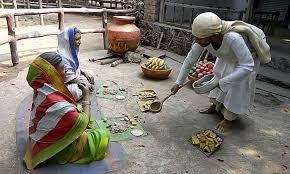
    “Athiti is what ever creature is hungry and comes on to you, at that (kakabali-crow offering) time, whether it is human or a bird, beast or insect.

    All these seek food. The real Athiti that you get, (but) you do not regard as such. These have come to you in lakhs.

    Nana! give up your rotten interpretation*. At kakabali, take plenty of boiled rice outside the house and leave it there.

    Do not shout or call for any, nor drive away. Whatever the creature that comes to eat, let not that disturb your mind. You get thus the merit of feeding lakhs of guests. “

    Baba in BCS para 309 to N G Chandorkar alias Nana


    *The phrase “Atithi Devo Bhava” translates to “The guest is akin to God,” highlighting the reverence and care that should be given to guests.

    In Hinduism, welcoming guests, especially unexpected ones, is considered a sacred duty. This practice is deeply embedded in the culture and traditions, emphasizing the hospitality that should be extended to guests. Here are a few key aspects:

    Rituals and Practices for Welcoming Guests

    1. Traditional Welcome:
       – Guests are often greeted with a warm “Namaste,” a gesture of respect and reverence.
       – In some households, a ceremonial welcome called Aarti might be performed, where a small lamp is waved in front of the guest, accompanied by singing or chanting.
       – Some families may apply a small mark (often a red dot known as tilak) on the guestโ€™s forehead as a sign of blessing and respect.

    2. Offering Refreshments:
       – Guests are typically offered water, tea, butter-milk or other beverages upon arrival. This practice signifies hospitality and the intention to make the guest feel comfortable and valued.
       – Following this, guests may be served snacks or meals, often including traditional and home-cooked dishes.

    3. Providing Comfort:
       – Hosts ensure that the guests have a comfortable place to sit and rest. Clean towels, refreshments, and any other necessities are provided.
       – In many cases, if the guest is staying overnight, special arrangements are made to ensure their comfort, including clean bedding and private space.

    4. Treating Guests with Respect:
       – Throughout the visit, guests are treated with utmost respect. Conversations are often centered around the guestโ€™s well-being, their travel experiences, and any needs they might have.
       – Hosts may also offer small gifts or tokens of appreciation when the guest departs, further signifying the importance of their visit.

    These practices not only reflect the value placed on hospitality in Hindu culture, but also emphasize the spiritual aspect of serving and honoring guests as part of oneโ€™s duty (dharma).

  • Sai Devotees-Do Free Service at Shirdi Temple

    Sai Devotees-Do Free Service at Shirdi Temple

    Sai Devotees, You can now do Free Service at Shirdi, under Sai Sevak Scheme of Shirdi-Sai-Baba-Temple-Management.

    Opportunity to do seva at/near our Sai Mandir at Shirdi, and get Sai Baba’s blessings, directly.

    About Sai Sevak Scheme

    • Sai Sevak ‘Group’ with maximum 21 members
    • Seva period will be 7 days only ie Every Tuesday to Monday
    • Sai Sevak Group should reach on Monday at Sansthanโ€™s  Sai Ashram No.2 (Dharmashala) by 2.00 p.m.
    • Free facilities given:
      • 21 members accommodation, at Sai Dharmshala
      • Meals at Prasadalaya
      • Breakfast packets at accommodation
      • Tea at seva
      • Daily Darshan
      • Aarti once in 7 days.
    • Documents  required are 
      • 2 Passport size Photos.
      • Aaadhar Card Xerox.
      • Medical Fitness certificate.
      • Police (On Line) Verification or Character Certificate from Corporation Ward Member/ Municipal Chairman /Gram President.
    • No compensation/ claim for employment, against Seva.
    • Only 10 groups will be accepted for service in each week by Temple.
    • Service Places offered at:-
    • Contact:-
    • Website – online.sai.org.in
    • Email: labour@sai.org.in
    • Call: 02423 258811/10

    PS. The above details are given for information only. Contact the above, for Registration and latest updates.

    Steps in registration process
  • BABA WORSHIP IV -Refusing to own, the properties

    BABA WORSHIP IV -Refusing to own, the properties

    Baba began from 1908 to ask for dakshinas (Donations). Formerly, he would refuse offer of rupees to him, saying that he had no need for them.

    But from the time that this new tide began, he began to ask his visitors for payments of (even large) sums. Some he would ask for Rs.5, some for Rs.25, and some others for Rs.250.

    Baba would not ask for any funds except where he was going to recompense or where the visitor had already been blessed by Dana or Vittal and was bound to pay whom or those God pointed out.

    Many sent “vowed Sums” of their own accord, even Rs.6000 . Therefore, Baba easily succeeded in getting as dakshinas in the course of each day varying sums, that totaled up in the evening sometimes to Rs.300 and sometimes to thousands.

    Photo by Tima Miroshnichenko on Pexels.com

    In addition to the large crowd of persons who offered ย Naivedyas [food] of eatables to Baba, it was possible for 200 beggars to be fed everyday by Baba’s bounty and doles. Thus the appearance of a very prosperousย durbar was presented at Shirdi from 1909 up to 1918.

    It served a purpose, namely, the widening of Baba worship, which had a great purpose behind it. That is why Baba allowed all this to  develop his worship.

    Till then Baba avoided pomp. He would not even sit on a chair or lie on a cot, but sat and slept upon a sack cloth (gunny mattress) placed on the floor. He would not put on his head the crown or regal dress, when the devotees wanting him to look like a Maharaja/ King brought these for him. Nor would he accept or allow other royal insignia upon his person.

    Baba had no possessions, and all these regal paraphernalia mentioned above were kept with Ramakrishna Ayi, and on her death, were held by an association; and finally vested in the Sai Sansthan, formed by the “order of the Ahmednagar District Court in the year 1922“.

    When Baba left the body, he had only Rs.16 in his hand and no other property. Hence the Raja upacharas, which would have puffed up or affected other persons, did not affect him. In refusing to own properties or have a palace, he set an excellent example.

  • Earlier Years at Shirdi II-Food & Residence

    Baba, noting Mahlsapathy’s attitude, left the place (Khandoba temple), and went to the gode- neem tree, which he used as his halting place off and on. He went about the village and the surrounding lands and had no particular arrangements for food.

    Luckily the village head, Ganapat Rao Patil Kothe and his wife Bayaji Bai, were greatly attracted by Baba’s personality, and from the very beginning of his stay there, they undertook to feed him, even when he was running about. Gradually he gave up roaming and then went about the streets, halted at four or five places and from there collected whatever food was brought to him.

    For his stay and sleep, the dilapidated mosque of the village was the only place, and it soon became his residence. He was never for wholly deserting society and living in mountain caves and deserts.

    Mosque where Baba lived
  • Baba and Others Saints

    Baba and Others Saints

    Para Number in the Book -BCS & Baba’s appearance in the form of other saints

    1. Keshav Naik of Tardev, when Akkalkote Maharaj was passing away
      (about 1878) thus addressed him: Maharaj, if you go away, what support have we?
      Akkalkote Maharaj (giving his shoes to be worshiped): My Avatar (spirit) will be at Shirdi in Ahmadnagar District. Go there always. Be devoted there. If you do so, you will not remember me. And you will be happy
      When Akkalkote Maharaj passed away, Keshav Naik and his son
      Ramachandra Naik, accompanied by two orthodox Brahmins went to Sai Baba at Shirdi. On the way the Brahmins referred to Baba as a mad moslem fakir to whom no Brahmins could bow. When all four reached Baba.

    Baba to Keshav Naik: You and your son may come and visit me, if you like.
    (Pointing to the other two); These are Karmata Brahmins.
    Baba to Ramachandra Naik: Fetch Margosa (Neem) leaves.
    Ramachandra Naik brought some leaves. Baba distributed the leaves to the four.
    Baba: Eat the leaves. How do they taste?
    Brahmis (with a wry face): Very bitter.
    The two Naiks: The leaves are sweet. We ate plenty of the leaves.

    Thus Baba parted his sheep from the goats, and confirmed the statement of Akkalkote Maharaj.
    I am at Mirzgaon (‘Fakir Bua’)
    Why come here? (To Kusa Bhav)
    I am Bandra Moulana.
    [I am Nanded Moulana] You have already given me Rs.3-14-0

    75. I am with you wherever you may be. I do not require conveyance to take me.

    1. Baba (May 1914) addressing Mrs. T., a Bandra lady and her son Master T. : โ€œMother, I have to go thrice a day to your house.โ€
      Mrs. T.: Yes, Baba
      A local lady was astonished at this statement. She saw Baba daily at Shirdi. She said “Baba, what is this strange thing you say?”
      Baba: I do not speak falsehood. I am Mahalaxmi. Mother I come to your house. You give me things to eat, is that not true?
      Bandra Lady: Yes, Baba
      Shirdi Lady: Truly, does Baba go to you and do you feed him? Bandra Lady: Yes.
      Baba to Master T.: Do I not come to your house?
      Master T.: Yes, Baba.
      Baba to Shirdi Lady: Yes, mother, I go easily to Bhav’s house
      (at Bandra). In the middle, there is a wall. Jumping over it, next comes the railway line, and then Bhav’s house. (Here Baba described the crow’s flight from Shirdi to the lady’s house at Bandra).
      I have to fly across walls and excavations.
    2. Mrs. Tendulkar of Bandra daily heaped up garlands of bakul (flower) over
      Baba’s picture in her house at Bandra for two months and then went to Shirdi.
      Baba : Hallo, Kaka (ie.To H.S. Dixit) these two or three months I have not been at Shirdi at all. This mother has smothered me with bakul flower and I was quite dizzy, and unconscious of myself. Now I am slowly coming around.
    3. I went to Bandra and saw Bhav left nothing for me to eat, so I have returned hungry.
    4. Do you think of me, at meal ? Am I not present near you ? Do you give me a morsel ?
    5. I am not at Shirdi, but in all.
    6. He who thinks that (Sai) Baba is in Shirdi (alone) has totally failed to see (i.e., know) Baba.
    7. Why do you (weep and) behave so madly. Am I not there (at Bombay) by your side?
    8. He (Sai) who is at Shirdi now is also at Machandragad here. It is to teach you this, I sent you here. (To Manker)
    9. I have just been to Kasi and had a bath.
      I was at Jejuri, Bagat.
      I was at Dhulia, did you not see me? (To Upasaniโ€™s son)
      When you heard my voice, why doubt? Bolted doors do not bar access to me. (To Megha)
    10. I will go with you (invisibly). Do not worry. Mother, I take thought for your family. Well, Go. I am by your side.
    11. I am myself sitting there (invisibly), guarding you (Purandhare) and your wife.
    12. Wherever you may be, think of me, and I am by your side.
    13. Wherever you may be, whatever any of my devotees think, say or do, that very instant I am aware of it.
      (cf Quran-โ€œAnd when my servants ask thee concerning me, then I nigh unto them and answer the cry of him that crieth unto meโ€
    14. I look equally on all. Not a leaf moves, except by my grace. I look on all with equal eye.
  • UBIQUITY OF BABA

    UBIQUITY OF BABA

    Para Number in the Book-BCS & His Universalities

    1. I am formless and everywhere.
      I am in everything.
      I am in everything and beyond.
      I fill all space. All that you see taken together is Myself. I do not shake or move.
    2. All that is seen is my form; ant, fly, prince, pauper.
    3. I am in the water, in dry places, in woods, amidst crowds, and in the solitary wilderness. I am in the fire and in ether. I am not limited to any place.
    4. Feeding the hungry bitch is feeding me. I have the feeling of my hunger being satisfied, when hers is satisfied.
      Baba to Laxmi Bai Sciedhe: I am hungry.
      Laxmi Bai Scindhe; Shall I go and bring food?
      Baba; Do.
      Laxmi Bai Scindhe; Then brought food; Baba took nothing from it and placed the entire plate before a hungry bitch.
      Laxmi Bai Scindhe: Baba why do you do so?
      Baba: Is not the bitch also a Jiva? We talk, bitches do not. She is hungry; she and I are one and the same. It is the same if I eat or she eats.
    5. I am still belching with the heavy feeding you gave the dog this morning. I am also in the mire besmirched pig (that you did not feed, though it came to you).
      To serve me, give up differentiation, (to Bombay Lady)
    6. Sometimes I come as dog, sometimes as pig.
      The devotee who recognises me in each form and treats me adequately is blessed.
    7. You have been with me eighteen years Nana. Does “Sai” mean to you only this 3’/2 cubits height of body?
      I am in the ant and fly.
      Whenever you see this sign, remember that I am there and that I can eat food through ants, flies etc.
      72-A. Baba: This body is but my house. My guru Mourshad has long ago taken me away from this.
    8. I went as a cat to drink this man’s Hansraj’s curds to save him, despite his cussedness. But he beat me to day.
      I was the black dog.
      I was the sickly sudra. I am in everything, and beyond.
      I was the fakir who begged of you, at Bombay.
      I was the spirit, you saw at midnight under the tree.
      [I am Akkalkote Maharaj.] I gave you Rs. 2, Pitale(Devotee)
      73-A. Baba as a cat is beaten.
      Baba to Hansraj, an Asthma patient: Do not take curds or taste sour things. But Hansraj was daily preparing curds overnight to drink it, at the noon meal. Daily a cat drank it off and one day he beat the cat.
      Baba to others, in the presence of Hansraj: “There is an Urphatia. a cussed, cross-grained man. I told him not to take curds. But he daily prepared it. Daily I went as a cat and drank it off, to save his life. Today 1 went again. Do you know what he did? He beat me over the shoulder. See here. (Hansraj looked and found a fresh weal on Baba’s shoulder, though it was a cat, he beat with a stick on the shoulder) cf. 359.
      73-B. Baba as a dog and sickly Sudra:
      Kasinath Govind Upasani-KGU Maharaj, who lived at Shirdi in 1911-4, prepared his food which a black dog was watching. Offering nothing to the dog, K.G.U. went to the masjid and offered it to Baba.
      Baba: Why did you bring it here? I was there.
      K.G.U.: Baba, there was none there, except a black dog.
      Baba : I was that black dog.
      Baba refused to accept food that day.
      Next day K.G.U. prepared his meal at his quarters and found no dog there. But a sickly Sudra(Lower caste) was standing, leaning on a wall and looking at the food. The orthodox K.G.U. drove him away from that place and brought the food to S.Baba.
      Baba : Yesterday you did not offer me food. Today also you drove me away. Why bring the food here?
      K.G.U.: Where were you there, Baba?
      Baba.: I was leaning on the wall.
      K.G.U.: What! Could you be in such a person?
      Baba: Yes I am in all things and beyond.
      Purusha Sukta -i.e. HE pervades the earth and transcends it.
  • Who are the fit persons, who have a right to live by the begging-bowl

    Sai Baba was neither a house-holder nor Vanaprastha. He was a celibate sannyasi, i.e., sannyasi from boyhood.

    His firm conviction was that the universe was His home, He was the Lord Vasudeo – the Supporter of the universe and the Imperishable Brahman. So He had the full right to have recourse to the begging-bowl.

    (2) Now from the standpoint of ‘Pancha-soon’ – five sins and their atonement. We all know that in order to prepare food- stuffs and meals, the householders have to go through five actions or processes, viz. (1) Kandani-Pounding, (2) Peshani-Grinding, (3) Udakumbhi – Washing pots, (4) Marjani – Sweeping and cleaning, (5) Chulli-Lighting hearths.

    These processes involve destruction of a lot of small insects and creatures, and thus the householders incur a lot of sin. In order to atone for this sin, our Shastras prescribe six kinds of sacrifices, viz. (1) Brahma- Yajna, (2) vedadhyayan – offerings to Brahman or the study of the Vedas. (3) Pitra- Yajna-offerings to the ancestors, 4)Deva-Yajna – offerings to the Gods, (5) Bhoota- Yajna-offerings to the beings, (6) Manushya-Atithi-Yajna-offerings to men or uninvited guests. If these sacrifices, enjoined by the Shastras are duly performed, the purification of their minds is effected and this helps them to get knowledge and self-realization.

    Baba, in going from house to house, reminded the inmates of their sacred duty, and fortunate were the people, who got the lesson at their homes from Baba.

    SSSC Ch-9

  • Bread and Food getting is an Auspicious. Here is Baba’s own story.

    ย Do not discard offers of food; served dish should not be thrust away. Offers of bread and food should be regarded as auspicious signs of success.” Saying this Vanjari offered us food and asked us to be calm and patient.

    Again we did not like this good hospitality and discarded his offer and went away. Without doing any quest and without taking any food, the three began to move out. So obstinate were they.

    I (Baba) was hungry and thirsty and I was moved with the Vanjari’s extraordinary love; we thought ourselves very learned but were quite strangers to pity and kindness. The Vanjari was a quite illiterate and unqualified fellow and belonged to a low caste. Still he had love in his heart and asked us to eat the bread.

    In this way he who loves others disinterestedly is really enlightened and I thought acceptance of his hospitality was the best beginning of getting knowledge. So very respectfully I accepted the loaf of bread offered, ate it and drank water.

    Then to! The Guru at once came and stood before us, “What was the dispute about?” He asked and I told him everything that had happened. Then he said, “Would you like to come with me? I will show you what you want; but he alone, who believes in what I say, will be successful.” The others did not agree to what he said and left him; but I bowed to him reverently and accepted his dictum.

    Then he took me to a well, tied my feet with a rope and hung me – head downwards and feet up – from a tree near the well. I was suspended three feet above the water, which I could not reach with My hands, nor which could go into my mouth. Suspending me in this manner he went away, no one knew where. After 10 or 12 ghatakas (4 or 5 hours) he returned and taking me out quickly asked me how I fared.

    “In Bliss supreme, I was. How can a fool like me describe the joy I experienced?” I replied. On hearing my answer the Guru was much pleased with me, drew me near him and stroking my body with his hand kept me with him. He took care of me as tenderly as a mother-bird does of her young ones.

    He put me into his school; how beautiful it was! There I forgot my parents, all my attachment was snapped and I was liberated easily. I thought that I should embrace his neck and remain staring at him always. If his image were not fixed in my pupils, I would like better to be blind. Such  was the school!

    No one, who entered it once, could return empty-handed. My Guru became my all-in-all, my home and property, mother and father, everything. All my senses left their places and concentrated themselves in my eyes, and my sight was centred on him. Thus was my Guru, the sole object of my meditation and I was conscious of none else. While meditating on him my mind and intellect were stunned and I had thus to keep quiet and bow to him in silence.

    .. By his grace, realization flashed upon me of itself, without effort or study. I had not to seek anything, but everything became clear to me as broad day-light.