Category: Medias

A curated library of books, magazines, online publications, and media for devotees seeking to deepen their knowledge of Shirdi Sai Baba, His life and His teachings.

  • Browsers one-click translation feature

    Browsers one-click translation feature

    ๐Ÿ“ฑ Browsers with Automatic Translation (AI generated )

    Browser@PlatformUser Experience
    (Icon/Prompt Location)
    Google ChromeDesktop
    Icon (often a square/stacked language symbol) appears on the right side of the address bar.
    Google ChromeMobileA pop-up bar appears /accessible via the three-dot More menu, when ‘Not in Preferred language’ is detected by Chrome and ‘Offer to send’ was selected
    Microsoft EdgeDesktopIcon appears in the address bar ‘when Not in Preferred language’ is detected by EDGE and ‘Offer to translate’ was selected.
    Microsoft EdgeMobileA translation bar appears at the top/bottom. Feature accessible via the toolbar/three-dot menu.
    Apple SafariDesktop (macOS)The Translate button is displayed directly in the Smart Search field (address bar) when a translatable page is detected.
    Apple SafariMobile (iOS/iPadOS)Accessed by tapping the “aA” icon (View Menu) on the left side of the address bar, then selecting “Translate to [Language]”.
    Mozilla FirefoxDesktopIcon usually appears as a panel/toolbar icon or a prompt in the address bar area.
    Mozilla FirefoxMobileShows a prompt or an icon in the address bar area to initiate the translation.
    Samsung InternetMobile (Android)Uses a “Browsing assist” or Translate icon in the main toolbar.
  • All Festivals in Sai Baba Temple, Shirdi

    All Festivals in Sai Baba Temple, Shirdi

    I. Important Festivals

    Top vibrant festivals at Shirdi are:

    i. Shree Ram Navami

    Shri Ram Navami is celebrated as Rama’s birthday. Started in 1911, during the lifetime of Sai Baba, Shri Ram Navami at Shirdi is special. The day has been celebrated continuously every March/April, by both Muslims and Hindus with great unity.

    ii. Shree Guru Pournima

    Guru Poornima is a Hindu festival, celebrated with devotion at Shirdi. Poornima means a “full moon” and Guru means “the master.” Baba asked his devotees to celebrate it. Guru Poornima at Shirdi began in the year 1910. It is celebrated on the full moon day of the Ashadh month of the Hindu calendar every July.

    III.Vijayadasami (Shree Sai Baba Punyatithi- Anniversery )

    Vijaya Dasami is a Hindu festival. It is known by different names, such as Dasara, Dussehra, and Dussarah. It is celebrated as the festival of “Victory of Good over the Bad” during every September/October. This day holds great significance for Sai devotees; Baba passed away on this day of Vijaya Dasami on 15-10-1918 around 2:30 PM.

    II. Other Festivals

    The following festivals are also being celebrated, regularly at Shirdi Temple.

    • Mahashivarathri -At 12 Midnight RudraAbhishek at Gurusthan
    • Rang Panchami- Chariot Procession at 5 PM
    • Gudhi Padwa- Traditional Ornaments to Shree Sai Baba & Rath Yatra at 5 PM
    • Hanuman Jayanti-Starts at 4 AM; Recite Bhajans throughout Night at Hanuman Temple.
    • Ashadhi Ekadashi -Remembrance of Baba’s darshan to Dasganu Mahraj, as Lord Vittal
    • Shravani Somvar -Every Monday of Shravan month. Sai Baba in white dress with Rudraksha
    • Gokul Ashtami -Midnight Bhajans; placing Silver idol of Balakrishnan in cradle. Rath Yatra at 9.15pm
    • Narli Pournima – The Only day, Sai Baba wears Golden Ring in His index finger. Priest ties Rakhi to Him
    • Pola – Earthen Bullocks and Cow are worshipped, on Shravan Krishna Amavasaya.
    • Ganesh Charturthi – Dome shaped sweet made up of grated Coconut and jaggery offered to Baba.
    • Anant Chaturdashi- On Bhadrapad shuddha Pournima.
    • Kojagiri Pournima – Ladshmi-Indra Pooja at 11 PM & Moon, reflected in Milk is worshiped at Midnight.
    • Deepawali – Paste of Sandalwood is smeared on Baba’s idol & Lakshmi Pooja with Silver Lotus.
    • Kartiki Ekadashi – Palki Procession at 9.15 PM with photos of Sai Baba and Lord Vitthal.
    • Tulsi Vivah /Marriage – At Dwarkamai on Kartik shuddh Dwadashi.
    • Shree Datta Jayanthi – Rath Yatra at 9.15 with photos of Sai Baba and Lord Dattatraya.

    Source: Thanks Publicity Department, SSST & Souvenir of SSST given on Sai Media Summit on 5th October 2025.

  • ๐ŸŒŸ Turning Inward: The Path to Self-Realization

    ๐ŸŒŸ Turning Inward: The Path to Self-Realization


    ๐Ÿง˜โ€โ™‚๏ธ In the teachings of Shri Sai Baba, this inward journey leads to Self-realization, detachment from worldly distractions, and ultimately, liberation. The Shri Sai Satcharitra offers profound insights into this transformative path.


    ๐Ÿ” Instances from Shri Sai Satcharitra

    1. ๐Ÿ•‰๏ธ Antarmukhata โ€“ The Gateway to Brahma-Jnana

    โ€œSince human senses are naturally outward-bound, a person seeking self-realization and immortal life must turn his gaze inwards, and look to his inner Self.โ€

    • Antarmukhata (introversion) is a core qualification for attaining Brahma-Jnana.
    • The seeker must reverse the flow of attention from external objects to the inner Self.
    • This marks the beginning of true spiritual inquiry.

    1. ๐ŸŒพ Grinding Wheat โ€“ A Symbolic Teaching

    โ€œHold fast to the handle of knowledge of this mill, as I do, and do not wander far away from the same but turn inward to the Center, and you are sure to be saved.โ€

    • The mill symbolizes the grinding down of impulses, desires, and ego.
    • The act of turning inward is likened to centering oneself amidst the chaos of worldly existence.
    • This allegory teaches detachment and purification as steps toward Self-realization.

    1. ๐Ÿ™ Inner Worship โ€“ A Devoteeโ€™s Practice

    โ€œIntrovert our mind, turn it inward, give us discrimination between the Unreal and the Real and non-attachment for all worldly things and thus enable us to get Self-realization.โ€

    • Hemadpant advocates inner worship as a means to spiritual liberation.
    • The prayer to Sai Baba is for discrimination (viveka) and non-attachment (vairagya).
    • True worship begins with stilling the mind and focusing inward.

    1. ๐Ÿ”„ Prayer for Liberation โ€“ Hemadpantโ€™s Appeal

    โ€œRestrain us from the outgoing of our senses to their objects and introvert us and bring us face to face with the Atma (Self).โ€

    • Liberation from the cycle of births and deaths requires control over the senses.
    • Hemadpantโ€™s prayer emphasizes the need to face the Atma directly.
    • Self-realization is impossible without checking the outward tendencies of the mind.

    ๐ŸŒŒ Conclusion
    The journey inward is not a retreatโ€”it is a return to the source. Through the teachings of Sai Baba, we learn that introversion is not isolation, but a sacred alignment with the Self. As we turn our gaze inward, we move closer to the truth, peace, and liberation that lies within.


  • Sai Baba was there, truly!

    Sai Baba was there, truly!

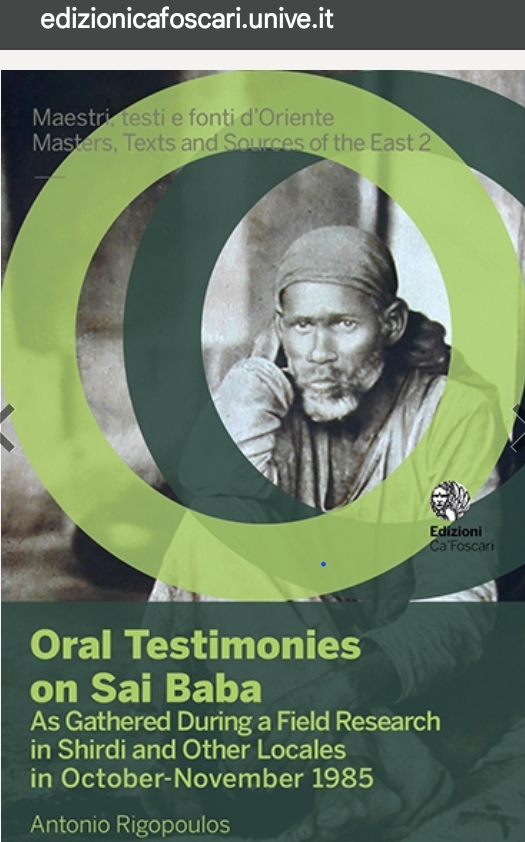
    Dr Antonio Rigopoulos, Italy in his ‘Oral Testimonies on Sai Baba As Gathered During a Field Research in Shirdi and Other Locales in October-November 1985′ (Venice Ca’ F Editions Oscar – Digital Publishing 2021) explained his own Experience that:-

    ”I went to the cฤvaแธฤซ and while I was casually sitting at the cฤvaแธฤซโ€™s entrance, looking at the raแน…golฤซs, the auspicious signs that some young women were skilfully drawing on the ground, a stray dog caught my attention. He was full of pustules and eczemas, of fleas, and was in a really bad shape. Then it suddenly flashed on me that that dog was Sai Baba. It was something stronger than a simple thought, like an insight or a sudden flash of awareness that I find hard to put into words. I really felt that he was that dog and that he was standing in front of me in that very form: it had the force of an incontrovertible truth. It was a strange and startling experience indeed. Sai Baba was that dog: the lowest, the despised, the most neglected creature. The dog had sweet and penetrating eyes, which called for sympathy and attention.

    I felt I finally understood something: not intellectually, i.e. with the head, but emotionally, i.e. with the heart. There was Sai Baba, truly and fully. It came like a revelation and I shed a few tears; couldnโ€™t help it. It was just so overwhelming”

    -On 21 Oct 1985 at 7.30 am

    Thanks / Reference:

    Rigopoulos, Antonio. โ€˜7 Shirdi-Kopargaon-Shirdi. Monday, October 21, 1985โ€™. Masters, Texts and Sources of the East (2020): n. pag. Crossref. Web.

  • Western Scholars Contributions on Sai Baba

    Western Scholars Contributions on Sai Baba


    Several scholars have made significant contributions to the academic understanding of Shirdi Sai Baba. Noteworthy contributions include:

    • Antonio Rigopoulos:
      • A distinguished scholar who authored the first book-length academic study of Shirdi Sai Baba, titled “The Life and Teachings of Sai Baba of Shirdi” (1993). His work emphasizes Sai Baba’s syncretic and tolerant nature while offering an analysis of his teachings and yogic powers.
    • Karline McLain:
      • Recognized for her work, “The Afterlife of Sai Baba: Competing Visions of a Global Saint,” she critically examines the diverse interpretations of Sai Baba and the Hinduization of his figure through textual, visual, and material culture.
      • Additionally, her study, “Be United, Be Virtuous,” investigates the role of Sai Baba’s teachings in fostering religious harmony and their broader cultural impact within Indian society.
    • Smriti Srinivas:
      • Investigates the devotional spaces and transnational reach of the Sai Baba movement, exploring how Sai Baba’s presence is constructed and experienced across various geographies, including Asia and Africa, as presented in her publication, “Devotional Spaces of a Global Saint: Shirdi Sai Baba’s Presence” (2022).
    • Jonathan Loar:
      • Makes noteworthy contributions to the comprehension of hagiographical interpretations, particularly in his work, “From Neither/Nor to Both/And: Reconfiguring the Life of Shirdi Sai Baba in Hagiography,” which explores the dynamics of defining Sai Baba’s religious identity.
    • David Hardiman:
      • Through his publication, “Miracle Cures for a Suffering Nation: Sai Baba of Shirdi,” provides valuable insights into the social and curative dimensions of Sai Baba’s miracles, with a particular emphasis on the significance of sacred ash (Udi) and its influence on the expansion of his following.
    • Charles White (1972)
      • His article โ€œThe Sai Baba Movement: Approaches to the Study of Indian Saintsโ€ was among the first to academically frame Babaโ€™s growing popularity as a pan-Indian phenomenon. White also coined the term โ€œSai Baba movement,โ€ which later scholars like Rigopoulos and McLain expanded upon. His work emphasized Babaโ€™s role in transcending caste and religious boundaries.
    • Arthur Osborne (1958)
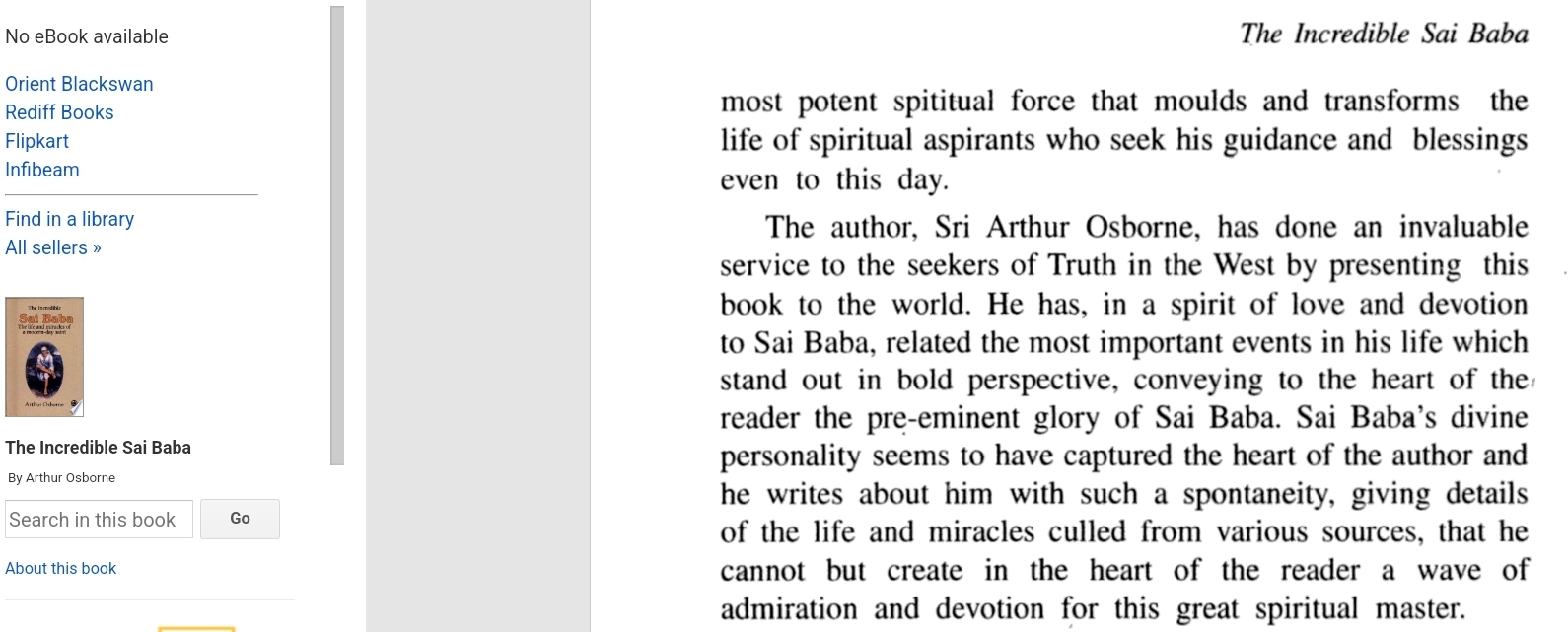
      • The Incredible Sai Baba is one of the earliest popular biographies written in English. Osborne, a devotee of Ramana Maharshi, approached Baba with reverence and spiritual admiration. While not academic in the modern sense, his book helped introduce Baba to Western audiences and shaped early devotional perceptions. Itโ€™s more hagiographic than critical, but still influential in its time.

    References:

    1. https://it.m.wikipedia.org/wiki/Antonio_Rigopoulos (it)
    2. https://www.bucknell.edu/fac-staff/karline-mclain
    3. https://anthropology.ucdavis.edu/people/smriti-srinivas
    4. https://wrldrels.org/?s=Jonathan+Loar
    5. https://www.researchgate.net/publication/
    6. https://core.ac.uk
  • Shirdi Sai Baba temples  in UK

    Shirdi Sai Baba temples  in UK

    These Sai Baba Temples in UK, including Prayer Centers, offer important spaces for worship, spiritual practices and community interaction.

    Readers are invited to share their experiences and offering any updates the temple information. Such contributions are essential in ensuring the directory remains a reliable and beneficial tool for the broader Sai community.

    ๐Ÿ›• Shirdi Sai Baba Temple Association of London (SHITAL) Website

    Temples (with daily aarti & services):
    1. Wembley, London:
    Union Hall, Union Road, Wembley, Middlesex, HA0 4AU.1 Map
    Phone: 020 8902 2311

    2. Leicester:
    18 Melton Street, Leicester, LE1 3NB. Map
    Phone: 0116 367 1833

    3. Reading:
    44 West Street (next to Primark), Reading, RG1 1TZ_ Map
    Phone: 0118 959 1084

    ๐Ÿ›• Additional Shirdi Sai Baba Temples & Organizations

    1. Shirdi Sai Baba Temple Milton Keynes, 12 Winchester Cir, Kingston, Milton Keynes MK10 0BA Map
    2. Shirdi Sai Temple, 122 Ley Street, Ilford IG1 4BX. Map
    3. Sai Dham, Nottingham, Situated at 75โ€“79 Egypt Road, Nottingham. Map
    4. Sree Sai Baba Shrine, Dudley Rd E, Tividale, Oldbury B69 3DU. Map
    5. Granite Shirdi Baba, 65 Downham Rd, London N1 5AH. Map


      World Shirdi Sai Baba Organisation (UK):
    6. Shirdi Sai Baba Temple – London, East Ham, 298 High St N, London E12 6SA. Map
    7. Shirdi Sai Baba Temple – London, Forest Gate: 370A Romford Road, E7โ€ฏ8BS .Map

    II. You can also click the following link to get a Map list of around 10 SAI BABA temples or Prayer Centers in United Kingdom.

    https://maps.app.goo.gl/N3h4LQA66jTDrqWw7

    Please click the link, check the reviews, ensure the correct route, and cross-check the timing without fail.

    III. Decide the suitable Sai Temple and

    Go there, sit and do meditation; and feel the eternal bliss.

    IV. OM SAI BABA, GUIDE AND BLESS YOUR CHILDREN, please.

    PS: 1. This list is for informational purposes only. We are not sponsoring. Check before proceeding.

    2. If this above List/link hasnโ€™t included any Sai Baba Temple or Prayer Place you know in UK, please add it to Google Maps. Then send that Google Map link with Templeโ€™s Name, Address and other details to us.

    3. For any such addition, correction or deletion in the above list, inform us here.

  • Complete surrender to the Guru involves

    Complete surrender to the Guru involves

    Complete surrender to the Guru encompasses several dimensions, as elucidated in the Shri Sai Sat Charitra:
    Devotion and Remembrance: This entails a total surrender of oneself while consistently recalling the Guru’s presence, with the necessity of continually chanting the Guru’s name.
    Seeing the Guru in all beings: Engaging in meditation on the Guru allows one to perceive Him within every being, thereby bestowing eternal bliss. A true devotee regards every Guru as Krishna.
    Lack of Egoism: This principle mandates the relinquishment of pride and ego, thereby surrendering to the Guru who resides within one’s heart. The removal of egoism and the complete trust in the Lord liberates one from worldly constraints.
    Service: True surrender requires Sarvaswa Sharangati (total surrender) to the Sad-guru, where one must recognize that they are not the sovereign of their own body; rather, the body belongs to the Guru and exists solely to serve Him.
    Faith and compliance: A disciple’s duty and dharma necessitate implicit and prompt adherence to the Guru’s directives.
    Channeling Senses to the divine: Prior to indulging the senses, mind, and intellect in their respective pursuits, it is incumbent to remember the Guru; such remembrance serves as an offering to Him.
    Experiencing Oneness: The individual who approaches the Guru achieves oneness with Him, akin to a river merging with the sea.
    Desirelessness: The Guru liberates His devotees from desires, rendering them free.
    Love: The Guru desires nothing but love for all sentient beings. Genuine love requires earnest affection; thus, where there is true yearning and feeling, God reveals Himself.
    Mindfulness: Regularly chanting the Guru’s name and engaging in meditation fosters the ability to perceive Him in all beings, which in turn grants eternal bliss. A definitive indication of this practice is the attainment of a calm and peaceful mind.

  • Study materials available to Foreigners, interested in Shirdi Sai Baba.

    Study materials available to Foreigners, interested in Shirdi Sai Baba.


    Foreign individuals seeking to understand the life, teachings, and global influence of Shirdi Sai Baba have access to a wide array of study materials.

    1. Academic Works

    Academic studies offer a structured, critical, and contextual understanding of Shirdi Sai Baba, often distinguishing historical facts from hagiographical embellishments.

    As per (Thanks) Oxford Bibliographies:-

    “Academic study of Shirdi Sai Baba has emerged within the past several decades as scholars of religion in South Asia began to engage in a wide array of studies of popular saints and gurus;

    and as they observed the rapid growth in devotion to Shirdi Sai Baba in particular within the Indian subcontinent and, eventually, beyond India.

    White 1972 provided the first academic analysis of Shirdi Sai Baba, noting his growing popularity in western India and attributing it to the unifying bond created between Sai Babaโ€™s devotees, a bond that crosses distinctions of caste, class, and social status.

    Antonio Rigopoulos 1993 is the first book-length academic study of Shirdi Sai Baba, which presents a biography of Sai Baba in the first half that draws upon Hindu-authored hagiographies, and presents Sai Babaโ€™s key teachings in the second half with an emphasis on interreligious tolerance.

    Warren 2004 includes a valuable translation of the diary kept by Abdul Baba, a Muslim follower of Sai Baba in Shirdi, and draws upon that to present an interpretation of Sai Baba as a Muslim fakir who traveled the Sufi path.

    McLain 2016 traces Shirdi Sai Babaโ€™s rise from small village guru to global phenomenon, using a wide range of textual, material, and visual sources to investigate the different ways that Sai Baba has been understood and the reasons behind his skyrocketing popularity among Hindus in particular.

    The edited collection Srinivas, 2022 provides insight into the worship of Sai Baba beyond the village of Shirdi in the early twentieth century, with essays that examine more contemporary worship at multiple sites within India as well as in Asia and Africa.

    Several articles also make valuable contributions to the study of Shirdi Sai Baba:

    Hardiman 2015 analyzes the miracle healing cures associated with Sai Baba and the relationship between his spiritual power and secular science;

    Rigopoulos 2012 analyzes some of Sai Babaโ€™s miracles in connection with yoga powers;

    Vicziany 2016 examines the worship of two syncretic figures, Shirdi Sai Baba and Haji Ali, in the city of Mumbai, India; and

    Loar 2018 compares the hagiographies of Shirdi Sai Baba that were written by two of his Hindu followers, Dabholkar and Narasimhaswami.”- Thanks Oxford for your article at www.oxfordbibliogrsphies.com.


    Cambridge University

    Cambridge University have explored aspects of Sai Baba’s life and the movement he inspired.

    1. Academic Research and Publications:
    * Cambridge Core: Cambridge University Press has published academic works that discuss Shirdi Sai Baba and the broader Sai Baba movement.
    ย ย  * Smriti Srinivas’s article, “Sai Baba: The Double Utilization of Written and Oral Traditions in a Modern South Asian Religious Movement,” published in Diogenes, examines the origins of the Sai Baba movement rooted in Shirdi Sai Baba.
    ย ย  * Another article in Comparative Studies in Society and History titled “Miracle Cures for a Suffering Nation: Sai Baba of Shirdi” explores his popularity and perceived ability to provide miraculous cures.
    ย ย  * The “Cambridge Companion to New Religious Movements” features a chapter by Tulasi Srinivas on the Sathya Sai Baba movement, which originated from Shirdi Sai Baba’s legacy.
    * Cambridge University Library: Kevin R.D. Shepherd, a British author, conducted private research at Cambridge University Library for twelve years, focusing on the history of religions and philosophy. He has authored books such as “Sai Baba of Shirdi: A Biographical Investigation” and “Investigating the Sai Baba Movement.”
    2. Perspectives on Shirdi Sai Baba:
    * Syncretism: Some scholars highlight Shirdi Sai Baba’s image as a unifying figure between Hindu and Muslim traditions, emphasizing the composite nature of Indian culture in the growth of his devotion.
    * Miracles and Faith: His devotees often attribute miraculous abilities to him, which contributed to his widespread popularity. Academic analysis has also focused on these aspects.
    * Historical Context: Research connects the rise of Shirdi Sai Baba’s popularity with the Indian nationalist movement and the search for unifying symbols.
    3. Mentions in Other Contexts:
    * Sathya Sai Baba: Sathya Sai Baba of Puttaparthi, and his movement have also been subjects of academic study, including publications by Cambridge University Press.
    * Educational Initiatives: Cambridge University Press has collaborated with Indian educational institutions for programs like the “SAI-Cambridge Reading Quest,” although this is related to language skills development and not directly to the study of Sai Baba.
    While Cambridge University’s press has published scholarly articles and books that analyze his life, teachings, and the socio-religious movements associated with him. Individual researchers connected to the university have also contributed significantly to this field of study.


    Teachings and Philosophy

    Social and Cultural Significance

    • Karline McLainโ€™s Be United, Be Virtuous: This work investigates the role of Sai Babaโ€™s teachings in promoting religious harmony and examines the movementโ€™s cultural impact within Indian society.
    • Edited Volumes (e.g., Devotional Spaces of a Global Saint): These collections often feature contributions that analyze the institutional development of the Sai Baba movement and its place in the lives of modern devotees.

    Miracles and Belief Systems

    • Analytical Perspectives on Miracles: Academic literature explores the narrative function of miracles in constructing Sai Babaโ€™s authority, examining their sociological and psychological dimensions and drawing comparisons with miracle traditions in other religions.

    Global Spread and Contemporary Practices

    • Studies on Globalization: Scholars analyze how Sai Babaโ€™s devotion has transcended geographic boundaries, highlighting the establishment of temples and devotional practices in international contexts.
    • Media and Technology: Contemporary research considers how digital media platforms are employed to maintain global devotional networks and disseminate teachings.

    Methodological Approaches

    Engagement with academic resources introduces foreign learners to various methodological frameworksโ€”historical criticism, sociology of religion, and anthropologyโ€”that enable a comprehensive and critical study of religious figures and movements.

    2. Devotional and Informational Websites

    In addition to academic works, several online platforms provide accessible resources tailored to the needs of international devotees.

    Websites for International Devotees (e.g., shirdisaibaba.international)

    • Curated Publications: These platforms offer English-language articles, news updates, and publications, suited for global audiences.
    • Translations of Key Texts: They often provide details of translated versions of significant devotional texts and biographies.
    • Community Engagement: Discussion forums and community pages offer a space for interpretation, Lists of Sai Baba temples in countries like the USA, UK, Canada, Singapure, Dubai…and sharing of experiences, reflecting the living tradition of Sai Baba devotion.

    Official Temple Trust Website (sai.org.in)

    • Authoritative Information: Offers official narratives, details of temple rituals, and historical overviews from the perspective of the temple trust.
    • Online Resources: Includes downloadable material, videos, and frequently asked questions, all primarily in English, facilitating introductory-level engagement.

    3. Key Considerations for Foreigners

    Language Accessibility

    The wide availability of English-language materialsโ€”both academic and devotionalโ€”greatly enhances accessibility for non-Indian audiences.

    Multiple Perspectives

    A balanced approach that includes both academic and devotional materials provides a more nuanced and comprehensive understanding of Shirdi Sai Baba.

    Cultural Context

    Academic studies help situate Sai Baba within the broader Indian religious and cultural milieu, an essential context for foreigners unfamiliar with the subcontinentโ€™s spiritual traditions.

    Critical Engagement

    By engaging with academic sources, foreigners are encouraged to critically examine the narratives surrounding Sai Baba, differentiating between historically substantiated facts and devotional interpretations.


  • Where certain actions or entities are considered better than others

    Where certain actions or entities are considered better than others

    1. A human body is better than other bodies–
      • Despite its filth, mucus, and susceptibility to decay, disease, and death, the human body’s special value lies in its capacity to acquire knowledge and attain God-vision, which is impossible in any other birth.
    2. Love is better than intelligence-
      • The pure love of Shirdi women, despite their ignorance, inspired them to compose poems, implying that love is more inspiring than intelligence.
    3. Giving food is better than other charities-
      • While other charities like giving away wealth, property, and clothes require some discrimination, offering food requires no such consideration.
      • Also, the merit of feeding lame, crippled, blind, and diseased paupers is much greater than that of feeding able-bodied persons and relations.
    4. Butter-milk (Leelas) is better than Milk (Darshan)-
      • If one desires to see Sai Baba’s but they did not get any opportunity of taking His darshan, their quest for milk (darshan) will be, to a great extent, satisfied by the butter-milk (Leelas).
    5. Remembering and chanting Hari’s and Guru’s name confers salvation is better than getting the powerful Bhakti of the Nathas-
      • one Madhavarao did not like Kakasaheb’s pessimistic attitude of how to get the powerful Bhakti of the Nathas, as he said, ‘has not Baba told us authoritatively that remembering and chanting Hari’s and Guru’s name confers salvation? Then where is the cause for fear and anxiety?’
    6. The observance of the vow of silence is the best way of praising the Sad-guru-
      • In reality, the observance of the vow of silence is the best way of praising the Sad-guru.
    7. Having recourse to Sai Baba’s Feet and surrendering to Him is the best luck-
      • The best luck is to get an opportunity to have recourse to Sai Baba’s Feet and surrender to Him, than any other
  • Oh Sai, create in us reverence for Your stories

    • When a man takes a plunge into the sea, he gets the merit of bathing in all the Tirthas and sacred rivers.
    • Similarly when a man takes refuge at the feet of the Sad-guru, he gets the merit of bowing to the Trinity, i.e. Brahma, Vishnu and Siva and also Para-Brahma.
    • Victory be unto Shri Sai, the wish-fulfilling tree and the ocean of knowledge, who gives us self-realization.
    • Oh Sai, create in us reverence for Your stories.
    • Let the readers and audience devour them with the same relish; the chatak bird drinks the water from the clouds and becomes happy.
    • While listening to Your stories, let them and their families get all the true and pious emotions, viz.
      1. let their bodies perspire,
      2. let their eyes be full of tears,
      3. let their breath be steady,
      4. let their minds be composed,
      5. let their hair stand on end,
      6. let them cry, sob and quiver,
      7. let their hostilities vanish.
    • When these things happen, that is a sign of the grace of the Guru dawning upon them.
    • When these emotions develop in you, the Guru is most pleased.
    • The Guru will definitely guide you to the goal of self-realization.
    • The best way, therefore,
      • to get free from the shackles of Maya,
      • is our complete and whole-hearted surrender to Baba.
    • The Vedas cannot take you across the ocean of Maya. It is only the Sadguru, who can do so, and make you see the Lord in all creatures