Category: Moral teaching

Explore the ethical and moral teachings of Shirdi Sai Baba โ€” principles of right living, integrity, compassion, and righteous conduct that form the foundation of Every devotee’s life.

  • Blessed knows the greatness of his Guru

    Blessed knows the greatness of his Guru

    Make me the sole object of your thoughts and actions. You will, no doubt, attain Paramartha (the spiritual goal of life).

    Look at me whole-heartly; and I, in turn, look at you.

    Sitting in this Masjid, I speak the truth, nothing but truth.

    No sadhana or proficiency in the six Shastras, is necessary. Have faith and confidence in your Guru. Believe that, Guru is the sole Actor or Doer.

    Blessed is he, who knows the greatness of his Guru and thinks him to be Hari, Hara and Brahma (Trimurti -Gods) Incarnate.”

    Sai Baba in SSSC-Chapter 18 & 19.

  • Dearth of persons asking for spiritual matters

    “Oh, My dear friend, do not be anxious, I shall immediately show you the Brahman; all My dealings are in cash and never on credit.

    So many people come to Me, and ask for wealth, health, power, honour, position, cure of diseases and other temporal matters.

    Rare is the person, who comes here to Me and asks for Brahma-Jnana. There is no dearth of persons asking for wordly things, but as persons interested in spiritual matters are very rare”

    Baba to avaricious Man in SSSC -Ch21 When ask him to “surrender five things to get self-realization”

  • Quotation- BCS 309

    Quotation- BCS 309

    Alms giving without discrimination


    “Athiti is what ever creature is hungry and comes on to you, at that (kakabali-crow offering) time, whether it is human or a bird, beast or insect.

    All these seek food. The real Athiti that you get, (but) you do not regard as such. These have come to you in lakhs.

    Nana! give up your rotten interpretation*. At kakabali, take plenty of boiled rice outside the house and leave it there.

    Do not shout or call for any, nor drive away. Whatever the creature that comes to eat, let not that disturb your mind. You get thus the merit of feeding lakhs of guests. “

    Baba in BCS para 309 to N G Chandorkar alias Nana


    *The phrase “Atithi Devo Bhava” translates to “The guest is akin to God,” highlighting the reverence and care that should be given to guests.

    In Hinduism, welcoming guests, especially unexpected ones, is considered a sacred duty. This practice is deeply embedded in the culture and traditions, emphasizing the hospitality that should be extended to guests. Here are a few key aspects:

    Rituals and Practices for Welcoming Guests

    1. Traditional Welcome:
       – Guests are often greeted with a warm “Namaste,” a gesture of respect and reverence.
       – In some households, a ceremonial welcome called Aarti might be performed, where a small lamp is waved in front of the guest, accompanied by singing or chanting.
       – Some families may apply a small mark (often a red dot known as tilak) on the guestโ€™s forehead as a sign of blessing and respect.

    2. Offering Refreshments:
       – Guests are typically offered water, tea, butter-milk or other beverages upon arrival. This practice signifies hospitality and the intention to make the guest feel comfortable and valued.
       – Following this, guests may be served snacks or meals, often including traditional and home-cooked dishes.

    3. Providing Comfort:
       – Hosts ensure that the guests have a comfortable place to sit and rest. Clean towels, refreshments, and any other necessities are provided.
       – In many cases, if the guest is staying overnight, special arrangements are made to ensure their comfort, including clean bedding and private space.

    4. Treating Guests with Respect:
       – Throughout the visit, guests are treated with utmost respect. Conversations are often centered around the guestโ€™s well-being, their travel experiences, and any needs they might have.
       – Hosts may also offer small gifts or tokens of appreciation when the guest departs, further signifying the importance of their visit.

    These practices not only reflect the value placed on hospitality in Hindu culture, but also emphasize the spiritual aspect of serving and honoring guests as part of oneโ€™s duty (dharma).

  • Baba is a Master of “Catechectics”

    Baba is a Master of “Catechectics”

    Catechectics is an Art of teaching by Question and answer (as a Part of ‘Howย emotionalย investmentsย shapeย ourย behaviorsย andย thoughts’). Baba is in very advanced stage in this science. This is an example:-

    It was in the year 1916, a Chennai Bhajani Mela (Party of the Ramadasi Panth) started on a Pilgrimage to the holy city of Kasi/Banaras. The Party consisted of a man, his wife, daughter and sister-in-law; and they had come to Shirdi to get Gift of money from Baba. There the husband got a wonderful vision in his dream one night as follows :-

    He was in a big city, the police there had arrested him, tied his hands with a rope, and put him up in lock-up. As the police were tightening the grip, he saw Sai Baba standing quiet outside, near the cage. On seeing Baba so near, he said in a plaintive tone – “Hearing Your fame, I came to Your Feet, and why should a calamity befall me, when You are standing here in person?”

    • Baba said – “You must suffer the consequences of your action”
    • He said – “I have not done anything in this life, which would bring such a misfortune on me.”
    • Baba said – “If not in this life, you must have committed some sin in your past life.”
    • He replied, “I do not know anything of my past life, but assuming that I did commit some sin; then why should it not be burnt and destroyed in Your presence, as dry grass before fire? “.
    • Baba – “Have you got such faith?”
    • He – “Yes.”
    • Baba then asked him to close his eyes.
    • No sooner did he shut them, than he heard a thumping sound of something falling down, opening his eyes,
      • he saw that he was free and the police had fallen down, bleeding.
      • Being much frightened, he began to look at Baba who said – “Now you are well caught, officers will now come and arrest you.”
      • Then he begged – “There is no other saviour except You, save me anyhow.”
    • Then Baba again asked him to close his eyes. He did so and when he opened them,
      • he saw that he was free, out of the cage and
      • that Baba was by his side.
      • He then fell at Baba’s Feet.
    • Baba then asked him –
      • “Is there any difference between this namaskar (Hello) and your previous ones? Think well and reply.”
      • He said “There is a lot of difference; my former namaskaras were offered with the object of getting money from You, but the present namaskar is one offered to You as God”
    • Then a desire arose in his mind, to get the darshan of his Guru Ramdas;
      • when Baba asked him to turn back and see. And when he turned,
      • lo, Ramadas was in front of him.
      • No sooner did, he begin to fall at His Feet, Ramadas vanished.
    • Then he inquisitively asked Baba,”You look old. Do You know Your age?”. Baba – “What! Do you say I am old! just run a race with Me and see.” Saying this, Baba began to run and he too followed. Baba disappeared in the dust raised by His foot-steps while running, and the man was awakened.
    • After awakening, he began to think seriously about the dream-vision. His mental attitude was completely changed and he realised the greatness of Baba. After this, his grabbing and doubting tendencies disappeared and true devotion to Baba’s Feet sprang in his mind.
    • The vision was a mere dream, but the questions and answers therein were most significant and interesting.
    • Next morning, when all the persons assembled in the Masjid for the Arati, Baba gave him as prasad two rupees’ worth sweetmeats and also two rupees from His pocket and blessed him.
    • Baba made him stay there for a few more days and gave him His blessing, saying, “Allah (God) will give you plenty and He will do you all good”. He did not get more money there, but he got far better things viz. Baba’s blessing, which stood him in good stead all along.
    • The party got plenty of money afterwards; and their pilgrimage was successful: as they had not to suffer any trouble or inconvenience during their journey.
    • They all returned home safe and sound, thinking of Baba’s words and blessings and the Anand(Bliss) they experienced by His grace.

    In SSSC Ch-29

  • Baba’s standpoint similar to Mahatma Gandhi

    Baba’s standpoint similar to Mahatma Gandhi

    That is ‘Live and let live’- and To unite persons, use common joint formula.

    Mahtama Gandhi (freedom fighter of India) tried to effect a rapproachment between Hindus and Muslims. He started the formula noted below, where Rahim and Ram are put together. He also made his Hindu and Muslim followers repeat the formula or mantra.

    Raghupati Raghava Rajaram Patita paavana Sitaram,

    Iswara Allah Tere nam, Sabko Sanmati De Bhagavan,

    Rama Rahim Krishna Karim, Sabko Sanmati de Bhagavan.

    Mahatma Gandhi aimed to familiarise the ears of impartial and co-operatively minded Hindus and Muslims, with a mix of both cultures. This would help both groups to hear each other’s names without losing equanimity.

    This would become easier and inspiring by habit for future generations. That was the great object of Mahatma Gandhi’s formula. Baba added to Gandhiji’s plan of work. He secretly worked on the hearts of all.

    Baba was perfectly neutral and submitted to the peculiar idiosyncracies of his worshippers in order to avoid offending them. Left to himself Baba would have no mark on his forehead. Baba did not believe at all that there is a separate Siva and a separate Vishnu as Gods. ‘To him, there was only one God. It might be called Siva or Vishnu, Vittal, Rama or Datta. Khuda, Khandoba, Devi, Allah or Hari; might all be names given with equal justification’. “A rose by any other name would smell as sweet”.

    If each wants to get on in his own way, he should do so. He should choose the way that suits him best. By all means, let him do so. He should not be hindered. This is the only way to unite all sincere worshippers. Sincere bhaktas’ worship of Sai is the same as the worship of God.

    That is their feeling and according to correct metaphysics and philosophy, there is no difference between the worship of Sai treated as God and the worship of God under any other name or any other form. Both achieve the same ends.

    “In whatever form you surrender to Me, in that form, I respond- BG (4) 11.

    LoSB/Part I: Ch-XIV

  • Who is Shirdi Sai Baba

    Who is Shirdi Sai Baba

    Sri Krishna, Sri Rama, Sai Baba, are all divinely gifted or perfected souls and expressions of divinity. They transform everyone who comes into contact with their divine personality. This is especially true for those who are drawn through Rinanubandha (karmic Bond) by their divinity. That is the purpose or mission of their lives.

    Baba’s Birth and Grown-up:

    • Sai Baba (1838-1918) was an Indian spiritual Guru, Yogi, and Fakir, revered as a saint by millions of devotees, both Hindu and Muslim, across the world.
    • Sai Baba stated that while still a young child, his parents entrusted him to the care of a fakir. The fakir raised him.
    • From this foster father, Baba acquired Vairagya (detachment from worldly pleasures and pains) and developed a spiritual mindset.
    • That fakir passed away within four or five years after taking charge of him.
    • This fakir instructed his wife to take the young Baba and leave him in the care of the renowned saintly zaminder, Gopal Rao Deshmukh (Provincial Governor) in Selu.
    • Gopal Rao was an exceedingly devout individual, deeply attached to Tirupati Lord Venkatesa. He was affluent and generous, and he supported education and piety.
    • A wealth of true education was available to the young Baba, as he was consistently in attendance on this master.
    • Gopal Rao, upon departing from this world peacefully, signaled to the young Baba with a wave of his hand, instructing him to leave Selu and proceed westward to his new abode. (Shirdi is situated along the banks of the Godavari river, directly west of Selu).
    • After some time, Chand Bhai Patel, the Headman of Dhoop (Dhukeda) Village in Nizam’s State, arrived in Shirdi with a grand procession. He had come for the marriage of his wife’s nephew at Shirdi, around 1872. Sai Baba accompanied him for this occasion. When the marriage party arrived in Shirdi, they halted at Mhalsapati’s land near the Khandoba temple.
    • Bhagat Mhalsapati noticed the young Fakir disembarking from the bullock cart and greeted him with โ€œYA SAIโ€ (Welcome Sai). Others began to address him as Sai, and henceforth he became known as Sai Baba.
    • Babaโ€™s final residence was Shirdi, where he lived from 1872 until the end of his life in 1918.

    Baba’s Mission:

    Baba has notย  one mission, but a hundred missions. Divine personalities have specific functions. They protect the good (virtuous). They onlyย reform the wicked. They also establish Dharma (Virtue) or its hold on the people. And Baba was performing all theseย functions.

    His mission is to help every one, that means, of course,  everyone capable of benefiting, not persons who come in an unreceptive mood .

    Baba’s marga-Path:

    Studying  Gitas, one sees that there is no meaning in asking for โ€˜any one marga (path)โ€˜ expounded by the Divine Person. Saints expound all the margas. They find which marga or combination of margas would suit each approaching devotee. Then they give the same to him.

    Thusย Baba adopted every marga. In particular, one may note that the predominance in Sai’s methods was neither for ritual nor for Vedic study. Instead, it was forย living in consonance with the Supreme manifestation of Divinity in himself.

    Baba distributes:

    Baba quoted his master’s or Guru’sย  behest. “As he had received liberally from His master, He must similarlyย  distribute liberally amongst those that approached him.”ย  Baba was distributing not merely wealth, worldly relief and comforts; He was also giving spiritual gifts and spiritual blessings to all and sundry capable of receiving those benefits.

    Baba advises :

    • ‘Love all creatures.
    • Do not fight with  any.
    • Do not retaliate nor scandalize any.
    • When any one talks ill of you, that is,  against you, pass on unperturbed. His words cannot pierce into your body.  Others’ acts will affect them alone and not you.’

    Baba was ever active and never idle and His advice was,  ‘Do not be idle. Work, Utter God’s name. Read scriptures’.

    Baba is also advising:

    • ‘We should not harbour envy, rivalry, or combative disposition towards others.
    • If  others hate us, let us simply take to Nama Japa and avoid their company.
    • Hearken to the words of your parents. 
    • Help your mother in her tasks.
    • Speak the truth and truth alone’.

    Baba’s advice was  always simple and capable of being accepted and acted upon by even persons  of the meanest capacity.

    Baba’s moral teachings:

    Important thing for peace and happiness is love of all creation.  Baba’s moral teachings were conveyed by his own life and activity. Baba loved all creatures. The underlying motive of every act of his was love towards all human beings and all creatures.

    Baba’s Powers:

    He did not even appear to be  a teacher and was chiefly a granter of wishes. But all the same, he was a  powerful instiller of principles and virtue. He instilled these into the hearts of those capable of receiving such impress.

    Other Saints, about Sai Baba:

    The meaning of the name, โ€˜Sai Babaโ€™:

    Sai Baba/ Sai/ Baba has achieved, the supreme task of:-

    • Sai has come to achieve the supreme task of uniting the entire mankind as one family, through the bond of brotherhood of affirming;
    • And illumining the Atmic Reality of each person. This is done in order to reveal the Divine, which is the basis on which the entire Cosmos rests.
    • And also instructing all to recognise the common Divine Heritage that binds man to man. This way, man can rid himself of the animal. He can rise into the Divine, which is his goal.

    The most important facts to remember about Baba is that,

    • Baba was the embodiment of all virtues,
    • Baba did, nothingย  which he did not preach.
    • In Himself, all the virtues were the efflorescence of the  central root in Him, with which he began as a little child, namely:-
    • love for the Guru, 
    • love that knows no bounds of time, place, or circumstance, and
    • love that  sacrifices anything and everything at its altar.
    • Gratitude, service, equality, justice, consideration and so many other good qualities that were in him and taught by him were the direct issue of this love. These qualities could not have all been sustained without this love. This is the central point to remember about Baba.

    This enables  the sishya (student or Devotee) to get more and more like unto the Guru. By constant meditation  on him, the sishya becomes the soul of the Guru.ie

    • The sishya/Student/Devotee grows in love,
    • absorbs the love from the Guru, and
    • returns  it with all his soul and body.
    • Does not consider himself as anything except as  the lover and the beloved of the Guru.

    • Thus Devotee attains
    • moral perfection,
    • spiritual  perfection,
    • perfection of siddhis and
    • perfection of every sort .
    • This is the natural  result of Baba’s moral teachings. 
  • โ€œSri Sai Baba’s Charters and Sayingsโ€œ -BCS

    โ€œSri Sai Baba’s Charters and Sayingsโ€œ -BCS

    As Lord Sree Krishna manifests Himself in the Bhagavad Gita, so does Baba in the โ€œSri Sai Baba’s Charters and Sayingsโ€- which was compiled by Sri B.V. Narasimha Swami Ji, India. This Book was published by All India Sai Samaj, Mylapore, Chennai-600004, INDIA

    “Self-realisation is the aim of Mysticism; but the โ€˜means to the endโ€™ must be suited to the needs of the individual.

    Baba in the flesh was the embodiment of the Supreme Spirit, lighting the Sadhakas’ path by His every word and action, to his devotees.

    The โ€˜Charters and Sayings’ were compiled by Narasimha Swami. They originate from Shirdi Sai Baba’s Word and Action. This compilation will serve as a manifestation of that Supreme Spirit in words.

    As Lord Sree Krishna manifests Himself in the Bhagavad Gita, so does Baba in the ‘Charters and Sayings’.

    It would transport persons, like my humble self who had the privilege of being at Baba’s feet when HE was in the body, back into the old times. It revive fond memories of the blissful moments spent with the Master.

    At one stage says Baba “I am your servant’s servant”; next “I am a servant of Allah”; and yet again “I am HE.” Intellect fails here; but the spirit beyond the intellect and mind is manifest.

    In the body, Baba was the insignificant human being. He was between it and the supreme Shiva as “Jeeva,” a wheel in the great machine. Transcending these, He stood as Shiva Himself.

    The miracles referred to in the book may cause a sceptic to stare. Devotees in tune with the Infinite Baba see them as events in evolution. These events are mysterious to the mere man. However, they are explicable in the light of Faith and Love.

    The onward march of Science may someday co-ordinate these phases in the frame of the Intellect.

    The ‘Charters and Sayings’ are useful as precepts both in the world spiritual and the world material”

    We cannot be too grateful to Nara Simha Swamiji for the labour of love. It has crystallized this phase of Baba’s divine personality in the ‘Charters and Sayings’. May the book serve to create and foster Faith and Devotion in all corners of the country (World)”.

    By Mr. Justice M. B. Rege, B.A., L.B., High Court ex-Judge, Indore, India, in his Foreword Note


    Posts relating to BCS

    Quotation- BCS 309

    Alms giving without discrimination “Athiti is what ever creature is hungry and comes on to you, at that (kakabali-crow offering) time, whether it is human or a bird, beast or insect. All these seek food. The real Athiti that you get, (but) you do not regard as such. These have come to you in lakhs.โ€ฆ

    Keep reading

    SAVING LIFE

    Babaโ€™s saving life Para Number in the Book & About His Saving Life SAVING LIFE (a) S.B. Nachne’s 579. Baba, in the presence of S.B.N. and many others in 1913 said: “We should not trust mad men.” In 1914 Nachne was doing puja at home and a mad man rushed inside, seized his throat, and said, “I will drink your blood, and opened his mouth wide to bite throat. S.B.N. thrust a spoon into the man’s openโ€ฆ

    Keep reading

    HELP IN MARRIAGE

    Babaโ€™s Says on Marriage Para Number in the Book & About Marriage (a) Adam Dalali 575. Adam Dalali (to Baba): My son has to be married. Unless you bless and give permission, how am I to get the money for it? B.: “Wait.” After a time, Baba said to A.D. : ‘Now, celebrate your son’sโ€ฆ

    Keep reading

    Baba’s help in travel

    Baba helped his devotees in travel Para Number in the Book ‘BCS” , About His Help in Travelling 564. Baba to Nana (with Haridas): “Take food and go to the train.” [Haridas having no faith in Baba started without meal and …Nana Chandorkar started only after taking his meal and again taking leave of Baba,โ€ฆ

    Keep reading

    KINDNESS EVEN TO CRIMINALS

    Babaโ€™s kindness even to criminals Para Number in the Book &About His kindness to Criminals A clerk then came and prostrated before Baba. There was a warrant out for him for having embezzled his master’s money. So his immediate senior officer, who was present at the mosque, thought that he must go and inform theโ€ฆ

    Keep reading

    Something went wrong. Please refresh the page and/or try again.

  • TOP-2  Quotation

    TOP-2 Quotation

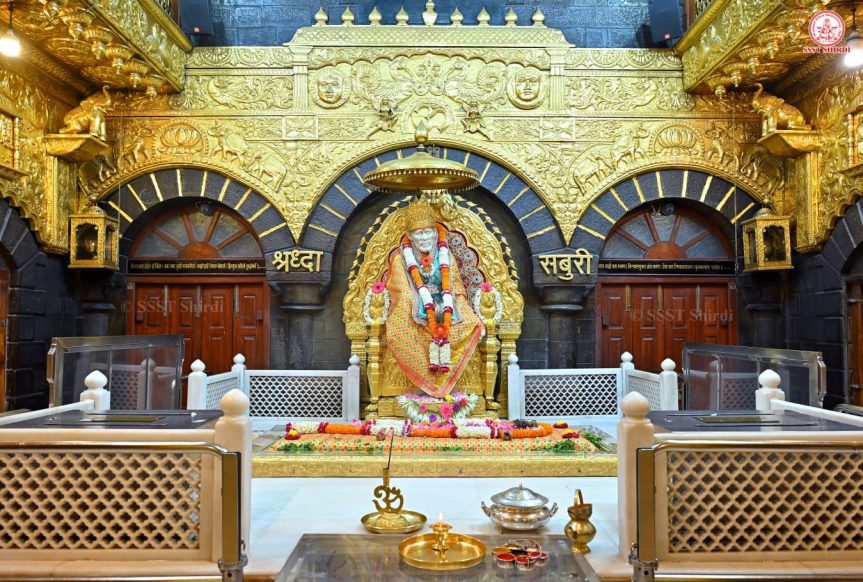
    I want Faith (Nishta) and Patient-Cheerful endurance (Saburi).“- Baba

  • Earlier Years at Shirdi VI-Second Impediment

    The second impediment is more interesting. Baba had both Hindu and Muslim features in his body and in his actions and practice, and, HIS mission in life was to unify Hindus and Muslims into one compact mass with common religious, spiritual and worldly interests.

    As he had a Hindu Guru, namely, Gopal Rao Deshmukh alias Venkatesa or Venkusa, he was considered fitted to guide his Hindu followers.

    In order to guide his Muslim followers, initiation into Islamic scripture by a Maulana was essential according to public opinion. So, his destiny had to be fulfilled by his getting a second Guru, a Muslim. Jawar Ali Maulana was a distinguished Maulana of the last century, residing for some time at Rahata. He had extraordinary ability and learning, but had disagreed with his Rahata followers.

    He came to Shirdi and noted that Baba had a large Hindu following who worshipped him at the Mosque. He called upon Baba to come out of the Mosque and asked him whether he knew the Koran and the Shariat. Baba had learnt neither.

    So Jawar Ali Maulana ordered him to accompany him to Rahata and there Baba was living with this Guru for about two months. The Guru initiated him into the mysteries of Islamic spiritual literature.

    Baba did humble seva to this Guru, carrying water pots, fetching faggots, lighting up fire, doing hard physical work, which others would complain of. But in the case of Baba, he accepted his position as the sishya of Jawar Ali with perfect sincerity and underwent with sweet complacency, all the ordeal and the course of training given to him.

    The villagers of Shirdi, headed by Mahlsapathy who were very anxious to have Baba back again permanently settled at Shirdi, requested the Maulana to allow them to take Sai Baba with them. This was agreed to by the Maulana on the condition that with Baba he also should be taken to Shirdi, and that both he and Baba should be fed and supported by the villagers of Shirdi. So both came and lived at the Shirdi Mosque.

    Some time later, Jawar Ali was drawn purposely into a dispute with Devadas, a noted Hindu saint living in a chavadi at Shirdi, and Devadas’s questions cornered Jawar Ali. The latter had to make so many admissions that the surrounding spectators were moved to laughter. Jawar Ali resenting this humiliation left Shirdi and did not return there for long years to come.

    Baba’s worship at the Shirdi Mosque went on and gathered strength. What appeared as the second impediment tended only to increase the devotees’ attachment through Viraha and admiration and helped Baba’s mission. It must be noted here that the worship mentioned here is individual worship, each one going to Baba and placing flowers on his feet and treating him as God, Avatar or Guru.

  • Earlier Years at Shirdi V-Mad Fakir to Hero

    Suddenly one day an incident occurred which brought a thorough change in the situation, from obscurity to famous.

    Sai Baba was very fond of lights. He used to beg oil from shopkeepers-Banias, and keep lamps burning the whole night in the Masjidย and temple. This went on for some time.

    The Banias, who supplied oil gratis, once met together and decided not to give Him oil. When, as usual, Baba went to ask for oil, they all gave Him a distinct No.

    Unperturbed, Baba returned to the Masjid and kept the dry wicks in the lamps. The banias were watching Him with curiosity.

    Baba took the Tumrel (tin pot) which contained very little (a few drops) of oil, put waterย into it and drank it; and forced it fall in the container. After consecratingย the tin-pot in this way, He again took water in the tin-pot and filled all the lamps with it and lighted them.

    To the surprise and dismay of the watching Banias, the lamps began to burn and kept burning the whole night. The Banias repented and apologized.

    Baba forgave them, after asked them i) You really had Oil?, ii) if they had not come to the Mosque to enjoy the pain which they expected him? ; and then iii) asked them to be more truthful in future & never again to take pleasure in other’s distress!.

    The effect of this incident was marvelous. The contemptible pagal-Mad fakir, as they called him, was turned overnight into the Hero or the weird magician or the holy Sadhu of the place.