Category: Functional

Baba knows Functional Biology of Plant, Animals, Ecology, Physiology, Medicine and Even Engineering

  • Nature, Uses, and Preparation of Udi- Holy Ash

    Nature, Uses, and Preparation of Udi- Holy Ash

    Based on Chapter 33 of the Sree Sai Samartha Satcharita, here is the discussion on the nature, uses, and preparation of Udi:

    What is Udi?

    Udi is the sacred ash taken from the dhuni, the eternally burning fire kindled by Shirdi Sai Baba in the Masjid. It is regarded by devotees as a miraculous and holy substance that embodies Baba’s power and grace.

    Preparation by Baba

    Baba prepared Udi by offering an oblation of firewood (logs and sticks) into the dhuni. He purchased this wood using the dakshina (monetary offerings) collected from devotees, piling it in large heaps to keep the fire burning day and night. The resulting ashes were then distributed to his followers as a blessing.

    Uses of Udi

    The sources categorize the significance of Udi into both material and spiritual realms:

    • Material World (Health and Prosperity): Udi is frequently used to cure physical and mental ailments. The text states there are “innumerable stories” where Udi was used to benefit the health and prosperity of devotees, acting as a “healing touch in the afflictions of life”.
    • Devotional and Spiritual (Destruction of Sins): Spiritually, Udi serves as a reminder of the transience of the human body and the illusory nature (Maya) of the universe. It teaches that the body will ultimately be reduced to ashes, prompting a focus on the eternal Brahman. Applying Udi with devotion is said to destroy sins and help seekers cross the “ocean of existence”.

    Notable Instances of its Power

    The sources describe two specific instances where Udi—or even road dust used in its stead—demonstrated Baba’s omnipresence:

    • The Jamner Miracle: When Nana Chandorkar’s daughter was suffering from intense labor pains in Jamner, Baba felt compassion from Shirdi. He sent a packet of Udi with Gosavi Ramgir (Bapugir) to Nana. Nana gave the Udi to his wife to administer to their daughter with water, resulting in an immediate safe delivery.
    • The “Road Dust” Incident: In another case, a devotee’s daughter was suffering from the plague. Her father sent a message to Nana Chandorkar asking for Udi. Nana, who was at Thane railway station and had no Udi with him, picked up a little dust from the ground, invoked Sai Baba’s name, and applied it to his own wife’s forehead on behalf of the girl. At that exact moment, the girl’s fever broke and she began her recovery.
  • Love as Forgiveness

    Love as Forgiveness

    Baba’s Forgiveness:

    • Transforming Initial Displeasure into Blessings: Baba’s “anger” was often a tool for spiritual correction rather than true wrath.
      • Initially enraged at the women who forcibly took the hand-mill to grind wheat, He quickly became pleased by their love and devotion.
      • He allowed Dr. Pandit to apply sandal paste to His forehead, a personal practice usually restricted to Mhalsapati. Baba explained it was because Dr. Pandit saw Him as his own Guru, showing acceptance of sincere devotion despite unconventional acts.
      • He sometimes appeared as “wrath Incarnate.” However, internally, He was “a stream of affection and motherly love.” Baba stated, “He is ever angry with His devotees.”
      • Baba used seemingly harsh words with Haji Sidik Falke. Initially, he prevented him from entering the Masjid and demanded a large sum. This ultimately led Haji to humility and acceptance. After this, Baba treated him with respect and gave him mangoes and money. This showed Baba clearing Haji’s spiritual block related to pride.
      • He confronted a Pandharpur pleader for slandering Him and others behind their backs. Baba directly addressed the pleader’s inner thoughts. “Baba’s remark was aimed at me. It was a hint to me. I should not indulge in reviling or scandalizing others”. This led to the pleader’s sincere reform. It resulted in the riddance of this “evil tendency”.
      • He initially gave Mr. Sapatnekar a harsh “Get out” upon his visit, likely due to Sapatnekar’s prior derision of Baba. Sapatnekar showed genuine penitence and perseverance. Baba then blessed him with a son. He said, “These feet are old and holy, you are care-free now; place entire faith in Me and you will soon get your object”.
      • He similarly dealt with Somadeva Swami, who initially judged Baba by outward appearances (like flags on Baba’s mosque). Baba’s “wild” response exposed the Swami’s inner thoughts, which led to the Swami realizing Baba’s omniscience and transforming into a staunch devotee. The Swami realized “Baba’s wrath was a blessing in disguise”.
      • Baba gently corrected Nanasaheb Chandorkar’s wandering mind. When he was smitten by a lady’s beauty, Baba advised him to let the senses do their work. He cautioned not to meddle with them. Baba also said, “When the heart is pure, there is no difficulty”.
      • When devotees tried to interfere with Mavsibai’s intense abdominal massage of Baba, as they feared she would hurt Him; Baba became enraged. He took hold one end of his Satka with both hands and pressed it in the hollow of His abdomen and other end on fixed on a Post ie. His body could withstand anything. This demonstrated that He permitted devotees to serve Him as they chose, and His “rage soon cooled down”, showing His understanding and forgiveness of well-intentioned but misguided interventions.
  • People benefited immensely  by having Baba’s Darshan.

    People benefited immensely by having Baba’s Darshan.

    • Some became vibrantly hale and hearty;
    • wicked souls were transformed into paragons of virtue.
    • Leprosy was miraculously cured in certain instances,
    • countless hearts had their deepest desires fulfilled,
    • without any medicine being into their eyes, some blind men get back their sight, and
    • the lame were blessed with limbs.
    • No one can fathom the boundless depth of His extraordinary greatness.

    SSSC Ch-7

  • No Fasting

    No Fasting

    Bromatology is the scientific study of food. It integrates principles from chemistry, biology, and engineering to understand and enhance the foods we consume.

    • Baba never fasted Himself, nor did He allow others to do so.
    • The mind of the faster is never at ease, then how could he attain his Paramartha (goal of life)?
    • God is not attained on an empty stomach; first the soul has to be appeased.
    • If there is no moisture of food in the stomach and nutrition,
      • with what eyes should we see God,
      • with what tongue should we describe His greatness and
      • with what ears should we hear the same?
      • In short, when all our organs receive adequate nutrition and remain sound, we can practice devotion. This also allows us to perform other sadhanas to attain God.
      • Therefore, neither fasting nor overeating is good. Moderation in diet is really wholesome both to the body and mind.

    SSSC-Ch 32

  • Baba is a Scientist in Optometry and Pharmacognosy

    Baba is a Scientist in Optometry and Pharmacognosy

    Optometry involves examining the eyes and related structures for defects and abnormalities. Pharmacognosy is study of crude drugs obtained from medicinal plants, animals, fungi and natural sources.

    Baba started practicing medicine in the village, examined patients and gave medicines. He was always successful, and He became famous as a Hakim (Doctor). A curious case may be narrated, about His knowledge of solving Eye problem with medicinal plants, here.

    One devotee got his eye balls quite red and swollen. No Doctor was available in Shirdi. The other devotees took him to Baba. Other Doctors would use ointments, Anjans, cow’s milk and camphorated drugs etc., in such cases.

    Baba’s remedy was quite unique. He pounded some ‘Beeba’ (Some Carpus Ana Cardium i.e. marking nuts) and made two balls of them, thrust them over each eye of the patient and wrapped a cloth-bandage round them (eyes). Next day, the bandage was removed and water was poured over them.

    The inflammation subsided and the pupils became white and clear. Though the eyes are very delicate, the Beeba caused no hurt, but removed the disease of the eyes. Many such cases were cured, this is only one instances in this regard.

  • Baba is a Aerobiology Scientist

    Baba is a Aerobiology Scientist

    Aerobiology – The study of the dispersion of airborne biological materials, as pollen, spores, microorganisms, or viruses in atmosphere

    Let us see How Sai Baba dispersed the airborne viruses in Shirdi, here from Hemadpant Book.

    “It was sometime after 1910 A.D. that I went, one fine morning, to the Masjid in Shirdi for getting a darshan of Sai Baba. I was wonder-struck to see the following phenomenon. After washing His mouth and face, Sai Baba began to make preparations for grinding wheat. He spread a sack on the floor; and thereon set a hand-mill.

    He took some quantity of wheat in a winnowing fan. Then he drew up the sleeves of His Kafni (robe) and took hold of the peg of the hand-mill. He started grinding the wheat. He put a few handfuls of wheat in the upper opening of the mill and rotated it.

    I thought ‘what business Baba had with the grinding of wheat? He possessed nothing and stored nothing. He lived on alms!’ Some people who had come there thought likewise, but none had the courage to ask baba what He was doing. Immediately, this news of Baba’s grinding wheat spread into the village. At once, men and women ran to the Masjid and flocked there to see Baba’s act.

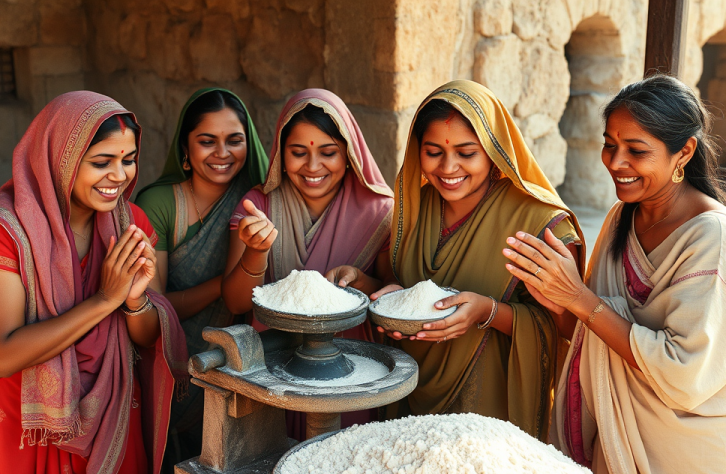
    Four bold women, from the crowd, forced their way up and pushing Baba aside, took forcibly the peg or handle into their hands, and, singing Baba’s Leelas, started grinding. At first Baba was enraged, but on seeing the women’s love and devotion, He was much pleased and began to smile. While they were grinding, they began to think. Baba had no house, no property, no children, none to look after. He lived on alms. He did not require any wheat-flour for making bread or roti. What will He do with this big quantity of flour? Perhaps as Baba is very kind, He will distribute the flour amongst us. Thinking in this way while singing, they finished the grinding. After putting the hand-mill aside, they divided the flour into four portions. They began to remove them one per head.

    Baba, Who was calm and quiet up till now, saying, “Ladies, Now please do this. Take the flour and throw it on the village border limits.” On hearing this, the women felt abashed. Whispering amongst them, they went away to the outskirts of the village. They spread the flour as directed by Baba.
    I asked the Shirdi people – “What was this that Baba did?” They replied that as the Cholera Epidemic was spreading in the village. This was Baba’s remedy against the same. It was not wheat that was ground. The Cholera itself was ground to pieces and pushed out of the village. From this time onward, the Cholera Epidemic subsided and the people of the village were happy.”- Hemadpant in Shri Sai Sat Charitra.

  • Baba knows Optometry ie. Science of Eye examination as well as Herbalist

    Baba knows Optometry ie. Science of Eye examination as well as Herbalist

    Baba started practicing Herb medicine in the village, examined patients and gave medicines. He was always successful, and He became famous as a Hakim (Doctor).

    A curious case may be narrated here.

    One devotee got his eye balls quite red and swollen. No Doctor was available in Shirdi. The other devotees took him to Baba. Other Doctors would use ointments, Anjans, cow’s milk and camphorated drugs etc., in such cases. Baba’s remedy was quite unique. He pounded some ‘BEEBA’ (Some Carpus Ana Cardium i.e. marking nuts) and made two balls of them, thrust them on in each eye of the patient and wrapped a cloth-bandage round them (eyes). Next day, the bandage was removed and water was poured over them in a stream. The inflammation subsided and the pupils became white and clear. Though the eyes are very delicate, the BEEBA caused no smarting; but removed the disease of the eyes. Many such cases were cured and this is only an instance in point.

    He charged no fees for His cures. He became renowned and famous by virtue of His merits. He gave health to many a poor and suffering person. This famous Doctor of doctors cared not for His interests. He always worked for the good and welfare of others. He suffered unbearable and terrible pain many a time in the process

  • Irani’s Daughter

    Irani’s Daughter

    Acology means the science of therapeutic remedies. It encompasses a wide range of practices and therapies. These include medications, physical therapy, mental health, and even alternative methods.

    Baba is very good in therapeutic remedies including alternative methods ie Acology

    Now read the experience of an Irani gentleman. His young daughter got fits every hour.

    She experienced a convulsion. She lost her power of speech. Her limbs shrunk and contracted. She fell down senseless. No remedy gave her any relief.

    A friend suggested that her father use Baba’s Udi. The friend asked him to get it from Kakasaheb Dixit at Vile Parle (suburb of Bombay). Then the Irani gentleman got the Udi and gave it mixed with water to his daughter daily for drinking.

    In the beginning, the convulsions occurred every hour. Then, they came every seven hours. After a few days, the daughter recovered completely.

  • Baba’s Yoga Practices

    Baba’s Yoga Practices

    Sai Baba knew all the processes and practices of Yoga. Some of them will be described here:

    • 1) DHAUTI or CLEANING PROCESS: Baba went to the well near a Banyan tree. It was at a considerable distance from the Masjid. Every third day, he washed his mouth and had a bath.
    • On one occasion, He vomited out his intestines. He cleaned them inside and outside. Then, he placed them on a Jamb tree for drying. There are persons in Shirdi, who have actually seen this, and who have testified to this fact.
    • Ordinary Dhauti is done by a moistened piece of linen, 3 inches broad 22 1/2ft. long. This piece is swallowed. It remains in the stomach for about half an hour to react there. Then, it is taken out. But Baba’s Dhauti was quite unique and extraordinary.
    • 2.) KHANDA YOGA: In this practice, Baba extracted the various limbs from His body. He left them separately at different places in the Masjid.
    • Once, a gentleman went to the Masjid, and saw the limbs of Baba lying separately at separate places. He was much terrified; and he first thought of running to the village officers, and informing them of Baba being hacked to pieces and murdered. He thought that he would be held responsible, as he was the first informant and knew something of the affair. So he kept silent. But the next day when he went to the masjid, he was surprised. Baba was hale, healthy, and sound, as before. He thought, that what he had seen the previous day, was only a dream.
    • 3) Baba was an adept of all the margas. (Path) . His chief marga was Bhakti marga. The special form of it is described as Guru Marga in the ‘Guru Gita’.
    • Jnana and siddhis, including yoga siddhis, came in the wake of his Guru bhakti.

    Baba had no particular marga, as the yoga marga etc. But if any person came to grief in his yoga marga, he could give relief. One yoga sadhaka had bleeding piles and came to Baba and got relief at Baba’s hands.

    • 4) Baba said, ‘Life is lived in vain if no yoga, yaga, tapas, or jnana be achieved’. He asked a devotee, ‘Will you sit idle merely eating your food? Have Saburi, that is patience and courage’.
    • Baba set the example himself of tapas. He kept awake the whole night, lying on a small narrow plank making Namasmaran, keeping his eyes open, and holding his mind in trance.
    • 5) What took place was the Baba’s conversion of water into oil. Somehow oil came into the lamp in a sufficient quantity, from Water to burn all night. Now this is not explicable to ordinary men with their notions of chemistry and physics.
    • Water is not converted into oil in a straightforward manner. Castor and other plants absorb water and combine it with their ingredients. They then produce oil in the seeds of their fruits. Without any such process, Baba was able to fill his lamps with oil.
    • 6) We take Baba’s first achievement at Selu of reviving the dead man with no other remedy or mantras than the throwing of his Guru’s pada duti on the corpse with a prayer for revival: or His taking water at his Shirdi Masjid and filling his lamps with that water for feeding the wicks with a prayer, we find his concentration on his Guru God is the only means.
    • 7) Baba was always thinking of God. Serving God is serving man and serving creation. He had evidently no need to determine the time of his death by noting the Arishta or omens or ripeness of his karma, according to Patanjali Yoga Sutra No. 23 for all knowledge to him was an open book.
    • His undertaking on behalf of his devotees to give them happy and blessed deaths, e.g., his promise to H. S. Dixit to carry him in a vimana, were fulfilled by him with remarkable accuracy of Dixit’s death, through his divine power.
    • 8) G.S. Khaparde was a highly cultured Sanskrit scholar and had evidently read yoga shastra. He has referred to certain instances and experiences of his in his diary in the year 1911-12, while he stayed at Shirdi.
    • In his Diary, he repeatedly mentions that Baba cast Yogic glances at certain persons. These individuals were immediately filled with a wave of bliss. This wave overpowered all their other mental activities. It kept them immersed in bliss for hours without break. Khaparde experienced such bliss after a yogic glance from Baba. This state lasted for three or four hours. He has noted this in his diary.
    • 9) Baba’s yoga sampoorna state enabled him to keep several people in such happy state, as they themselves have recorded in their experiences.
    • Mrs. Tarabai Sadasiva Tarkhad says that though she had physical pains in her body and mental worries, life was quite miserable. Yet when she went and sat before Baba, that very moment she felt steeped in Lethe. All her anxieties, pains, and cares, both physical and mental, vanished. Till her departure from Dwarakamayee, she was enjoying a happy state.

    What is this siddhi called? Patanjali’s Yoga Sutras and Srimad Bhagavata, llth Skanda, 15th Chapter, amongst other books, give a list of siddhis attained by yoga processes. What Baba did would be called ‘Yatha Sankalpa Samsiddhih’ and ‘Apratihata Ajna.’ This means producing whatever one wants by mere will power or supreme command.

    Srimad Bhagavata says ‘When one gets laya in God, all powers, all knowledge, all wisdom, all perfection, that are termed divine, shine forth from such a person’. Baba was perfect in his concentration on God. Therefore in the above quoted instances as in the other innumerable instances to be found in the Gospel of Sai Baba (i.e. BCS) or other books on Baba, the powers exercised by Baba were the result of his laya in God, that is, they were really divine powers

    SSSC Ch-7

  • Baba’s Tomp

    Baba’s Tomp

    During his last illness Baba said “Carry me to the Wada”, (ie. Buty wada). Buty was quite willing that his building should become the tomb of Baba.

    The Mamlatdar pointed out his difficulties. He said that if all parties agreed, he could give directions for the disposal of the body in accordance with the terms of the agreement. If they did not, he said, they should go to Ahamadnagar, and get the District Magistrate’s decree, and he (Mamlatdar) would have to act upon that decree. Then Dixit was ready to go to Ahamadnagar.

    As he was a solicitor of high repute, the Muslims thought that if he went to Ahamadnagar, he would get the District Magistrate’s order in his own favour, and they would be nowhere. So, they came to an agreement with the Hindus that Baba’s body should be in Buty wada, and, as usual the management of the tomb, etc., should also be with the Hindus, but Muslims should be allowed free access even though it was in a Hindu gentleman’s house, and that Mamul should continue.

    So, the Mamlatdar himself passed an order, and Baba’s body was buried without any difficulty at Buty wada, where it still remains. That was only a temporary settlement. The more important matter was as to the guidance of the future.

    That should be a scheme sanctioned by the District Court of Ahamadnagar. H.S. Dixit with his remarkable legal ability, his worldly wisdom, and great bhakti, drew up a Scheme and presented it with the signatures of number of influential devotees. That was sanctioned by the District Court in 1922 and that governs the Shirdi Sai Sansthan and Baba’s tomb and other affairs.

    The property of the Sansthan vested in a body of trustees with managing committee of fifteen. Dixit contented himself with being the Honorary Secretary, and his able management pleased all parties.

    H.S. Dixit thus laid firm foundation for the success of the Shirdi Sai Sansthan, and he must be given the credit for its present position. This may be ranked as one of his great services to Sai and to the public or to humanity.