Category: Sai Baba Temples

A dedicated space covering Sai Baba temples across India and internationally — temple events, darshan news, online facilities, and guides for visiting devotees.

  • Can we follow other Gods?

    Can we follow other Gods?

    In BG VII(7) 21-2, Sri Krishna said “In whatever from people surrender to Me, in that very form, I serve them. Every one following his own form of worship is really following My worship’.

    God can be approached under any name and in any manner, and

    Mahlsapathy (Baba’s closest devotee),

    • though sticking to the idea that Khandoba was his God,
    • derived the advantage of getting all his
    • other needs safeguarded and provided as far as possible
    • by Baba acting as his Providence.

    Other bhaktas also

    • who have their own particular forms, who however note the need or importance of food, shelter and other things for themselves and their familes, being provided by Baba
    • would be thus encouraged by Mahlsapathy’s example to seek Baba and place themselves under his protection.
    • Baba never interfered with
      • anybody’s orthodoxy or religious worship, and
      • the orthodox now in various places need not have any fears about the loss of their existing spiritual position by contacting Baba.
      • All the while, they would get unconscious expansion and refinement of their idea of God and Gods, and become ready for reaching the “Ekam Sat-That which exists is One”

    LoSB-P245

  • Study materials available to Foreigners, interested in Shirdi Sai Baba.

    Study materials available to Foreigners, interested in Shirdi Sai Baba.


    Foreign individuals seeking to understand the life, teachings, and global influence of Shirdi Sai Baba have access to a wide array of study materials.

    1. Academic Works

    Academic studies offer a structured, critical, and contextual understanding of Shirdi Sai Baba, often distinguishing historical facts from hagiographical embellishments.

    As per (Thanks) Oxford Bibliographies:-

    “Academic study of Shirdi Sai Baba has emerged within the past several decades as scholars of religion in South Asia began to engage in a wide array of studies of popular saints and gurus;

    and as they observed the rapid growth in devotion to Shirdi Sai Baba in particular within the Indian subcontinent and, eventually, beyond India.

    White 1972 provided the first academic analysis of Shirdi Sai Baba, noting his growing popularity in western India and attributing it to the unifying bond created between Sai Baba’s devotees, a bond that crosses distinctions of caste, class, and social status.

    Antonio Rigopoulos 1993 is the first book-length academic study of Shirdi Sai Baba, which presents a biography of Sai Baba in the first half that draws upon Hindu-authored hagiographies, and presents Sai Baba’s key teachings in the second half with an emphasis on interreligious tolerance.

    Warren 2004 includes a valuable translation of the diary kept by Abdul Baba, a Muslim follower of Sai Baba in Shirdi, and draws upon that to present an interpretation of Sai Baba as a Muslim fakir who traveled the Sufi path.

    McLain 2016 traces Shirdi Sai Baba’s rise from small village guru to global phenomenon, using a wide range of textual, material, and visual sources to investigate the different ways that Sai Baba has been understood and the reasons behind his skyrocketing popularity among Hindus in particular.

    The edited collection Srinivas, 2022 provides insight into the worship of Sai Baba beyond the village of Shirdi in the early twentieth century, with essays that examine more contemporary worship at multiple sites within India as well as in Asia and Africa.

    Several articles also make valuable contributions to the study of Shirdi Sai Baba:

    Hardiman 2015 analyzes the miracle healing cures associated with Sai Baba and the relationship between his spiritual power and secular science;

    Rigopoulos 2012 analyzes some of Sai Baba’s miracles in connection with yoga powers;

    Vicziany 2016 examines the worship of two syncretic figures, Shirdi Sai Baba and Haji Ali, in the city of Mumbai, India; and

    Loar 2018 compares the hagiographies of Shirdi Sai Baba that were written by two of his Hindu followers, Dabholkar and Narasimhaswami.”- Thanks Oxford for your article at www.oxfordbibliogrsphies.com.


    Cambridge University

    Cambridge University have explored aspects of Sai Baba’s life and the movement he inspired.

    1. Academic Research and Publications:
    * Cambridge Core: Cambridge University Press has published academic works that discuss Shirdi Sai Baba and the broader Sai Baba movement.
       * Smriti Srinivas’s article, “Sai Baba: The Double Utilization of Written and Oral Traditions in a Modern South Asian Religious Movement,” published in Diogenes, examines the origins of the Sai Baba movement rooted in Shirdi Sai Baba.
       * Another article in Comparative Studies in Society and History titled “Miracle Cures for a Suffering Nation: Sai Baba of Shirdi” explores his popularity and perceived ability to provide miraculous cures.
       * The “Cambridge Companion to New Religious Movements” features a chapter by Tulasi Srinivas on the Sathya Sai Baba movement, which originated from Shirdi Sai Baba’s legacy.
    * Cambridge University Library: Kevin R.D. Shepherd, a British author, conducted private research at Cambridge University Library for twelve years, focusing on the history of religions and philosophy. He has authored books such as “Sai Baba of Shirdi: A Biographical Investigation” and “Investigating the Sai Baba Movement.”
    2. Perspectives on Shirdi Sai Baba:
    * Syncretism: Some scholars highlight Shirdi Sai Baba’s image as a unifying figure between Hindu and Muslim traditions, emphasizing the composite nature of Indian culture in the growth of his devotion.
    * Miracles and Faith: His devotees often attribute miraculous abilities to him, which contributed to his widespread popularity. Academic analysis has also focused on these aspects.
    * Historical Context: Research connects the rise of Shirdi Sai Baba’s popularity with the Indian nationalist movement and the search for unifying symbols.
    3. Mentions in Other Contexts:
    * Sathya Sai Baba: Sathya Sai Baba of Puttaparthi, and his movement have also been subjects of academic study, including publications by Cambridge University Press.
    * Educational Initiatives: Cambridge University Press has collaborated with Indian educational institutions for programs like the “SAI-Cambridge Reading Quest,” although this is related to language skills development and not directly to the study of Sai Baba.
    While Cambridge University’s press has published scholarly articles and books that analyze his life, teachings, and the socio-religious movements associated with him. Individual researchers connected to the university have also contributed significantly to this field of study.


    Teachings and Philosophy

    Social and Cultural Significance

    • Karline McLain’s Be United, Be Virtuous: This work investigates the role of Sai Baba’s teachings in promoting religious harmony and examines the movement’s cultural impact within Indian society.
    • Edited Volumes (e.g., Devotional Spaces of a Global Saint): These collections often feature contributions that analyze the institutional development of the Sai Baba movement and its place in the lives of modern devotees.

    Miracles and Belief Systems

    • Analytical Perspectives on Miracles: Academic literature explores the narrative function of miracles in constructing Sai Baba’s authority, examining their sociological and psychological dimensions and drawing comparisons with miracle traditions in other religions.

    Global Spread and Contemporary Practices

    • Studies on Globalization: Scholars analyze how Sai Baba’s devotion has transcended geographic boundaries, highlighting the establishment of temples and devotional practices in international contexts.
    • Media and Technology: Contemporary research considers how digital media platforms are employed to maintain global devotional networks and disseminate teachings.

    Methodological Approaches

    Engagement with academic resources introduces foreign learners to various methodological frameworks—historical criticism, sociology of religion, and anthropology—that enable a comprehensive and critical study of religious figures and movements.

    2. Devotional and Informational Websites

    In addition to academic works, several online platforms provide accessible resources tailored to the needs of international devotees.

    Websites for International Devotees (e.g., shirdisaibaba.international)

    • Curated Publications: These platforms offer English-language articles, news updates, and publications, suited for global audiences.
    • Translations of Key Texts: They often provide details of translated versions of significant devotional texts and biographies.
    • Community Engagement: Discussion forums and community pages offer a space for interpretation, Lists of Sai Baba temples in countries like the USA, UK, Canada, Singapure, Dubai…and sharing of experiences, reflecting the living tradition of Sai Baba devotion.

    Official Temple Trust Website (sai.org.in)

    • Authoritative Information: Offers official narratives, details of temple rituals, and historical overviews from the perspective of the temple trust.
    • Online Resources: Includes downloadable material, videos, and frequently asked questions, all primarily in English, facilitating introductory-level engagement.

    3. Key Considerations for Foreigners

    Language Accessibility

    The wide availability of English-language materials—both academic and devotional—greatly enhances accessibility for non-Indian audiences.

    Multiple Perspectives

    A balanced approach that includes both academic and devotional materials provides a more nuanced and comprehensive understanding of Shirdi Sai Baba.

    Cultural Context

    Academic studies help situate Sai Baba within the broader Indian religious and cultural milieu, an essential context for foreigners unfamiliar with the subcontinent’s spiritual traditions.

    Critical Engagement

    By engaging with academic sources, foreigners are encouraged to critically examine the narratives surrounding Sai Baba, differentiating between historically substantiated facts and devotional interpretations.
  • How Baba prepared food and distributed

    How Baba prepared food and distributed

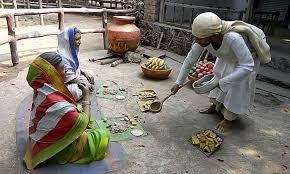
    Let us see how Baba prepared food and distributed it.

    Baba required very little food for Himself and what little He wanted, was obtained by begging from a few houses.

    But when He took it into His mind  to distribute food to all, He made all preparations from beginning to end, Himself.

    He depended on nobody and troubled none in this matter. First He went to the bazar and  bought all the things, corn, flour, spices etc., for cash. He did also the grinding.

    In the  open courtyard of the Masjid, He arranged a big hearth and after lighting a fire underneath kept a Handi over it with a proper measure of water…

    Sometimes He cooked ‘Mitthe Chaval’ (sweet rice), and at other times ‘pulava’ with  meat. At times in the boiling varan (soup), He let in small balls of thick or flat breads of  wheat flour. He pounded the spices on a stone-slab, and put the thin pulverized spices  into the cooking-pot. He took all the pains to make the dishes very palatable.

    He prepared  ‘Ambil’ by boiling jawari-flour in water and mixing it with butter-milk. With the food He  distributed this Ambil to all alike.

    To see whether the food was properly cooked or not,  Baba rolled up the sleeve of His Kafni. He put His bare arm in the boiling cauldron without the least fear. He churned (moved) the whole mass from side to side and up and  down. There was no mark of burn on His arm, nor fear on His face.

    When the cooking  was over, Baba got the pots in the Majid, and had them duly consecrated by the moulvi.

      First He sent part of the food as prasad to Mhalasapati and Tatya Patil. Then, He served the remaining contents with His own hand to all the poor and helpless people. They ate to their hearts’ content.

    Really blessed and fortunate must be those people who got food prepared  by Baba and served by Him.

  • During 72 generations that you were with me.

    During 72 generations that you were with me.

    A woman from Sholapur tried for 27 years to have a child, making prayers to various gods in vain. In her final effort, she and her stepson went to Shirdi and stayed for two months, serving Baba.

    Whenever she visited the Masjid, it was crowded, and Baba was always surrounded by people. She wanted to express her feelings, but couldn’t find the right moment to pray to Him for a child. In the end, she asked Shama to speak to Baba for her when He was alone.

    Shama told her Baba’s Darbar was open, still he would try for her, hoping the Lord would bless her. ‘She should be ready with a coconut and joss sticks when Baba had His meals. She should also come to Him, when he called’.

    One day, after dinner, Shama was wiping Baba’s wet hands with cloth, when Baba playfully pinched his cheek. Pretending to be upset, Shama said, “Deva, is it right to pinch me? We don’t want a mischievous God. Are we Your dependents; is this fruit of intimacy?”

    Baba replied, “Oh Shama, during 72 generations that you were with me, I never pinched you until now. Now you resent my touch.”

    Shama: “We want a God who always love us and give food; we don’t want reward or heaven. Let our faith unto your feet be awake.” Baba: “Yes, I have come for that. I care for you and love you.”

    Then Baba sat down, and Shama signaled to a lady who offered a coconut and joss sticks. Baba shook the dry coconut, and the kernel made noise. He said, “Shama, look how it’s rolling, what does it mean?” Shama replied, “The woman hopes to have a child that rolls and grows in her womb. Please bless her.”

    Baba questioned, “Will the coconut give her a child? People are foolish to believe such things!” Shama insisted, “Your blessing will bring her children. You are just wrangling and not giving a real blessing.” They continued to discuss.

    Baba wanted to break the coconut, but Shama suggested gifting it to the lady instead. Then Baba agreed, saying, “She will have a child in 12 months.” The coconut was split in two. One half was eaten by Baba and Shama. The other half was given to the lady.

    Shama alias Madhav looked at the woman and said, “You will be my witness. If you don’t have a child in a year, I will break a coconut on Deva’s head. If I fail, I won’t call myself Madhav anymore.”

    A year later, she had a son, taken to Baba at five months. The grateful father, Mr. Aurangabadkar, donated Rs.500, which was spent to build a shed for Baba’s home, “Shyamakarna.”

  • Various teachings and practices, prescribed by Baba

    Various teachings and practices, prescribed by Baba

    • Baba lovingly urged many to remember His name and to surrender to Him,
    • Yet for those seeking to understand ‘who they truly were’ (the ‘Who am I’ enquiry), He gently recommended Shravanam (study) and Mananam (meditation).
    • To some, He lovingly guided
      • the remembrance of God’s name,
      • to others, the joy of hearing HIS Leelas /Plays,
      • to some, the sacred worship of His Feet,
      • and to others, the reading and studying of the Adhyatma Ramayan, Jnaneshwari, and more sacred scriptures.
    • Some He tenderly invited to sit near His Feet,
    • while others He lovingly sent to Khandoba’s temple,
    • He advised some
      • to repetition the thousands of names of Vishnu,
      • and others to engage in the study of the Chhandogya Upanishad and Geeta.
    • To some, He offered His guidance directly in person, and to others, through the precious visions in their dreams.
    • He lovingly explained certain Mantras, such as ‘Guru Brahma’, “Raja Ram’ in their dreams.
    • To one devotee,
      • who was earnestly practicing Hath-Yoga,
      • HE conveyed a gentle message to leave those practices aside,
      • to sit in quiet and embrace patience (Saburi).
    • Truly, it is an immense task to describe all of His ways and methods, each filled with love and compassion.
  • Now, How to visualize Baba

    Now, How to visualize Baba

    • Let us remember and visualize Shri Sai, now.
    • Let us go to Shirdi, and see carefully the programmes, after the noon-Arati. After the Arati ceremony was over, Sai used to
      • come out of the Masjid, and
      • standing on its edge,
      • distribute udi to the devotees with
      • very kind and loving looks.
    • The Bhaktas also got up with equal fervour,
      • clasped His Feet, and
      • standing and staring at Him,
      • enjoyed the shower of Udi.
    • Baba
      • passed handfuls of Udi into the palms of the devotees and
      • marked their foreheads with Udi with His fingers.
    • The love He bore for them in His heart was boundless. Then He addressed the Bhaktas as follows:-
      • “Oh Bhau, go to take your lunch;
      • you Anna, go to your lodgings;
      • you Bapu, enjoy your dishes”.
    • In this way He accosted each and every devotee and sent them home.
    • Even now, you can enjoy these sights if you bring into play your imagination. You can visualize and enjoy them.
    • Now bringing Sai before our mental vision, let us meditate on Him, from His Feet upwards to His face, and prostrating before Him humbly, lovingly and respectfully

    Baba in SSSC-Ch20

  • Blessed knows the greatness of his Guru

    Blessed knows the greatness of his Guru

    “Make me the sole object of your thoughts and actions. You will, no doubt, attain Paramartha (the spiritual goal of life).

    Look at me whole-heartly; and I, in turn, look at you.

    Sitting in this Masjid, I speak the truth, nothing but truth.

    No sadhana or proficiency in the six Shastras, is necessary. Have faith and confidence in your Guru. Believe that, Guru is the sole Actor or Doer.

    Blessed is he, who knows the greatness of his Guru and thinks him to be Hari, Hara and Brahma (Trimurti -Gods) Incarnate.”

    Sai Baba in SSSC-Chapter 18 & 19.

  • Who, When, How and Why Shri Sai SatCharitra (SSSC) created?

    Who, When, How and Why Shri Sai SatCharitra (SSSC) created?

    • When seeking facts about Sai Baba,
      • the remarkable work that stands out is ‘Sai Satcharitra’ by HemadPant, known as Anna Saheb Dabolkar.
      • It is written in the Marathi language.
      • This wonderfully crafted poetical masterpiece spans 53 vibrant chapters and over 1000 pages, narrating incidents from Sai Baba’s inspiring life.
      • Written in rich and expressive Marathi, it beautifully fulfills the purpose of Puranic study, serves daily parayana.
      • It offers readers a path to deeper understanding and devotion.(LoSB p6)
    • Baba conveyed his heartfelt blessing to Hemadpant in 1916, when asked permission to write Baba’s life teachings and expressions,
      • by providing him with udhi and placing his Asirvada hand upon Dabolkar’s head, proclaiming,
      • “Let him compile a collection of My stories and experiences,
      • diligently maintaining notes and memos.
      • I shall assist him in this endeavor.
      • He is merely an external instrument. It is I who should document my life and fulfill the aspirations of my devotees.
      • When his ego is entirely extinguished, leaving no remnants, I shall personally enter within him to narrate my life.
      • Listening to my stories and teachings will instill faith in the hearts of devotees, facilitating their journey toward self-realization and eternal bliss.“
    • Hemadpant diligently gathered information concerning the lilas of Baba and, as a proficient writer possessing a profound command of Marathi verse and prose, along with a solid foundation in religious literature,
      • aspired to compose a comprehensive study of Baba’s lilas, thereby creating a significant chronicle of Baba’s life.
      • This endeavor would align with the framework established by Saraswati Gangadhar’s Guru Charitra, offering solace and happiness to individuals burdened with sorrow and the afflictions stemming from worldly existence.
      • Additionally, it would provide them with Jnana, or knowledge and wisdom, regarding both temporal and spiritual matters.
      • Baba’s lilas would serve as both instructive and engaging, akin to the Vedas,
      • and, upon contemplation, they would facilitate laya, or union with Brahman, as well as mastery of Yoga and Yoga Ananda.
      • Consequently, he resolved to compile these narratives, considering the publication as a form of upasana, or worship, of his Guru.
      • This collection would be particularly invaluable to those unable to experience Baba in person, allowing them to form an understanding of Baba through this compilation.
      • Baba’s teachings and expressions were the natural outcome of his boundless self-realization; it was Dabolkar’s belief that Baba himself inspired this initiative to gather and present his life’s essence.(P376. )

    Shri N.V.Gunaji adapted the above Shri Hemanpant’s “Sri Sai SatCharita” and translated into English and donated the entire proceeds to the Sai Sansthan Trust, Shirdi.

  • Proof Reading of Sai Literatures, Opportunity at Shirdi

    Proof Reading of Sai Literatures, Opportunity at Shirdi

    Public Appeal from Shirdi, Shri Sai Baba Sansthan

    Shri Saibaba Sansthan, Shirdi is planning to reprint its Literatures in Marathi, Hindi, Telugu, Tamil, Malayalam, Bengali, Odia, Kannada, Gujarati, Assamese, Punjabi, Sindhi, Urdu, Nepali etc.

    For this purpose, Sansthan is inviting Sai Devotees, who have PHD to Form a Committee of 30/40 members.

    The work involves i)corrections ii) proof reading of the text and iii) Helping Sansathan to resolve issues/doubt, raised by Sai Devotees, on a regular basis.

    Since Sai Seva, there is no compensation for this project.

    Thanks SSS Trust, Shirdi

    PS: please check their official website for latest updates.

  • Sai Devotees-Do Free Service at Shirdi Temple

    Sai Devotees-Do Free Service at Shirdi Temple

    Sai Devotees, You can now do Free Service at Shirdi, under Sai Sevak Scheme of Shirdi-Sai-Baba-Temple-Management.

    Opportunity to do seva at/near our Sai Mandir at Shirdi, and get Sai Baba’s blessings, directly.

    About Sai Sevak Scheme

    • Sai Sevak ‘Group’ with maximum 21 members
    • Seva period will be 7 days only ie Every Tuesday to Monday
    • Sai Sevak Group should reach on Monday at Sansthan’s  Sai Ashram No.2 (Dharmashala) by 2.00 p.m.
    • Free facilities given:
      • 21 members accommodation, at Sai Dharmshala
      • Meals at Prasadalaya
      • Breakfast packets at accommodation
      • Tea at seva
      • Daily Darshan
      • Aarti once in 7 days.
    • Documents  required are 
      • 2 Passport size Photos.
      • Aaadhar Card Xerox.
      • Medical Fitness certificate.
      • Police (On Line) Verification or Character Certificate from Corporation Ward Member/ Municipal Chairman /Gram President.
    • No compensation/ claim for employment, against Seva.
    • Only 10 groups will be accepted for service in each week by Temple.
    • Service Places offered at:-
    • Contact:-
    • Website – online.sai.org.in
    • Email: labour@sai.org.in
    • Call: 02423 258811/10

    PS. The above details are given for information only. Contact the above, for Registration and latest updates.

    Steps in registration process