Category: Other Sadhnas

Beyond the well-known practices, Baba prescribed many personal spiritual disciplines (sadhnas) tailored to individual devotees. Explore this rich variety of paths leading to the same divine goal.

  • Handle Anger

    Handle Anger

    When you find anger rising within you,

    • you may withdraw from the place to provide time for cooling your emotions. Or
    • you may drink a glass of cold water and sit quietly in a place. Or,
    • take a brisk walk for a mile to get over your anger. Or,
    • stand before a mirror and look at your face.

    By any one of these methods, your anger will gradually come down.

    • Do not, however,
      • stay near the person who has provoked your anger,
      • because there is no limit to what anger may lead you to.
    • Owing to anger and agitation,
      • the blood gets heated up.
      • It takes three months for the blood to cool down. Within that period,
      • the nerves become weaker and even the
      • blood cells get destroyed.
        • Weakness is aggravated and the
        • memory power is reduced.
        • Old age sets in prematurely.
    • All the aberrations that we witness today among men arise from anger.
    • -Puttaparti Satya Sai Baba in the Divine Discourse, Apr 22, 1985.
  • Control senses to increase lifespan.

    Control senses to increase lifespan.

    With determination, man can touch the sky and conquer the world. But today man is losing this strength. What is the reason for this?

    He is losing his mastery over the senses. The more sensual he is, the lesser is the lifespan.

    Today’s man is losing his physical strength and consequently destroying his inner strength completely. To remain immortal and retain youth, the power of the senses should be developed by controlling them.

    There should be no body-attachment. If on one hand, man loses control over the senses and on the other hand, he develops body-attachment, then what will be his plight? 

    These two can be compared to two holes in a pot filled with water. Water is filled in such a pot, which gets drained.

    Similarly, the pot of our heart is filled with nectarous grace of God. Man has to foster his heart. But without forbearance and sympathy, he has drilled holes into it. Consequently, his lifespan has decreased.

    In this limited life span,

    what good deeds can he do? How can he work for the welfare of the society? God-given strength should be utilized properly by Satsangam (Good Company), by Satpravartana (Good conduct) and by Seva (Service). Only then can your strength improve.

    – Puttaparti Satya Sai Baba in the Divine Discourse, Oct 02, 2000.

  • Where certain actions or entities are considered better than others

    Where certain actions or entities are considered better than others

    1. A human body is better than other bodies
      • Despite its filth, mucus, and susceptibility to decay, disease, and death, the human body’s special value lies in its capacity to acquire knowledge and attain God-vision, which is impossible in any other birth.
    2. Love is better than intelligence-
      • The pure love of Shirdi women, despite their ignorance, inspired them to compose poems, implying that love is more inspiring than intelligence.
    3. Giving food is better than other charities-
      • While other charities like giving away wealth, property, and clothes require some discrimination, offering food requires no such consideration.
      • Also, the merit of feeding lame, crippled, blind, and diseased paupers is much greater than that of feeding able-bodied persons and relations.
    4. Butter-milk (Leelas) is better than Milk (Darshan)-
      • If one desires to see Sai Baba’s but they did not get any opportunity of taking His darshan, their quest for milk (darshan) will be, to a great extent, satisfied by the butter-milk (Leelas).
    5. Remembering and chanting Hari’s and Guru’s name confers salvation is better than getting the powerful Bhakti of the Nathas-
      • one Madhavarao did not like Kakasaheb’s pessimistic attitude of how to get the powerful Bhakti of the Nathas, as he said, ‘has not Baba told us authoritatively that remembering and chanting Hari’s and Guru’s name confers salvation? Then where is the cause for fear and anxiety?’
    6. The observance of the vow of silence is the best way of praising the Sad-guru-
      • In reality, the observance of the vow of silence is the best way of praising the Sad-guru.
    7. Having recourse to Sai Baba’s Feet and surrendering to Him is the best luck-
      • The best luck is to get an opportunity to have recourse to Sai Baba’s Feet and surrender to Him, than any other
  • Don’t entertain the sense of doership

    Don’t entertain the sense of doership

    Once Shri Vasudevanand Saraswati, known as Shri Tembye Swami, camped at Rajamahendri (Andhra State) by the river Godavari. He was a devoted Jnani and Yogi Bhakta of God Dattatreya.

    Mr. Pundalikrao, a pleader from Nanded, visited him with friends, during which they mentioned Shirdi and Sai Baba.

    The Swami bowed when Baba’s name was spoken. He gave Pundalikrao a coconut. The Swami asked him, to offer it to Baba, with his regards. He also wanted Pundalikrao, to remind Baba to remember him.

    The Swami noted that he usually does not bow to others, but made an exception here. Pundalikrao agreed to take the fruit and message to Baba.

    A month later, Pundalikrao and his friends traveled to Shirdi with the coconut. They stopped at a rivulet for water. Feeling hungry, they broke the coconut. They mixed it with their Chivda, making it tastier. Unfortunately, this was the coconut, meant for Baba.

    When Pundalikrao reached Shirdi, he remembered the coconut and felt guilty. He saw Baba, Who already knew about the coconut and asked Pundalikrao, to give the items from his brother -swami.

    Pundalikrao confessed his negligence. He sought forgiveness and offered to replace the coconut.

    Baba declined his offer, saying its value was far greater than an ordinary one.

    Baba also added- “

    • Now you need not worry yourself any more about the matter.
    • It was on account of my wish that the coconut was entrusted to you.
    • Ultimately it was broken on the way.
    • Why should you take the responsibility of the actions on you?
    • Do not entertain the sense of doership in doing good, as well as for bad deeds; be entirely prideless and egoless in all things and
    • thus your spiritual progress will be rapid
  • Baba is a Scientist in Teaching Education

    Baba is a Scientist in Teaching Education

    Pedagogics is the art and science of teaching and education. It involves not only conveying information, but also understanding how people learn. It requires creating environments, that foster growth and development.

    Sai Baba is also not only delivering information, but create environment for learning and growing of His devotees. viz:

    • One,
      • totally devoid of any book study, but
      • possessed of
        • perfect self-surrender,
        • humility,
        • trust, and
        • love towards the Guru Baba,
        • was and is the person who could derive
        • the fullest benefits from Baba.
    • The idea that
      • one has understood all about Jiva and Paramatma and
      • the methods by which Paramatma could be reached by a Jiva,
      • forms the greatest obstacle to one’s progress.
    • It is
      • not the intellect, the keenness of intellect, that is
      • wanted from a person approaching Baba.
    • It is
      • humility,
      • receptivity, and
      • a readiness to receive all that Baba gives, that counts.
    • As Baba pointed out to the Valambi Station Master,
      • persons (evidently with much conceit of learning etc.) came to him
      • like vessels the mouth of which was kept inverted; and were therefore
      • incapable of receiving any benefits from him.
    • In the case of Nana (Devotee),
      • his very high learning and
      • great ability in official and other matters were naturally accompanied
      • by a high degree to self-assertion and egotism;
      • which make for success in
        • literary study,
        • official matters, and to a certain extent even in
        • spiritual matters.
      • But for the highest results in spiritual matters, it is just the opposite, namely,
        • utter reduction of egotism,
        • the power to relax the Ego and
        • keep it relaxed for long periods, that is essential.
    • This is why
      • the consumption of water, that was used to washing of the feet of the Guru, and
      • the acceptance of his Uchchishta tirtha (the remnants of food that have been contaminated by the Guru’s saliva) are emphasized in the
      • Guru Gita” for a pupil’s advancement,
      • as these practices foster a profound annihilation of Ahamkara, or Ego,
      • through deep reverence for the Guru, culminating in Love.
    • In Baba’s system,
      • the Guru-Teacher imparts virtue after virtue to the sishya-Student.
      • HE trains him step by step to secure these virtues and the knowledge, he wishes to equip the pupil with.
      • This process is just as the cat carries its kittens to safe and good places.
    • The first essential preparatory step in Baba’s course is thus,
        • not book learning, but the
        • development of
          • humility and
          • receptivity.
        • These would result from
          • perfect faith, absolute faith,
          • unlimited and powerful faith in the Guru.
        • The Guru must be everything to the sishya,
          • the giver of bread,
          • the giver of life and light and
          • the giver of all that life is worth living for, and
          • at one stroke.
          • He must not regard anything else. This alone is the tyaga of Tan, Man, Dhan – body, mind and possessions.

      LoSB-Vol II’ Ch 2

      • Baba’s company was the highest education one could get. As a Mahratta saying goes, ‘Let us stay with saints. If they do not give us Upadesa, let us note what they do and say. That is the best Upadesa‘.
    • How Baba prepared food and distributed

      How Baba prepared food and distributed

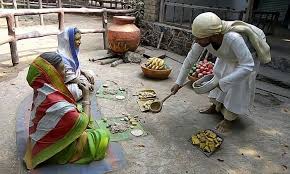
      Let us see how Baba prepared food and distributed it.

      Baba required very little food for Himself and what little He wanted, was obtained by begging from a few houses.

      But when He took it into His mind  to distribute food to all, He made all preparations from beginning to end, Himself.

      He depended on nobody and troubled none in this matter. First He went to the bazar and  bought all the things, corn, flour, spices etc., for cash. He did also the grinding.

      In the  open courtyard of the Masjid, He arranged a big hearth and after lighting a fire underneath kept a Handi over it with a proper measure of water…

      Sometimes He cooked ‘Mitthe Chaval’ (sweet rice), and at other times ‘pulava’ with  meat. At times in the boiling varan (soup), He let in small balls of thick or flat breads of  wheat flour. He pounded the spices on a stone-slab, and put the thin pulverized spices  into the cooking-pot. He took all the pains to make the dishes very palatable.

      He prepared  ‘Ambil’ by boiling jawari-flour in water and mixing it with butter-milk. With the food He  distributed this Ambil to all alike.

      To see whether the food was properly cooked or not,  Baba rolled up the sleeve of His Kafni. He put His bare arm in the boiling cauldron without the least fear. He churned (moved) the whole mass from side to side and up and  down. There was no mark of burn on His arm, nor fear on His face.

      When the cooking  was over, Baba got the pots in the Majid, and had them duly consecrated by the moulvi.

        First He sent part of the food as prasad to Mhalasapati and Tatya Patil. Then, He served the remaining contents with His own hand to all the poor and helpless people. They ate to their hearts’ content.

      Really blessed and fortunate must be those people who got food prepared  by Baba and served by Him.

    • Give one and receive tenfold

      Give one and receive tenfold

      “If I take one rupee as Dakshina from anybody I have to return it tenfold to him.

      I never take anything gratis. I never ask any one indiscriminately.

      I only ask and take from him whom the Fakir (My Guru) points out. If any one is indebted formerly to the Fakir money is received from him.

      The donor gives, i.e. sows his seeds, only to reap a rich harvest in future.

      Wealth should be the means to work out Dharma. If it is used for personal enjoyment, it is wasted.

      Unless you have given it before, you do not get it now. So the best way to get is to give.

      The giving of Dakshina advances Vairagya (Non-attachment) and thereby Bhakti and Jnana. Give one and get tenfold”.

      Sai Baba in SSS- Ch31

    • Last thought, man has at death-hour, determines his future

      Last thought, man has at death-hour, determines his future

      The last wish or thought that a man has at the hour of death, determines his future course.

      Shri Krishna has said in Gita (VIII-5-6) that “he who remembers Me in his last moments, comes verily to Me, and he who meditates otherwise at that time, goes to what he looks for.”

      We cannot be certain that we can entertain a particular good thought at our last moment, for, more often than not, we are more likely to be frightened and terrif ied by death.

      Hence constant practice is necessary, for enabling us to fix our mind on any desired good thought at any moment.

      All Saints, therefore, recommend us to always remember God and chant His name always, so that we may not be puzzled when the time for departure comes.

      The devotees on their part surrender themselves completely to the Saints, fully believing that the all-knowing Saints (Sai Baba) would guide and help them in their last moments.

    • Oh Sai, create in us reverence for Your stories

      • When a man takes a plunge into the sea, he gets the merit of bathing in all the Tirthas and sacred rivers.
      • Similarly when a man takes refuge at the feet of the Sad-guru, he gets the merit of bowing to the Trinity, i.e. Brahma, Vishnu and Siva and also Para-Brahma.
      • Victory be unto Shri Sai, the wish-fulfilling tree and the ocean of knowledge, who gives us self-realization.
      • Oh Sai, create in us reverence for Your stories.
      • Let the readers and audience devour them with the same relish; the chatak bird drinks the water from the clouds and becomes happy.
      • While listening to Your stories, let them and their families get all the true and pious emotions, viz.
        1. let their bodies perspire,
        2. let their eyes be full of tears,
        3. let their breath be steady,
        4. let their minds be composed,
        5. let their hair stand on end,
        6. let them cry, sob and quiver,
        7. let their hostilities vanish.
      • When these things happen, that is a sign of the grace of the Guru dawning upon them.
      • When these emotions develop in you, the Guru is most pleased.
      • The Guru will definitely guide you to the goal of self-realization.
      • The best way, therefore,
        • to get free from the shackles of Maya,
        • is our complete and whole-hearted surrender to Baba.
      • The Vedas cannot take you across the ocean of Maya. It is only the Sadguru, who can do so, and make you see the Lord in all creatures

    • Joy and sorrow are mere delusion.

      Joy and sorrow are mere delusion.

      Mere appearance of worldly joy is not true happiness. The worldly man is forcibly drawn to it, as he believes it to be true happiness.

      According to the Prarabdha (accumulated karma) of each, one gets delicacies (Panchamrita): one, stale crumbs, and one, mere bran-gruel; The latter fancy themselves unhappy at that, and the former fancies he lacks nothing. But the result of eating any of these is merely the satisfaction of hunger.

      Some cover themselves with laced shawls, others with barks. Both serve only one purpose, covering the body.

      This joy and this sorrow is due to opinion, which is mere illusion and is ruinous.

      Whenever any idea of joy or sorrow arises in your mind, resist it. Do not give room to it. It is pure delusion.

      The ‘Shadripus’ -six enemies (Lust, Anger, Covetousness, Delusion, Pride and Jealousy) are all misleading Illusion; they make the unreal appear as real.

      If a rich man wears a gold ornament, the poor man gets jealous, and thinks he must have one. This is Lobha.
      All are like this. So one must conquer the six enemies. If they are conquered, waves of passion will not arise. Else they will enslave you.

      If they are subordinated and reason made the commandant, then the delusive pressures and pains will no longer hold sway over you.